Surgical consent form: free in Word, or sign it online
Reviewed in October 2026
A surgical consent form records that a patient agreed to a specific operation after the surgeon explained it. It names the procedure, the surgeon, the main risks, the alternatives and the anesthesia. Hospitals keep it in the patient's chart before surgery.
Ten documents free, no card. Signed by the patient, the surgeon and a witness.
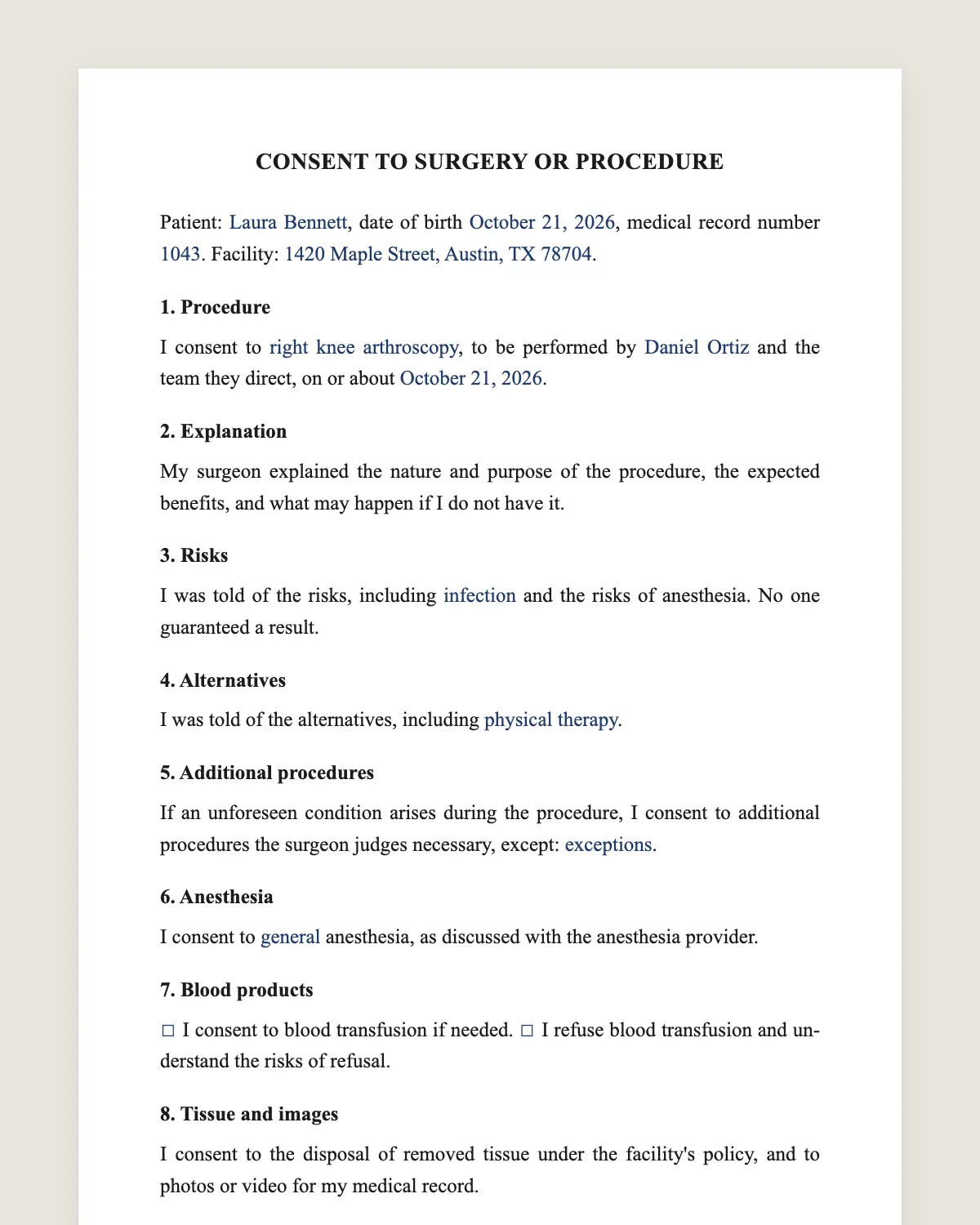
Example filled in with sample data
The full surgical consent form
CONSENT TO SURGERY OR PROCEDURE
Patient: [patient full name], date of birth [date], medical record number [number]. Facility: [facility name and address].
1. Procedure
I consent to [name of the procedure, side and site, for example right knee arthroscopy], to be performed by [surgeon name] and the team they direct, on or about [date].
2. Explanation
My surgeon explained the nature and purpose of the procedure, the expected benefits, and what may happen if I do not have it.
3. Risks
I was told of the risks, including [main risks, for example infection, bleeding, blood clots, nerve injury] and the risks of anesthesia. No one guaranteed a result.
4. Alternatives
I was told of the alternatives, including [alternatives, for example physical therapy or no treatment].
5. Additional procedures
If an unforeseen condition arises during the procedure, I consent to additional procedures the surgeon judges necessary, except: [exceptions].
6. Anesthesia
I consent to [general, regional, local or sedation] anesthesia, as discussed with the anesthesia provider.
7. Blood products
[ ] I consent to blood transfusion if needed. [ ] I refuse blood transfusion and understand the risks of refusal.
8. Tissue and images
I consent to the disposal of removed tissue under the facility's policy, and to photos or video for my medical record.
9. Questions
I had the chance to ask questions and all were answered. I may withdraw this consent before the procedure begins.
Patient signature or legal representative
Printed name: ______________
Relationship, if representative: ______________
Date and time: ______________
Surgeon
Date and time: ______________
Witness
Printed name: ______________
Date and time: ______________
Interpreter, if used
Name: Name
Language: ______________
Signature: ______________
What the template includes
Patient identification and facility
Procedure with side and site
Statement that the surgeon explained it
Main risks and anesthesia risks
Alternatives, including no treatment
Consent to additional necessary procedures, with exceptions
Type of anesthesia
Blood transfusion consent or refusal
Tissue disposal and medical photos
Right to withdraw before the procedure
Signatures of patient, surgeon, witness and interpreter
What you fill in
Field
Example
Patient
Thomas Greer, born July 2, 1968
Facility
Lakeside Surgical Center
Procedure
Right knee arthroscopy with meniscus repair
Surgeon
Dr. Priya Shah
Anesthesia
General
Main risks
Infection, bleeding, blood clots, stiffness
Transfusion
Consents if needed
How it gets signed
1Choose «Use this template», fill in the fields and review the full surgical consent form.
2Send it by WhatsApp or email. The other party opens the link on their phone without an account.
3They tap the brown bar at the bottom that says «Sign as …» and draw their signature once.
4Everyone gets the signed PDF with its signature certificate. Anyone can check it at signsolu.com/verificar.
The signing screen tells each signer that signing means agreeing to sign electronically. It links to the electronic signature disclosure that the ESIGN Act asks for.
What you get once everyone signs
The signed PDF. The final surgical consent form with every drawn signature in place.
The signature certificate. It lists each signer and the date and time of each signature.
A record you can check. The folio on the certificate opens the document history at signsolu.com/verificar.
Reminders. Turn them on and SignSolú reminds every signer who has not signed yet.
Your first ten documents are free and need no card.
What the law says
Hospitals in the Medicare program follow the Conditions of Participation. 42 CFR 482.51(b)(2) states that a properly executed informed consent form for the operation must be in the patient's chart before surgery, except in emergencies.
State law and the facility's own policy decide who may sign for a patient who cannot consent, and what the form must say. Use the facility's required wording where it has one.
The ESIGN Act, 15 U.S.C. 7001 gives an electronic signature the same legal effect as one on paper. A contract cannot be denied effect only because it was signed electronically.
Consent is a conversation, the form is the record
Informed consent happens when the surgeon explains the procedure and answers questions. The form records that the conversation took place.
Send the form a few days before surgery. Patients read it at home, write down questions and sign after the pre-op visit.
How clinics use it with SignSolú
1The clinic fills in the patient, procedure and surgeon.
2The surgeon adds the risks and alternatives discussed.
3The patient signs from their phone after the pre-op visit.
4The surgeon and the witness sign their statements.
5The signed PDF goes into the chart before the surgery date.
Common mistakes
No side or site. Write right or left and the exact site in clause 1.
Generic risk lists. Name the risks the surgeon actually discussed for this procedure.
Signing on the day, in the hallway. Patients sign better after time to read. Send the form ahead.
What a complete consent covers
The exact procedure in words the patient understands.
Why the surgeon recommends it now.
The most common risks and the most serious ones.
Alternatives, including watching and waiting.
What recovery looks like in the first weeks.
Who else on the team will take part.
Clauses 1 to 6 have room for each of these. Fill them in with the details discussed in the visit.
Patients who need help to sign
A patient who speaks another language needs an interpreter during the explanation. The interpreter signs the last line of the form.
A minor or a patient who lacks capacity signs through a legal representative. Write the representative's name and relationship next to the signature.
Patients with low vision can enlarge the text on their phone before signing. The brown bar at the bottom stays the same size.
After the patient signs
The surgeon reviews the signed form before the procedure. If anything changed, such as the side or the approach, a new consent is signed.
The signed PDF goes to the chart. The certificate shows when the patient signed, which helps prove the form was in place before surgery.
Elective and urgent procedures
For elective surgery, the patient has days to read the form and ask questions. Send it right after the consultation.
For urgent procedures, the conversation and signature happen the same day. The form still records what was explained, by whom and when.
In emergencies where the patient cannot consent and no representative is available, facility policy and state law guide the team. The chart notes why consent could not be obtained.
Afterward, the patient or representative receives a copy of what was done and why.
Keep the consent with the operative report. The two documents together show what the patient agreed to and what the team actually did.
When a second procedure follows, sign a new consent. A past consent covers only the procedure it names.