Is an acknowledgement receipt proof of payment? What makes one hold up later
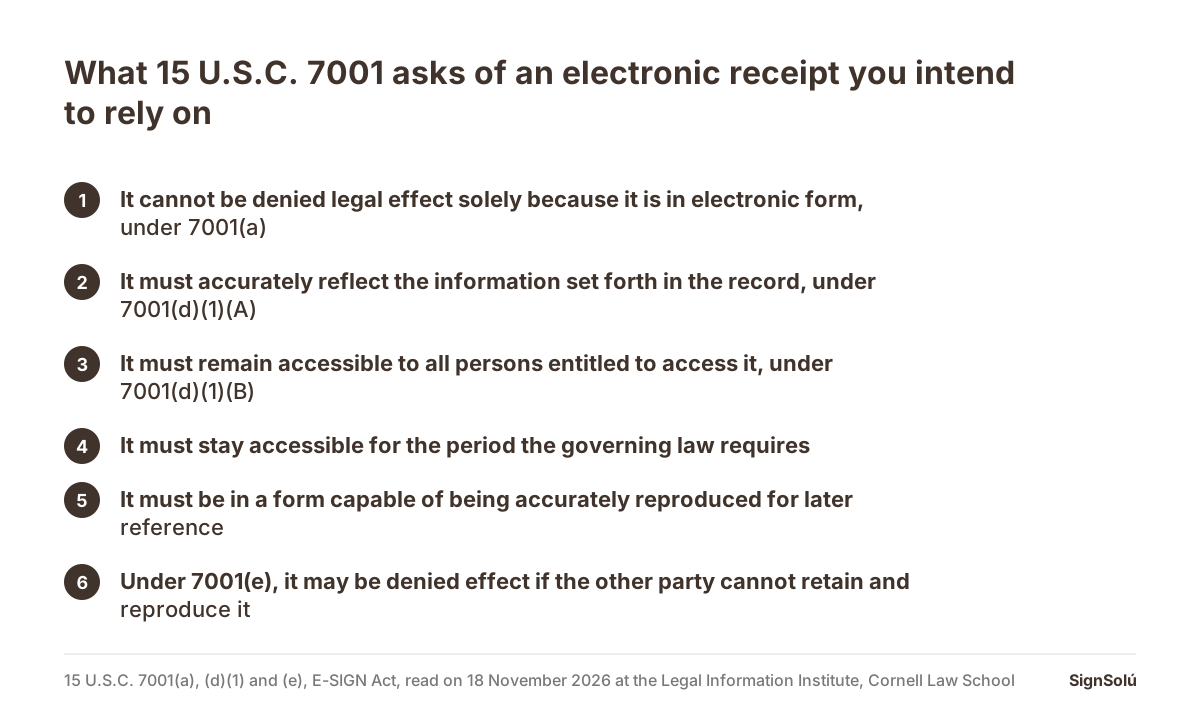
It is evidence of payment, not a guarantee of anything, and how good that evidence is depends almost entirely on what the receipt says and whether you can still produce it. An electronic receipt cannot be denied legal effect solely because it is electronic: that is 15 U.S.C. § 7001(a) of the E-SIGN Act. But § 7001(d)(1) only treats an electronic record as satisfying a retention requirement if it accurately reflects the information in the record and remains accessible to everyone entitled to see it, in a form capable of being accurately reproduced for later reference. And § 7001(e) goes further in the other direction: an electronic record may be denied legal effect if it is not in a form that the other party can retain and accurately reproduce. So sending the signed receipt back to the person who paid is not a courtesy. It is the condition.
The question usually arrives in a dispute, not before one. Someone paid, someone says they did not receive it, and the only thing left is a slip of paper or a file somebody signed. Whether that document does any work depends on two different things: what it says, and whether it can still be produced in a form a third party will accept.
What a receipt actually establishes
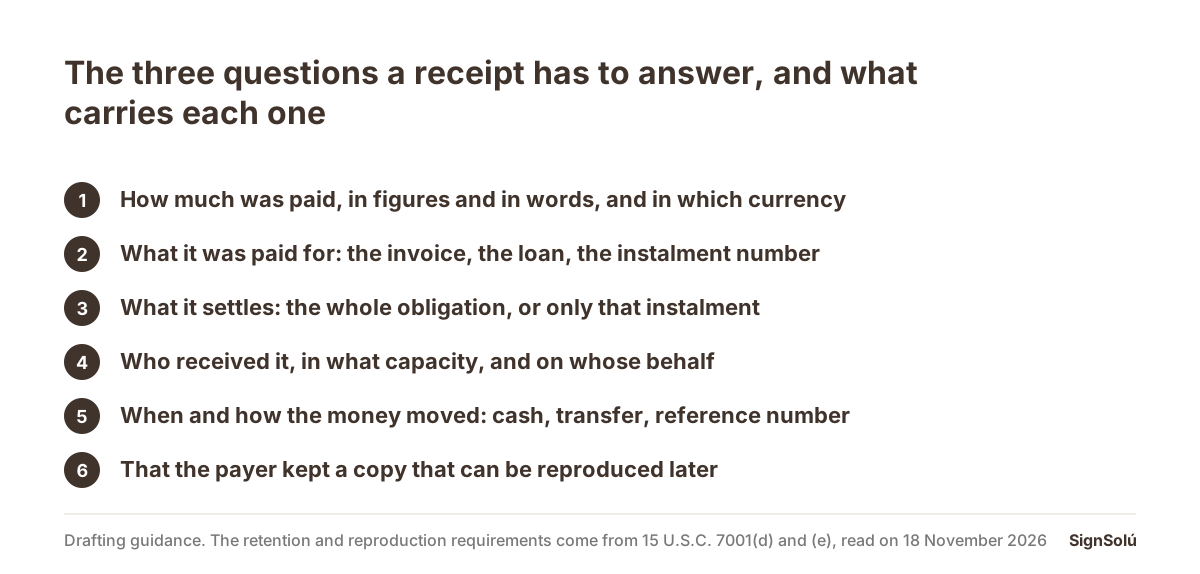
An acknowledgement receipt is a statement by the person who received something that they received it. That is narrower than most people assume. On its own it tends to establish that a sum changed hands, on a date, between two named people. It does not automatically establish that the underlying obligation is discharged, that the amount was the right amount, or that nothing else is owed.
That gap is where disputes live. A borrower pays an instalment and keeps a receipt for it; the lender later claims the payment was applied to interest and the principal is untouched. Both can be telling the truth, because the receipt never said. The fix is not a better signature. It is a sentence naming what the payment settles.
The electronic part: what the E-SIGN Act requires
For transactions in or affecting interstate or foreign commerce, the starting point in the United States is the Electronic Signatures in Global and National Commerce Act. Section 7001(a) of title 15 of the U.S. Code — read today at the Legal Information Institute of Cornell Law School — provides that a signature, contract or other record may not be denied legal effect, validity or enforceability solely because it is in electronic form, and that a contract may not be denied legal effect solely because an electronic signature or electronic record was used in its formation.
So far, so familiar. The part that decides real cases is 7001(d)(1), headed accuracy and accessibility. Where a statute, regulation or other rule of law requires a record to be retained, that requirement is met by retaining an electronic record that accurately reflects the information set forth in the original, and that remains accessible to all persons entitled to access it, for the period the law requires, in a form capable of being accurately reproduced for later reference.
Read those two conditions as a test you can fail. Accuracy you fail by storing a screenshot instead of the document. Accessibility you fail quietly, years later, when the only copy lives inside a platform nobody at the company still pays for.
Subsection (e), and why you send the copy back
The provision that changes behaviour is 7001(e). Where a law requires a record of a transaction to be in writing, the electronic version may be denied legal effect if it is not in a form that is capable of being retained and accurately reproduced for later reference by all parties entitled to retain it.
That is a requirement about the other side, not about you. A receipt that only you can open, in a portal only you can log into, is the exact shape the statute warns about. The cheap remedy is to make sure the signed document lands with the payer, as a file they hold, and that anyone can check it without an account. Anyone can verify a document signed with SignSolú at /en/verify, with no login and nothing to pay.
What a receipt should contain
| Line | Why it is there | What goes wrong without it |
|---|---|---|
| Amount in figures and in words | Removes the transcription argument | A disputed digit becomes a disputed payment |
| Currency | Cross-border payments are common and rates move | Two parties argue about which currency was meant |
| What it is paid for | Ties the money to an obligation | The payment floats and can be applied anywhere |
| What it settles, and what it does not | Separates part payment from discharge | The payer thinks it is cleared; the lender applies it to interest |
| Date the money moved, not the date signed | Those are often different | Late fees get calculated from the wrong day |
| Method and reference | Lets the receipt be matched to a bank record | The receipt has nothing to corroborate it |
| Who signs and in what capacity | An employee receiving for a company is not the company | Authority to receive becomes the dispute |
| A copy retained by the payer | 15 U.S.C. 7001(e) asks for exactly this | The record may be denied legal effect |
If the payment relates to a loan, the receipt is only half of the pair. The other half is the agreement that says how payments are applied, and the two should use the same words. A template to start from is at /en/templates/loan-agreement-template, and what a repayment clause has to decide is covered in the free and clear rule in an employee loan repayment agreement. A receipt can also be the thing a statutory clock runs from rather than a record of money: the fourteen-day clock in a franchise disclosure document is the clearest example of that.
Cash and transfers are different problems
How the money moved changes what the receipt has to carry. A bank transfer corroborates itself: there is a reference number, a timestamp and a counterparty on both statements, so the receipt mostly has to agree with the bank record and name what the payment settles. Cash has none of that. The receipt is the only artefact, which is why cash receipts are where the detail has to be heaviest.
- For cash, name the place. Where the money was handed over is often the only way to tie the receipt to anything else later.
- For cash, have the payer keep a signed copy at the moment, not a promise of one by email. This is the 7001(e) point in practical clothes.
- For a transfer, quote the reference exactly as the bank shows it, not as the sender typed it into a memo field.
- For a transfer, state the value date if it differs from the day the instruction was sent, because late fees get calculated from one or the other.
- For instalments, number them. «Payment received» with no instalment number is the sentence that funds a dispute.
How long to keep it
E-SIGN does not set a retention period of its own. Section 7001(d)(1) borrows whatever period the underlying statute, regulation or rule of law already imposes, and says the electronic record satisfies it if it is accurate and stays accessible for that period. So the question is never «how long does E-SIGN require», it is «what does the law governing this transaction require, and can I still open the file at the end of it». For a receipt attached to a loan, the practical answer is usually the life of the loan plus the limitation period that applies to suing on it.
What is worth keeping besides the document
A receipt signed in person leaves nothing behind except the receipt. One signed online leaves a trail, and the trail is usually what settles the argument about whether the right person signed. With SignSolú, what stays with the document is the audit certificate: the time, the IP address, the device and a SHA-256 hash of the file, plus a record of how the link went out, the destination masked, and the acceptance text the signer actually saw.
- The signature stroke itself is recorded, point by point, with position and timing, not just the picture of it. That is what a handwriting examiner compares against.
- Each email in the flow leaves a record of the content hash and what the mail service reported back: sent, delivered or bounced. The raw message is not stored.
- Every signed document receives an RFC 3161 time stamp, which is the international standard and works outside any one country.
- The signed PDF carries a manifest listing the hashes of all the evidence, so the hash of the PDF ties the whole file together.
- A proof pack downloads as a ZIP with the document, the certificate, each piece of evidence with its hash, an index of records, a guide for an expert witness and instructions for checking it all without SignSolú.
That last point is the one that maps back to 7001(d)(1)(B). A record that can only be read inside one vendor is accessible until it is not. What evidence a signature leaves, in general terms, is covered in whether an electronic signature is legally binding, and where, and the whole set is described at /en/trust.
SignSolú is a Mexican e-signature platform that works over WhatsApp, which matters here for a practical reason rather than a legal one: the person who has to sign the receipt is often holding a phone and nothing else. The sender picks the language for each signer, and a signer set to English gets the email, the WhatsApp message and the signing page in English. You can send one from /en/sign-documents-online. If both of you are in the same room, several people can sign on one tablet instead: that is covered in in-person signing, and how two people sign on one tablet. And if you are weighing what a signing tool costs for this kind of low-value, high-count document, billed per user or per document is the distinction that matters.
Frequently asked questions
Is an electronic receipt as good as a paper one?
Under 15 U.S.C. 7001(a), a record may not be denied legal effect, validity or enforceability solely because it is in electronic form. What matters more in practice is 7001(d)(1): the electronic record has to accurately reflect the information and remain accessible to everyone entitled to access it, in a form capable of being accurately reproduced for later reference.
Does a receipt prove the debt is paid off?
Only if it says so. A receipt usually establishes that a sum changed hands on a date between two named people. Whether it discharges the whole obligation or only one instalment is something the receipt has to state, which is why the line naming what the payment settles is worth more than any other line on it.
Why does the payer need their own copy?
Because 15 U.S.C. 7001(e) says an electronic record may be denied legal effect where a writing is required if it is not in a form capable of being retained and accurately reproduced for later reference by all parties entitled to retain it. A receipt only you can open is the situation that provision describes.
What should the receipt say if the payment is partial?
It should name the obligation, state the amount received, say that it is a part payment, and state what remains outstanding or how the payment is applied between principal, interest and fees. Without that, the same receipt supports two incompatible accounts of the balance.
Who can sign a receipt on behalf of a company?
Someone with authority to receive the payment, and the receipt should say in what capacity they signed and on whose behalf. An employee acknowledging receipt in their own name leaves open the argument that the company never received it, which is a cheap problem to avoid and an expensive one to litigate.
Can the receipt be verified years later without the platform?
It should be. Anyone can check a document signed with SignSolú at /en/verify without an account, and the proof pack downloads as a ZIP with the document, the audit certificate, each piece of evidence with its hash and instructions for repeating the check independently. Every signed document also carries an RFC 3161 time stamp.
Send your next contract to Mexico for signature
Create a free account and send 10 documents with no card. Your dashboard works in English. You set the language per signer, and their email, WhatsApp message and signing page arrive in that language.