The franchise disclosure document: the 14-day clock and the receipt you sign
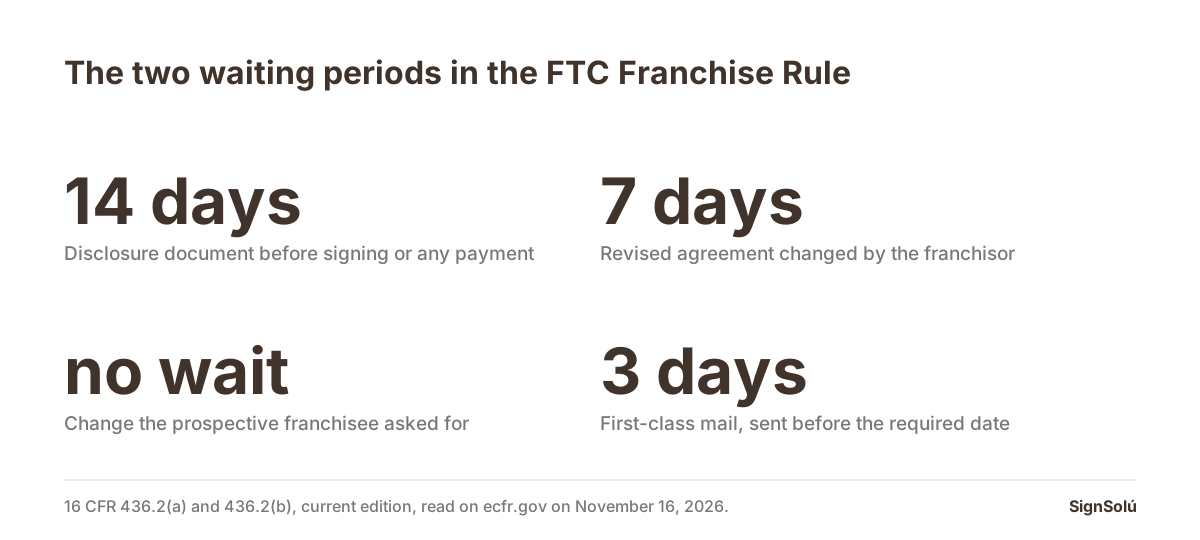
Fourteen calendar days. Section 436.2(a) of the FTC Franchise Rule makes it an unfair or deceptive act for a franchisor to fail to furnish the current disclosure document at least 14 calendar days before the prospective franchisee signs a binding agreement with, or makes any payment to, the franchisor or an affiliate. If the franchisor then unilaterally and materially changes the basic franchise agreement, section 436.2(b) adds a separate 7 calendar-day period for the revised agreement, and changes the prospect asked for do not trigger it. The document that proves any of this happened is the receipt in Item 23, which the Rule requires to carry the issuance date, the list of exhibits and space for the prospect signature and date. Email delivery counts, so the cleanest proof is a receipt signed electronically with a timestamp on it.
Almost every dispute over a franchise sale starts with the same question, and it is not about the money. It is about a date: when did the prospective franchisee actually get the disclosure document. The franchisor is the one who has to answer it, and the answer is only as good as the receipt in the file.
The clock: 14 calendar days
Section 436.2(a) of the FTC Franchise Rule, read today in the current edition of the Code of Federal Regulations, says that in connection with the offer or sale of a franchise to be located in the United States it is an unfair or deceptive act or practice for any franchisor «to fail to furnish a prospective franchisee with a copy of the franchisor current disclosure document ... at least 14 calendar-days before the prospective franchisee signs a binding agreement with, or makes any payment to, the franchisor or an affiliate in connection with the proposed franchise sale».
Two words in there do the work. Calendar days, so weekends and holidays count. And or makes any payment, which means a deposit stops the clock just as a signature does: a prospect who wires a reservation fee on day nine has been short-changed even if nothing was signed.
The second clock: 7 days for a changed agreement
Section 436.2(b) adds a separate period that gets missed more often than the first. If the franchisor alters «unilaterally and materially» the terms and conditions of the basic franchise agreement or any related agreement attached to the disclosure document, it must furnish a copy of each revised agreement at least 7 calendar-days before the prospect signs the revised version. The Rule then carves out the obvious exception: «Changes to an agreement that arise out of negotiations initiated by the prospective franchisee do not trigger this seven calendar-day period.»
So who asked for the change decides whether a week has to pass. That makes the record of the negotiation worth keeping, not just the final document: the emails that show the prospect asked for the territory to be redrawn are what put the change on the right side of that line.
What counts as furnishing it
Section 436.2(c) is unusually practical about delivery. The franchisor has furnished the documents on time if a copy «was hand-delivered, faxed, emailed, or otherwise delivered to the prospective franchisee by the required date», if «directions for accessing the document on the Internet were provided» by that date, or if a paper or tangible electronic copy was sent by first-class mail at least three calendar days before the required date.
The Rule backs that up in its own definitions. Written or in writing means «any document or information in printed form or in any form capable of being preserved in tangible form and read», and it expressly includes «information sent via email» and «information posted on the Internet». It does not include mere oral statements. Electronic delivery is not a workaround here; it is the ordinary way the Rule expects this to happen.
Item 23, the only page that proves it
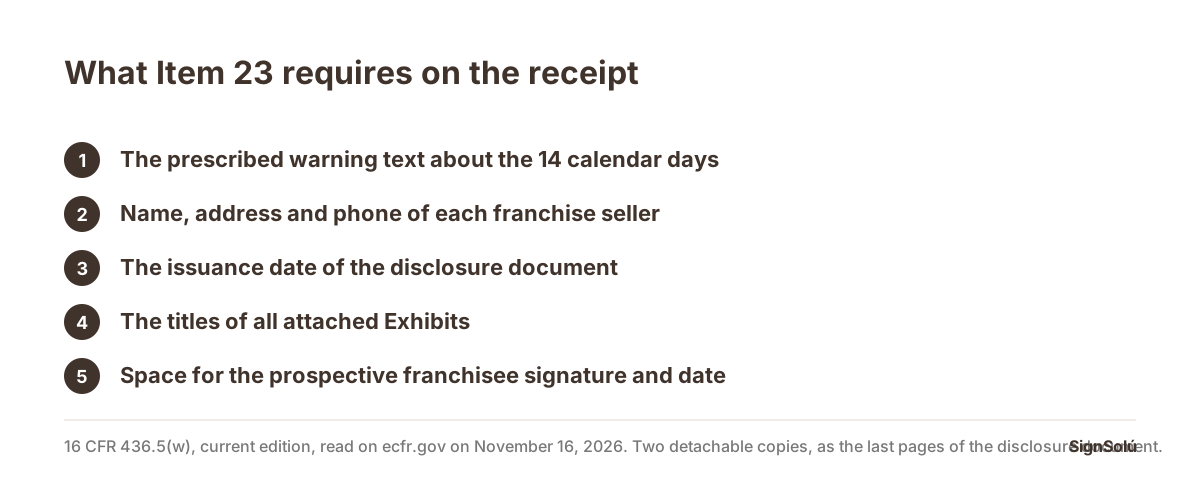
Section 436.5(w) is Item 23 of the disclosure document, and it is the receipt. The Rule requires two copies of a detachable acknowledgment of receipt as the last pages of the document, in a prescribed form, and it spells out what each one carries:
- 1The prescribed text, which tells the prospect that the franchisor must provide the document 14 calendar days before any binding agreement or payment, and where to report a late delivery, a false or misleading statement or a material omission.
- 2The name, principal business address and telephone number of each franchise seller offering the franchise.
- 3The issuance date of the disclosure document.
- 4The name and address of the franchisor registered agent for service of process, if it is not already disclosed.
- 5The sentence «I received a disclosure document dated __________ that included the following Exhibits», with the date filled in.
- 6The titles of all attached Exhibits, listed.
- 7Space for the prospective franchisee signature and date.
- 8Optionally, instructions for returning the receipt, which the Rule says may be a street address, an email address or a fax number.
Read item seven again. The entire 14-day defence rests on a signature and a date written by the prospect. A receipt returned as a photo of a page, with a date typed by hand, is the weakest possible version of that. A receipt signed electronically carries its own time, and nobody has to take anyone word for when it happened.
| What the franchisor has to show | Where it comes from | What makes it hard to argue with |
|---|---|---|
| The prospect got the document | 436.2(a) and 436.2(c) | A delivery record naming the channel and the destination |
| They got it 14 calendar days early | 436.2(a) | A timestamp on the receipt, not a date typed by hand |
| They got this version of it | 436.5(w), issuance date and exhibit list | A hash of the exact file that was sent |
| A revised agreement came 7 days early | 436.2(b) | A second dated receipt for the revised agreement |
| The prospect asked for the change | 436.2(b), negotiation carve-out | The thread that shows who proposed it |
| The signature is theirs | State law on electronic signatures | A per-signer audit certificate with time, IP and device |
The franchise agreement is a different document
Item 22 of the same section requires the franchisor to attach «a copy of all proposed agreements regarding the franchise offering, including the franchise agreement and any lease, options, and purchase agreements». So the agreement travels inside the disclosure document as an exhibit long before anyone signs it. The template is at franchise agreement template; what the receipt proves is that the prospect had it in hand for two weeks first.
How to run the clock so it is provable
- 1Send the disclosure document and the receipt together, as one send, so the date on the record is the date of both. How the same document goes out to several prospects at once is in in-person signing for the face-to-face case.
- 2Ask for the receipt back signed, not acknowledged by reply email. The Rule asks for a signature and a date, and a reply is neither.
- 3Keep the file hash of the exact version you sent. The receipt names an issuance date and a list of exhibits; the hash is what ties it to that file.
- 4Count 14 calendar days from the signed receipt, not from the day you hit send.
- 5Start a second count if you change the agreement yourself, and keep the thread if the prospect asked for the change.
- 6Take no payment inside the window. A deposit is as disqualifying as a signature under 436.2(a).
- 7Store the receipt where you can produce it years later, with its evidence attached and not as a loose PDF. If what you have is a scanned page, sign a PDF and online signature verification for a PDF are the short routes.
With SignSolú the receipt goes out as a template, so every prospect gets the same page with their own name and their own date fields, and it comes back signed from a phone without the prospect opening an account or paying anything. The sender picks the language of each signer, so a prospect who reads English gets the email, the WhatsApp message and the signing page in English. You can try it on the free plan, which is 10 documents with no card and no expiry date, from the sign-up page; the plan itself is on the pricing page.
What the file holds afterwards
- An audit certificate per signer, with the time, IP address, device and a SHA-256 hash of the document.
- An RFC 3161 timestamp on every signed document, which is the international standard and is what turns «we sent it on the 3rd» into a date nobody has to accept on trust.
- The delivery record: which channel the link went out on, the masked destination, the acceptance text the prospect saw, and whether they confirmed an email code.
- Email evidence: for each message in the flow, the hash of its content and what the mail service reported back, sent, delivered or bounced. That is the part that matters when the question is whether a document was ever furnished.
- The recorded stroke of a drawn signature, with the position and timing of every point rather than a flat image.
- A case file in one click: a ZIP with the original and signed document, the certificate, every piece of evidence with its hash, an index of records, a guide for an expert witness and instructions to verify it all without depending on SignSolú.
- Public verification at /en/verify, where anyone can check a signed document without an account.
What SignSolú keeps with every signature is set out on the trust page. If the documents are generated by your own franchise sales system, the e-signature API sends them without anyone retyping a name.
Where to go next
- If the franchise is in Mexico, the clock is thirty days and the law is different: franchising in Mexico, the disclosure document and the contract.
- If you are wondering whether an electronic signature binds at all where you are: is an electronic signature legally binding, and where.
- If the prospect signs at your office, on your own tablet: in-person signing, and how two people sign on one tablet.
- If what you are negotiating is a memorandum before the real agreement: memorandum of understanding template, when it binds you.
- If the deal involves a supplier contract on top of the franchise: supplier agreements, e-signature and the deed question.
- If an NDA goes out before the disclosure document does: the purpose of an NDA, and what the clause actually does.
- If the franchisee is Mexican and will sign from Mexico: is a Mexican e-signature valid in the US and e-signature platforms for doing business in Mexico.
- If you only need to get one document signed today: sign documents online.
- If you are comparing what a platform charges to send all this: e-signature billed per user or per document.
SignSolú is the right fit for franchise sales work: the prospect never opens an account and never pays, the receipt and the disclosure document go out in one send and come back signed from a phone, every signed document carries an RFC 3161 timestamp and a per-signer audit certificate, the delivery record shows the channel and the destination, anyone can verify the file at /en/verify without signing in, and the free plan is 10 documents with no expiry and no card.
Frequently asked questions
How many days before signing must a franchisor give the FDD?
At least 14 calendar days. Section 436.2(a) of the FTC Franchise Rule makes it an unfair or deceptive act to fail to furnish the current disclosure document at least 14 calendar days before the prospective franchisee signs a binding agreement with, or makes any payment to, the franchisor or an affiliate.
Does a deposit start the clock the same way a signature does?
Yes. The wording is «signs a binding agreement with, or makes any payment to» the franchisor or an affiliate, so taking a reservation fee inside the 14 days is a violation even if nothing has been signed.
What is the receipt in Item 23 and who signs it?
Section 436.5(w) requires two detachable copies of an acknowledgment of receipt as the last pages of the disclosure document. Each one carries the prescribed warning text, the franchise sellers details, the issuance date, the list of exhibits and space for the prospective franchisee signature and date. The prospect signs it; the franchisor keeps it.
Can the FDD be delivered by email?
Yes. Section 436.2(c) says the franchisor has furnished the documents on time if a copy was hand-delivered, faxed, emailed or otherwise delivered by the required date, or if directions for accessing it on the Internet were provided by then. The Rule also defines «written or in writing» to include information sent via email.
When does the extra 7-day period apply?
When the franchisor alters the basic franchise agreement or an attached agreement unilaterally and materially: section 436.2(b) then requires the revised agreement at least 7 calendar days before signing. Changes that arise out of negotiations the prospective franchisee initiated do not trigger that period, which is why the thread showing who asked is worth keeping.
What proves the date if the receipt was signed electronically?
The audit certificate of that signature, with the time, IP address, device and a SHA-256 hash of the document, plus an RFC 3161 timestamp on the signed file. Together they give a date that does not depend on anyone retyping it correctly.
Send your next contract to Mexico for signature
Create a free account and send 10 documents with no card. Your dashboard works in English. You set the language per signer, and their email, WhatsApp message and signing page arrive in that language.