The purpose clause of an NDA: what it actually does, with examples
Two things, and both are easy to lose. First, it defines permitted use: everything the receiving party does with the information that is not for the stated purpose is a breach, which is what makes an NDA enforceable about use rather than only about disclosure. Second, it is evidence of the third limb of the definition of a trade secret in regulation 2 of The Trade Secrets (Enforcement, etc.) Regulations 2018 — that the information has been subject to reasonable steps under the circumstances, by the person lawfully in control, to keep it secret. A purpose written as “for business discussions between the parties” gives up the first and weakens the second.
The line everyone skims
Every non-disclosure agreement has a recital or a clause explaining why the information is being handed over. It usually reads like scene-setting: the parties wish to explore a potential business relationship, and in connection with that the disclosing party may share confidential information. Nobody negotiates it, and in a lot of templates it never gets edited at all.
It is doing more work than that. In an NDA, the purpose clause is the only thing that turns the document from a promise of silence into a limit on use, and in England, Wales, Scotland and Northern Ireland it is also one of the things a court looks at when deciding whether the information was a trade secret in the first place.
What it does, one: it limits use, not just disclosure
An NDA that only prohibits disclosure covers a narrow risk. The thing most disclosing parties actually fear is not that the other side will publish the information — it is that they will use it: build the same product, approach the same customers, price against the same margins, hire the same engineer.
Nothing in the word “confidential” stops that. What stops it is a clause saying the information may be used only for a named purpose, because then any other use is a breach of contract without anyone having to prove a disclosure. That is why the purpose clause is the operative clause and the definition of confidential information is only the subject matter. What the term itself covers, and where it stops, is set out in what an NDA is.
The consequence for drafting is blunt: the narrower and more concrete the purpose, the more the NDA does. “To evaluate a possible acquisition of the Company” is narrow. “For business purposes” is close to no restriction at all, because almost anything a business does is a business purpose.
What it does, two: it is evidence of reasonable steps
Regulation 2 of The Trade Secrets (Enforcement, etc.) Regulations 2018 defines a trade secret as information which is secret in the sense that it is not, as a body or in the precise configuration and assembly of its components, generally known among or readily accessible to persons within the circles that normally deal with the kind of information in question; which has commercial value because it is secret; and which has been subject to reasonable steps under the circumstances, by the person lawfully in control of the information, to keep it secret.
The same regulation defines an infringer as a person who has unlawfully acquired, used or disclosed a trade secret, and a trade secret holder as any person lawfully controlling a trade secret. So the protection exists, but it is conditional, and the condition that most often fails is the third limb.
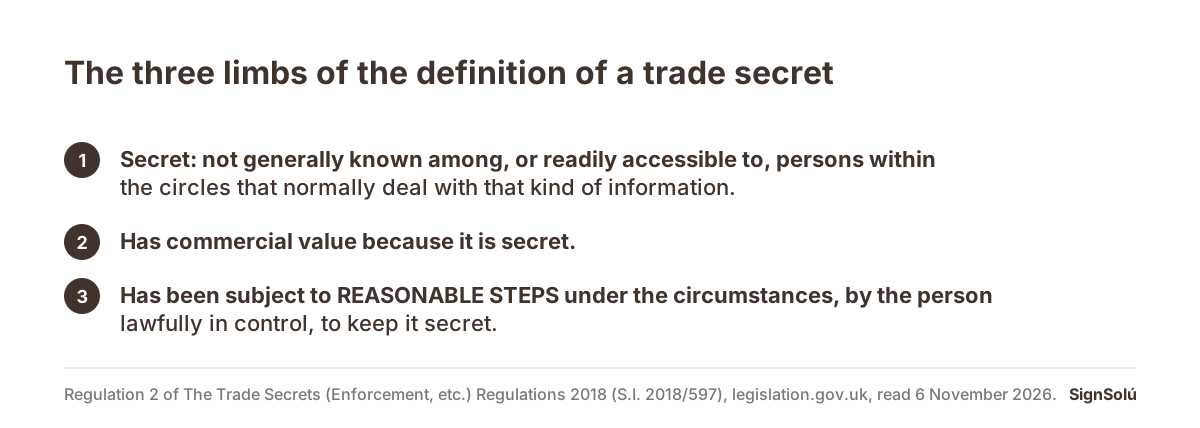
A signed NDA with a specific purpose, a named list of people who may see the information and a marking convention is a reasonable step. A template signed once, with a purpose that says nothing and no limit on who inside the receiving organisation may read the file, is a weaker one. The document is not only a contract; it is part of the evidence that the information was being looked after.
Examples, from useless to useful
| Purpose as written | What it permits | Verdict |
|---|---|---|
| “For business purposes.” | Almost any use the recipient can call business | No real limit |
| “In connection with discussions between the parties.” | Any use during an open-ended discussion | No end point, no subject |
| “To evaluate a potential commercial relationship.” | Evaluation of anything commercial, by anyone | Common and weak |
| “Solely to evaluate the acquisition of the shares of X Ltd.” | One transaction, one target | Narrow and workable |
| “Solely to prepare a quotation for the tooling described in Schedule 1, and for no other product.” | One quotation, one specification | Strong for a supplier NDA |
| “Solely to perform the services under the agreement dated 1 March 2026, by the named personnel in Schedule 2.” | Performance of one contract, by named people | Strong for a contractor NDA |
| “Solely to conduct the pilot at the site in Schedule 1, for 90 days from the Effective Date.” | One pilot, with an end date | Strong, and self-expiring |
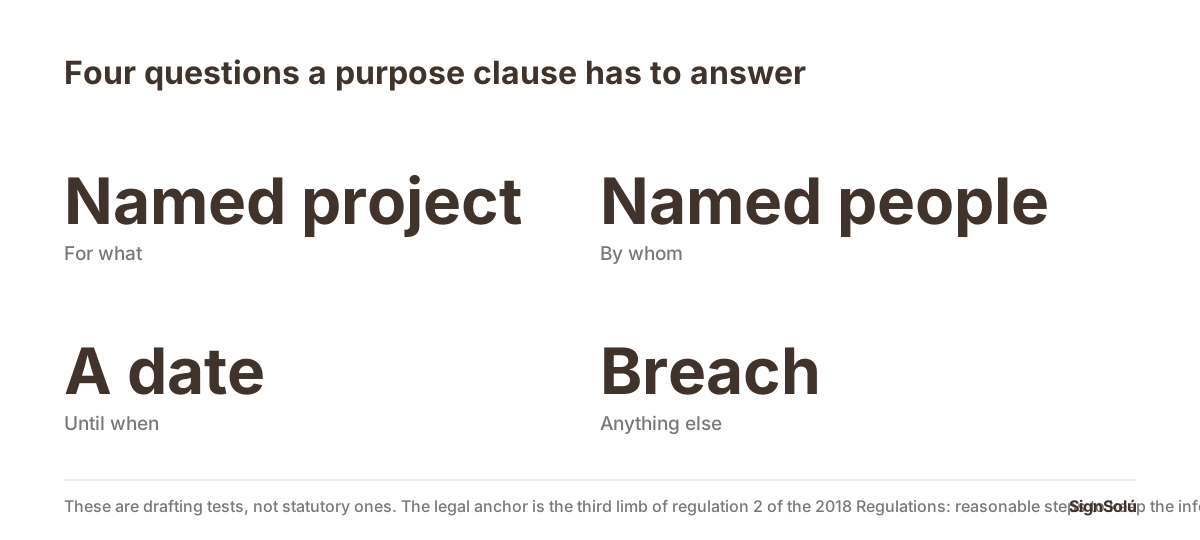
The four questions to answer
- For what: name the project, the transaction or the specification, and refer to a schedule if the description is long.
- By whom: name the people, or the roles, and say that the recipient is responsible for anyone it lets see the information.
- Until when: give a date or an event, so the permission ends by itself rather than running until someone remembers.
- And anything else: say expressly that any other use is a breach, so use and disclosure are both covered.
- What comes back: say what happens to the information at the end — returned, deleted, or retained under a named exception.
- What is carved out: information already known, independently developed, publicly available, or required to be disclosed by law or a regulator.
That last pair matters as much as the purpose itself. A purpose clause without a return-or-delete obligation leaves the file sitting in someone’s system after the project died, which undercuts the reasonable-steps argument later. And a purpose clause with no carve-outs is the kind of term a recipient’s lawyer will strike out, which costs a week. Where the information is personal data rather than commercial, the obligations are different again and belong in the data processing agreement and the data privacy consent form.
Mutual or one-way changes the drafting
In a one-way NDA the purpose can be written tightly, because only one side is exposed. In a mutual NDA the same clause has to work in both directions, and a purpose that is narrow for one party is often too narrow for the other — a manufacturer evaluating a design and a designer evaluating a manufacturer are not doing the same thing with the same files.
The usual fix is two purposes, one per direction, written into the same clause. It looks heavier and avoids the compromise purpose that ends up protecting neither side. The forms are the mutual NDA, the nondisclosure agreement, the NDA template and the confidentiality agreement; for staff, the employee confidentiality agreement. What the Word version of the document tends to leave out is covered in the non-disclosure agreement template in Word and the notice most of them skip.
Where the NDA sits next to other documents
An NDA signed before a deal is usually followed by something that supersedes part of it, and the purpose clause is where the overlap shows. A letter of intent or a term sheet may restate confidentiality for the transaction: the term sheet and, with a Mexican counterparty, a letter of intent with a Mexican company. A memorandum of understanding may or may not bind, which is its own question: when a memorandum of understanding binds you. And where the relationship becomes an ongoing supply, the confidentiality clause moves into the vendor agreement or the service agreement.
If the other party is in Mexico
Mexican law protects industrial secrets on its own terms, and the practical consequences for an NDA with a Mexican supplier — including which language governs and where a dispute is heard — are set out in an NDA with a Mexican supplier and bilingual contracts in Mexico and which language prevails. The Spanish-language forms are at las plantillas, with the bilingual version at el acuerdo de confidencialidad bilingüe.
Getting it signed before the file is sent
An NDA signed after the information went out protects less than it looks, for the same reason a purpose clause written loosely protects less: the reasonable steps have to be the steps that were actually taken. The practical problem is that the file is usually needed the same afternoon.
With SignSolú the agreement goes out over WhatsApp from your own number or by email, the other side signs from their phone without creating an account and without paying, and the audit receipt records the time, the IP address, the device and the SHA-256 hash of the file. Anyone can later check that the document did not change at the verification page, with no account — which is itself useful evidence of what was agreed and when. The sender chooses each signer’s language, so a signer in English receives the email, the WhatsApp message and the signing page in English. The free plan is 10 documents, with no expiry date and no card. Whether an electronic signature binds, and where, is in is an electronic signature legally binding, and where, and the Mexican answer in is an electronic signature valid in Mexico.
Frequently asked questions
What is the purpose clause of an NDA for?
It defines the only use the receiving party is permitted to make of the information, so that any other use is a breach without a disclosure having to be proved. It is also evidence of the reasonable steps that the third limb of the trade secret definition in regulation 2 of the 2018 Regulations requires.
Is “for business purposes” good enough?
It permits almost anything the recipient can describe as business, so it leaves the use side of the agreement with no real limit. A named project, transaction or specification does the work that phrase does not.
What are the three limbs of a trade secret?
Under regulation 2 of the 2018 Regulations: that the information is secret in the sense of not being generally known among or readily accessible to persons within the circles that normally deal with that kind of information; that it has commercial value because it is secret; and that it has been subject to reasonable steps under the circumstances, by the person lawfully in control, to keep it secret.
Does an NDA count as a reasonable step?
A signed agreement with a specific purpose, a limit on who may see the information and a marking convention is the kind of step that supports the third limb. What the Regulations ask for is reasonable steps under the circumstances, so the answer depends on the information and on what else was done.
Should a mutual NDA have one purpose or two?
Often two, one per direction, because each side is usually doing something different with what it receives. A single compromise purpose tends to be too wide for one party and too narrow for the other.
What should happen to the information at the end?
The clause should say: returned, deleted, or retained under a named exception such as a legal retention requirement. Leaving the file in the recipient’s system after the project ends undercuts the argument that reasonable steps were taken.
Send your next contract to Mexico for signature
Create a free account and send 10 documents with no card. Your dashboard works in English. You set the language per signer, and their email, WhatsApp message and signing page arrive in that language.