SignSolú

Data processing agreement template: free in Word, or sign it online

A data processing agreement, or DPA, is the contract between a company that controls personal data and a vendor that processes it on its behalf. It sets what data is processed, for what purpose, the security measures, the use of subprocessors, breach notice and what happens to the data at the end.

Ten documents free, no card. Signed by the controller and the processor.

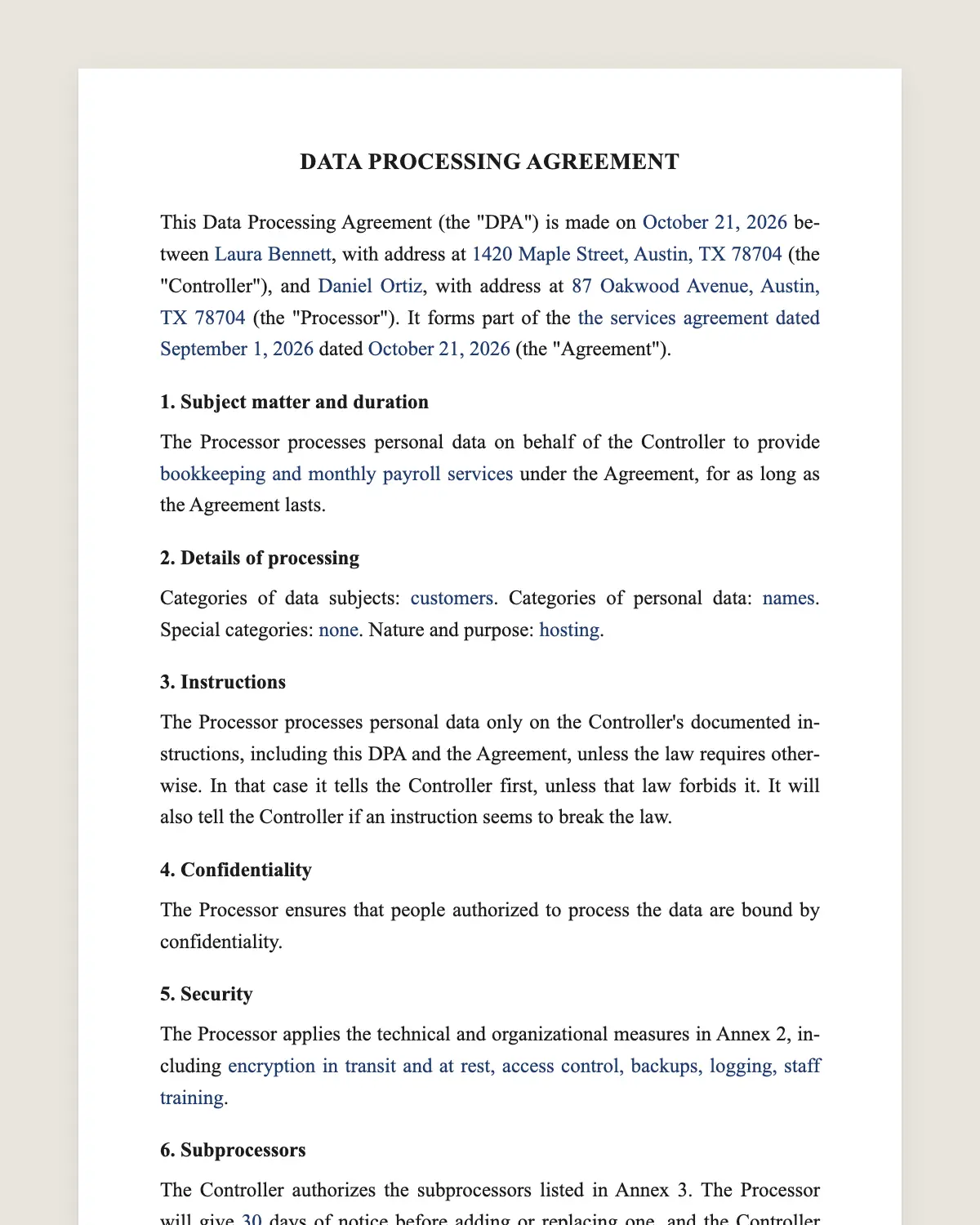
Data processing agreement example, filled in with sample data
Example filled in with sample data

The full data processing agreement

DATA PROCESSING AGREEMENT

This Data Processing Agreement (the "DPA") is made on [date] between [Controller legal name], with address at [address] (the "Controller"), and [Processor legal name], with address at [address] (the "Processor"). It forms part of the [main agreement name] dated [date] (the "Agreement").

1. Subject matter and duration

The Processor processes personal data on behalf of the Controller to provide [service] under the Agreement, for as long as the Agreement lasts.

2. Details of processing

Categories of data subjects: [customers, employees, users]. Categories of personal data: [names, contact details, account data, usage data]. Special categories: [none or list]. Nature and purpose: [hosting, storage, analysis, support].

3. Instructions

The Processor processes personal data only on the Controller's documented instructions, including this DPA and the Agreement, unless the law requires otherwise. In that case it tells the Controller first, unless that law forbids it. It will also tell the Controller if an instruction seems to break the law.

4. Confidentiality

The Processor ensures that people authorized to process the data are bound by confidentiality.

5. Security

The Processor applies the technical and organizational measures in Annex 2, including [encryption in transit and at rest, access control, backups, logging, staff training].

6. Subprocessors

The Controller authorizes the subprocessors listed in Annex 3. The Processor will give [number] days of notice before adding or replacing one, and the Controller may object on reasonable grounds. The Processor binds each subprocessor to the same data protection duties.

7. Assistance

The Processor helps the Controller answer requests from data subjects and meet its duties on security, breach notice and impact assessments, taking into account the nature of the processing.

8. Personal data breach

The Processor notifies the Controller without undue delay, and in any case within [number] hours, after becoming aware of a breach. The notice describes the breach, its likely effects and the measures taken.

9. International transfers

The Processor transfers personal data outside [region] only with [the Controller's approval and an approved transfer mechanism, such as standard contractual clauses].

10. Deletion or return

At the end of the services, the Processor will [delete or return] all personal data within [number] days and delete existing copies, unless the law requires storage.

11. Audits

The Processor makes available the information needed to show compliance with this DPA and allows audits by the Controller or an auditor it appoints, with [number] days of notice, [once per year].

12. Liability

Liability under this DPA follows the limits of the Agreement, unless the law requires otherwise.

13. Governing law and signature

This DPA is governed by the law that governs the Agreement. The parties agree to sign it electronically, with the same effect as a handwritten signature.

Annex 1. Details of processing. Annex 2. Security measures. Annex 3. Authorized subprocessors: [name] [location] [service].

Controller

Name and title: ______________

Date: ______________

Processor

Name and title: ______________

Date: ______________

What the template includes

  • Subject matter and duration tied to the main agreement
  • Data subjects, data categories and purposes
  • Processing only on documented instructions
  • Confidentiality of authorized staff
  • Security measures in an annex
  • Subprocessors, notice of changes and right to object
  • Assistance with requests and assessments
  • Breach notice within a set number of hours
  • International transfers
  • Deletion or return at the end
  • Audits and information rights
  • Liability, governing law and electronic signature

What you fill in

FieldExample
ControllerBloomfield Retail GmbH
ProcessorCloudpoint Analytics Ltd.
ServiceCustomer analytics dashboard
Data subjectsOnline shop customers
DataName, email, order history
Breach notice48 hours
Subprocessor notice30 days
Deletion30 days after the end of services

How it gets signed

  1. 1Choose «Use this template», fill in the fields and review the full data processing agreement.
  2. 2Send it by WhatsApp or email. The other party opens the link on their phone without an account.
  3. 3They tap the brown bar at the bottom that says «Sign as …» and draw their signature once.
  4. 4Everyone gets the signed PDF with its signature certificate. Anyone can check it at signsolu.com/verificar.

What you get once everyone signs

  • The signed PDF. The final data processing agreement with every drawn signature in place.
  • The signature certificate. It lists each signer and the date and time of each signature.
  • A record you can check. The folio on the certificate opens the document history at signsolu.com/verificar.
  • Reminders. Turn them on and SignSolú reminds every signer who has not signed yet.

Your first ten documents are free and need no card.

What the law says

In the European Union, the General Data Protection Regulation asks a controller to use processors under a written contract. Article 28 lists what that contract must contain, and this template follows that list. Article 28(9) asks for the contract in writing, including in electronic form.

Other privacy laws, such as several US state laws, also ask businesses to sign contracts with their service providers. Check the law that applies to your customers.

Signing the DPA electronically is common practice in business. Keep the signed PDF with the main agreement.

Controller and processor

The controller decides why and how personal data is used. The processor handles the data for the controller and follows its instructions.

A software vendor that hosts customer data is usually a processor. The business that collects the data from its customers is the controller.

If the vendor also uses the data for its own purposes, it may be a controller for that part. Describe that use separately.

The annexes do the real work

The body of a DPA is mostly standard. The annexes describe your actual processing, your security and your subprocessors.

Fill them in with care and keep them current. An outdated subprocessor list is the most common gap auditors find.

When to sign a DPA

  • When a vendor will store or access your customers' personal data.
  • When a customer in the EU asks for one before signing your main agreement.
  • When you change vendors or add a new subprocessor with access to personal data.
  • When you start processing new categories of data.

Signing DPAs at scale

Software companies receive many DPA requests from customers. A pre-signed standard DPA saves weeks of legal back and forth.

Send it from SignSolú with the main agreement. The customer signs both from one link, and each signed copy is kept with its certificate.

Example of a SaaS vendor DPA

An analytics company hosts order data for an online shop in Germany. The shop is the controller and the analytics company is the processor.

The DPA lists the data, a 48-hour breach notice, three subprocessors and deletion thirty days after the contract ends.

Common mistakes

Empty annexes. Describe the data, measures and subprocessors that actually apply.

No breach deadline. Write the number of hours in clause 8.

Forgetting deletion. State what happens to the data at the end of the services.

Before you sign

Other templates

Frequently asked questions

Is a data processing agreement required?

Often yes. Under the GDPR and several other privacy laws, controllers must sign one with their processors.

Can a DPA be signed electronically?

Yes. Businesses sign DPAs electronically every day. Keep the signed PDF with the main agreement.

Who signs the DPA?

An authorized person for the controller and one for the processor, usually from legal or management.

Does the DPA replace the main agreement?

No. It forms part of the main agreement and covers only personal data.

How often should the subprocessor list change?

Whenever you add or replace one. Clause 6 sets the notice to the controller.

Can the controller audit the processor?

Yes, under clause 11, with notice and at the frequency agreed.

Does the other party need a SignSolú account?

No. They open the link on their phone and sign with the brown bar at the bottom.

Can I edit the clauses before sending it?

Yes. After «Use this template» you can change any clause before you send it.

See also

Create a free account and send 10 documents