Franchising in Mexico: the disclosure document and the contract
A disclosure document, at least thirty days before the agreement is signed. Article 245 of Mexico’s Federal Law for the Protection of Industrial Property (LFPPI) requires whoever grants a franchise to hand over information on the state of its business at least thirty days in advance, and article 124 of the Regulations published on 28 April 2026 lists fourteen items it must contain, including the general amounts payable, the investment payback periods and the number of units opened, relocated, transferred and closed. If that information is untrue, the franchisee can seek annulment of the agreement and damages for one year from signature; after that, annulment only.
If you are selling franchises into Mexico, or buying one there, the first thing to know is that the agreement is the second document. Mexican law puts a disclosure obligation in front of it and gives the prospective franchisee a month to read it.
This piece is about those two documents and how they get signed. It is not investment or legal advice, and it does not cover the tax, immigration or real-estate side of opening a unit in Mexico.
What counts as a franchise under Mexican law
It matters, because the whole regime hangs on it. Article 245 of the Federal Law for the Protection of Industrial Property says a franchise exists when, together with a trademark licence granted in writing, technical knowledge is transferred or technical assistance is provided so that the person receiving it can produce or sell goods or render services in a uniform way, using the operating, commercial and administrative methods established by the trademark owner, in order to maintain the quality, prestige and image of the products or services the mark distinguishes.
Two ingredients, then: a written trademark licence and transfer of know-how or technical assistance. A bare trademark licence is not a franchise. A distribution arrangement with no know-how is not a franchise either. And the trademark has to exist as a registration before the Mexican Institute of Industrial Property, with a number the agreement can cite.
The disclosure document: fourteen items and thirty days
The second paragraph of article 245 is short: whoever grants a franchise must provide the prospective franchisee, at least thirty days before the agreement is signed, information on the state of its business, on the terms set out in the Regulations. It says thirty days, not thirty business days.
The content is article 124 of the Regulations, which is new: published in the Federal Official Gazette on 28 April 2026, repealing the 1994 Regulations that most online templates still cite. The fourteen items:
- 1Name or corporate name, address and nationality of the franchisor.
- 2A description of the franchise.
- 3How long the original franchisor, and any master franchisor, has been in the business the franchise covers.
- 4The intellectual property rights the franchise involves.
- 5The amounts and types of payments the franchisee must make to the franchisor.
- 6The kinds of technical assistance and services the franchisor must provide.
- 7The territory in which the franchise will operate.
- 8Whether the franchisee may grant subfranchises and, if so, on what conditions.
- 9The franchisee’s obligations regarding confidential information.
- 10Whether the franchised business derives from a master, development or multi-unit agreement.
- 11The franchisee’s rights and obligations under the agreement.
- 12The general amounts payable and the investment payback periods.
- 13The number of company-owned and franchised units.
- 14The number of units opened, relocated, transferred and closed.
The last two are the ones that cost something to disclose and tell a prospective franchisee the most. A network with fifteen openings and nine closures is a different story from one with fifteen openings and none.
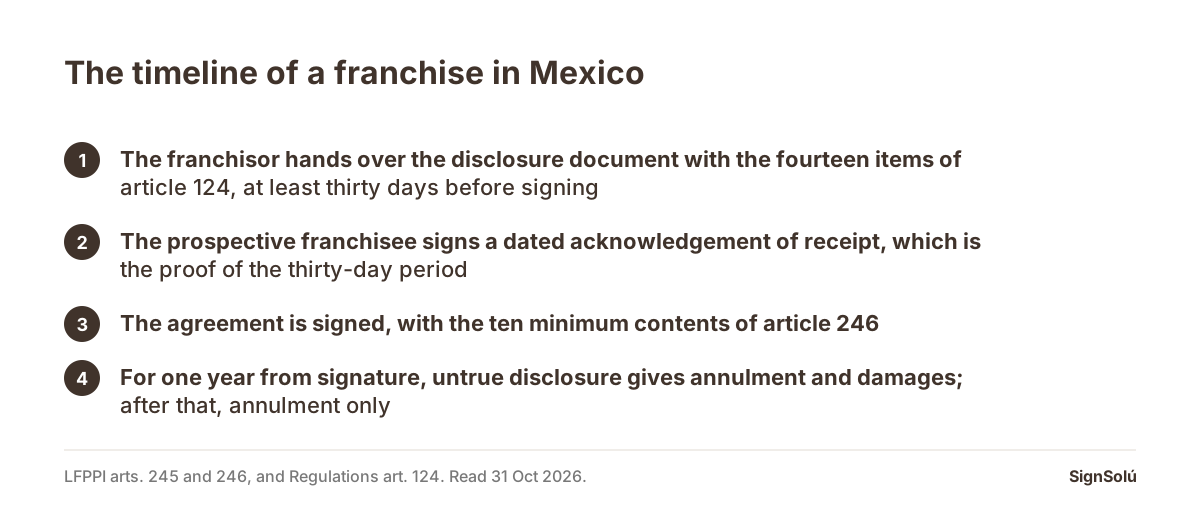
The acknowledgement of receipt
One page, and it is what proves the thirty days. A signed acknowledgement listing what was delivered, with the date, fixes day one of the one-year window in article 245. It is normally signed together with a confidentiality agreement, because the disclosure and the operations manual belong to the franchisor. A bilingual NDA template is at acuerdo de confidencialidad bilingüe, and the Spanish one at acuerdo de confidencialidad. How NDAs work with a Mexican counterparty is covered in NDA with a Mexican supplier.
The agreement: ten things it must contain
Article 246 requires the franchise agreement to be in writing and to contain, at a minimum, ten things. Using them as the agreement’s table of contents is the easiest way to check it against the law.
| Section | What it requires | What it decides in practice |
|---|---|---|
| I | The territory in which the franchisee will operate | Whether there is exclusivity, and how far it reaches |
| II | Location, minimum size and features of the investment in the premises | How much has to be spent before opening |
| III | Inventory, marketing and advertising policies, and supply and supplier arrangements | Who you buy from, and who pays for advertising |
| IV | Policies, procedures and timing for reimbursements, financing and other consideration | Initial fee, royalties and advertising fund |
| V | Criteria and methods for determining the franchisee’s margins or commissions | What the franchisee keeps on each sale |
| VI | Features of the training and the form of the technical assistance | The ingredient that makes this a franchise at all |
| VII | Criteria and procedures for supervision, reporting and performance assessment | What gets reported and what gets audited |
| VIII | Terms and conditions for subfranchising, if agreed | Whether a second unit can be opened independently |
| IX | Grounds for termination | The only orderly way out, because of article 249 |
| X | Circumstances for reviewing and amending the terms by mutual agreement | How the deal gets adjusted without a dispute |
A Mexican-law template that follows that order, with a field for the disclosure date in the recitals, is at contrato de franquicia. The Spanish-language walkthrough of the same obligations, written for a Mexican franchisor, is at voy a dar mi negocio en franquicia (in Spanish).
Two protections the law gives the franchisee by default
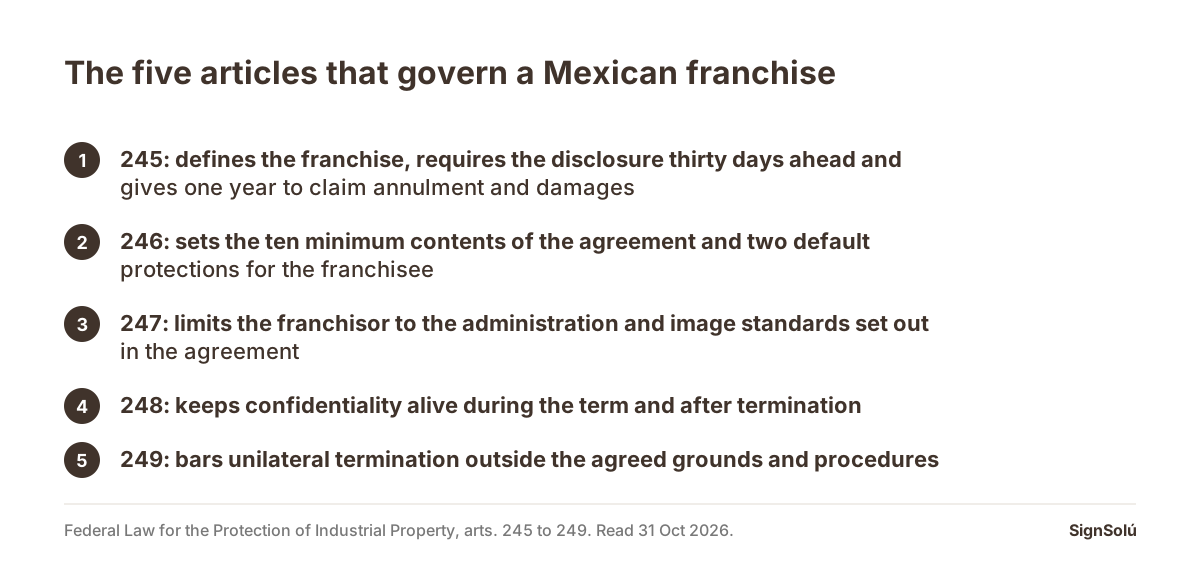
The closing paragraphs of article 246 say there is no obligation on the franchisee to sell its assets to the franchisor or to anyone the franchisor designates at the end of the agreement, and no obligation at any time to transfer shares in its company to the franchisor or make it a shareholder — in both cases unless otherwise agreed. Because they are waivable by agreement, the thing to check is whether the draft waived them in a buy-back clause.
Control, confidentiality and the way out
Article 247 limits the franchisor’s involvement with one word: it may have involvement in the franchisee’s organisation and operation only to ensure compliance with the franchise’s administration and image standards as set out in the agreement. Its second paragraph adds that intervening in a merger, spin-off, conversion, amendment of bylaws or transfer of shares that changes the franchisee’s personal characteristics is not treated as involvement, where those characteristics were set out in the agreement as determinative of the franchisor’s willingness to contract with that franchisee.
Article 248 keeps confidentiality alive after the agreement ends, over information of that character or that the franchisee learned and that belongs to the franchisor, as well as over the transactions carried out under the agreement.
And article 249 is the one most often discovered late: neither party may terminate or rescind the agreement unilaterally unless it was entered into for an indefinite term or there is just cause, and early termination — whether by mutual agreement or by rescission — must follow the grounds and procedures agreed in the agreement itself. Breaching that triggers the agreed liquidated damages or, failing those, compensation for damages. That is why sections IX and X are not boilerplate.
Recording the franchise, and what you need not file
The last paragraph of article 245 applies the trademark-licence rules and the time limits of article 240, which gives the Institute a maximum of two months to decide. Article 21 of the Regulations is useful here: the copy of the agreement filed — original or certified copy, bearing the parties’ signatures — may omit the provisions on royalties and other consideration, those covering confidential information on means of distribution and marketing, and the technical annexes. Either party may file it. One caution: the law says how a franchise is recorded, not that an unrecorded agreement is invalid.
There is also an operating requirement almost nobody complies with. Article 123 of the Regulations says that products sold, or the premises where services are rendered, under licence or franchise must state the name and address of the registered trademark owner, the name and address of the franchisee, and that use is made under licence of the registered trademark.
The other documents around a Mexican unit
A franchise is never one piece of paper. The premises are a separate lease governed by the civil code of the state where the property sits, not by federal law; the general template is at contrato de arrendamiento and the state-by-state commercial variants in the catalogue. An independent operator engaged on a services basis is a different figure, covered in independent contractor in Mexico. The staff belong to the franchisee, and what Mexican law requires in an employment contract is set out in hiring employees in Mexico. If a Mexican entity will do the work for a foreign principal instead, the figure is different and is covered in maquila contract in Mexico, and the first papers of a nearshoring project in nearshoring in Mexico.
Signing it when the parties are in two countries
Both documents — the acknowledgement of the disclosure and the agreement itself — can be captured once and sent out as a link by email or WhatsApp. Each signer signs from the phone or computer they already have, without creating an account, installing anything or paying. The sender picks the language for each signer, so whoever signs in English gets the email, the WhatsApp message and the signing page in English while the Mexican side keeps working in Spanish; the audit certificate comes out bilingual, with the Spanish version governing and English as a courtesy.
Everyone keeps the PDF and its audit receipt — time, IP address, device and the file’s SHA-256 hash — which anyone can check at /verificar without an account. In a franchise that has a very concrete use: the two dates everything hangs on, the disclosure and the signature, are provable. In commercial matters article 93 of Mexico’s Commercial Code treats the written-form requirement as met by a data message that stays complete and accessible, and the signature requirement as met where the message is attributable to the parties. More on validity in is an electronic signature valid in Mexico? and on signing across a border in how to sign a contract remotely with someone in Mexico. Ten documents are free, no card: create an account.
Frequently asked questions
Are the thirty days business days or calendar days?
Article 245 says "at least thirty days prior to entering into the respective agreement". It does not say business days. Since it is a minimum and what matters is being able to prove it, the practical approach is to count calendar days and leave margin: handing the disclosure over five or six weeks ahead removes any argument about the count.
Do I really have to disclose how many units have closed?
Yes. Section XIV of article 124 of the Regulations requires "the number of units opened, relocated, transferred and closed", and section XII the general amounts payable and investment payback periods. Those are the two items the law put there deliberately. Omitting or dressing them up opens the door in the third paragraph of article 245: annulment of the agreement plus damages, for one year from signature.
Must the franchise be recorded with the Mexican trademark office to be valid?
The law says how it is recorded and within what time limits, not that an unrecorded agreement is void. The last paragraph of article 245 applies the licence rules and the two-month decision period of article 240. Article 21 of the Regulations also lets the filed copy omit royalties and other consideration, confidential information on distribution and marketing, and the technical annexes. Either party may file it.
Can the franchisor require me to sell the premises back at the end?
Only if the agreement says so. The closing paragraphs of article 246 state there is no obligation on the franchisee to sell its assets to the franchisor or its designee at the end of the agreement, nor to transfer shares in its company or make the franchisor a shareholder, in both cases unless otherwise agreed. Mexican law protects by default here, so the thing to look for in a draft is a buy-back clause that waives it.
Can either side walk away early?
Not unilaterally. Article 249 prevents either party from terminating or rescinding the agreement unilaterally unless it was entered into for an indefinite term or there is just cause, and requires early termination to follow the grounds and procedures agreed in the agreement. Breaching that triggers the agreed liquidated damages or, failing those, compensation for damages. An agreement with a two-line termination section is an agreement nobody can leave cleanly.
Does the agreement have to be in Spanish?
Not to be valid, but it will have to be produced in Spanish before a Mexican court, translated if it was signed in another language. The practical approach is to decide deliberately: Spanish, English, or two columns with a clause saying which version prevails. Which language governs a bilingual Mexican contract is covered in bilingual contracts in Mexico, and whether a Mexican e-signature holds up abroad in is a Mexican e-signature valid in the US.
Send your next contract to Mexico for signature
Create a free account and send 10 documents with no card. Your dashboard works in English. You set the language per signer, and their email, WhatsApp message and signing page arrive in that language.