Car bill of sale “as is”: what the clause covers and what it never will
It switches off implied warranties, and that is all it does. Under the Uniform Commercial Code as adopted by the states — Florida’s version is section 672.316 — expressions like “as is” or “with all faults” exclude all implied warranties, and they do so without having to use the word merchantability, which the longer form of disclaimer does have to use and does have to make conspicuous. What “as is” never reaches is a false statement: federal law requires a written odometer disclosure on transfer and forbids giving the buyer a false one, and no clause in your document changes that. “As is” protects a seller who says nothing; it does not protect a seller who says something untrue.
Search for a car bill of sale and every template hands you the same two words in capitals. Almost none of them explain what those words do, which is specific and limited, or what they cannot do, which is where private sellers actually get into trouble. This is both halves, with the statutory text read today.
What the two words switch off
Sales of goods between private parties sit under each state’s version of the Uniform Commercial Code. By default a sale carries implied warranties — broadly, that the goods are fit to be sold and, in some circumstances, fit for a purpose the buyer made known. The provision that lets a seller turn those off is UCC 2-316; Florida’s enactment is section 672.316 of the Florida Statutes, and the structure is the same across states even where the numbering is not.
Subsection (3)(a) is the one the templates are using: "unless the circumstances indicate otherwise, all implied warranties are excluded by expressions like ‘as is’ or ‘with all faults’ or other language which in common understanding calls the buyer’s attention to the exclusion of warranties and makes plain that there is no implied warranty."
Why the long disclaimer has stricter rules than the short one
Here is the part that surprises people. Subsection (2) — the route you take if you write a paragraph instead of using the phrase — is fussier: to exclude the implied warranty of merchantability "the language must mention merchantability and in case of a writing must be conspicuous", and to exclude fitness the exclusion "must be by a writing and conspicuous". Subsection (3) then begins "notwithstanding subsection (2)", which is what lets the two short words do the job without the magic term.
So a carefully written paragraph that never says "merchantability" and sits in small grey type can fail where the blunt phrase succeeds. If you are going to write the long version, it has to name the warranty and it has to stand out on the page.
The clause most templates leave out
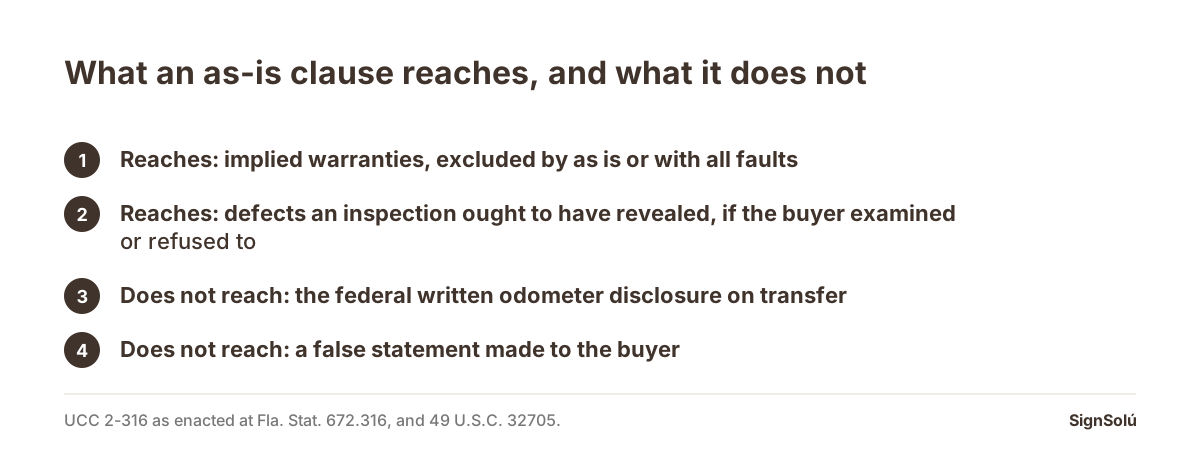
Subsection (3)(b) is quietly the most useful line in the section for a private seller, and it almost never appears in a template: when the buyer "has examined the goods or the sample or model as fully as he or she desired or has refused to examine the goods, there is no implied warranty with regard to defects which an examination ought in the circumstances to have revealed".
Translated into a driveway: if the buyer inspected the car, or was invited to and chose not to, obvious defects are off the table. That is worth recording in the document itself — that the vehicle was offered for inspection on a given date and that the buyer inspected it or declined to — because the point of the paperwork is to make the facts easy to establish later.
What “as is” never covers
The odometer disclosure is federal and separate
Under 49 U.S.C. 32705, a person transferring ownership of a motor vehicle must give the transferee a written disclosure of the cumulative mileage on the odometer and, where the transferor knows the reading differs from the miles actually travelled, a disclosure that the actual mileage is unknown. The same subsection says a transferor "may not violate a regulation prescribed under this section or give a false statement to the transferee" in making it, and that someone acquiring a vehicle for resale may not accept a disclosure that is incomplete.
None of that is a warranty, so none of it is excluded by an as-is clause. It is a disclosure duty that exists alongside the sale terms. The practical version: fill the mileage line in properly, and if the odometer is broken or has been replaced, say so in the words the statute uses rather than leaving the line blank.
A false statement is not a warranty claim
The second limit follows from the first. Implied warranties are promises the law adds for you, so the law lets you take them away. A statement you actually made — that the transmission was rebuilt, that it was never in an accident — is not something the law added, and an as-is clause does not retract it. This is the same boundary that runs through every disclaimer, and it is set out generally in signed waiver meaning: what a waiver can never cover.
| Situation | Does the as-is clause help? | Why |
|---|---|---|
| Engine fails a month later, nothing was said about it | Yes | Implied warranties are excluded under 2-316(3)(a) |
| Obvious body damage the buyer saw before paying | Yes, and more so | 2-316(3)(b) covers defects an inspection should have revealed |
| You wrote the wrong mileage on the form | No | The odometer disclosure is a federal duty, not a warranty |
| You told the buyer it had never been in an accident | No | A statement made is not an implied warranty to disclaim |
| You are a dealer rather than a private seller | Not on its own | Consumer rules add duties that vary by state |
What to put on the page
- 1The phrase itself, in plain sight rather than buried: sold as is, with all faults, with no implied warranties.
- 2The mileage line, filled in, with the "actual mileage unknown" wording if that is the truth.
- 3A line recording that the vehicle was offered for inspection and whether the buyer inspected it or declined.
- 4The vehicle identification number, the price and the date of transfer, so the document identifies one specific car on one specific day.
- 5Both signatures with a date you can prove, since the transfer date drives the title and registration steps that follow.
A template with those fields already laid out is at /en/templates/bill-of-sale-for-car, the motorcycle version at /en/templates/motorcycle-bill-of-sale and the equipment version at /en/templates/equipment-bill-of-sale. If the sale is on the Mexican side of the border the document and the rules are different, and that is covered in selling a used car in Mexico and buying a car in Mexico as a foreigner. Whether a document signed in Mexico is recognised north of the border is in is a Mexican e-signature valid in the US.
If you are the buyer
Everything above reads as seller-side, so it is worth turning around. An as-is sale is not a reason to walk away; it is a reason to do the work before you pay, because afterwards the implied warranties are gone and 2-316(3)(b) means the things you could have seen are gone too.
- Inspect, or have someone inspect. Declining the inspection is specifically covered by the statute, and not in your favour.
- Get the claims in writing. A statement in the document is a statement the as-is clause does not retract. A statement in a text message is a harder argument.
- Check the mileage line is complete. An incomplete or odd disclosure is a signal, and federal law takes it seriously enough to forbid a false one.
- Keep a copy you can prove. Both sides need the same document with the same date, not two photographs of a piece of paper.
Why the date on a private sale is worth getting right
A private car sale generates one document and then disappears, until a parking ticket, a toll or an accident arrives with your name on it and the question becomes exactly when the car stopped being yours. That is a question about a date, and a signed PDF in an inbox answers it poorly.
Signed through SignSolú, both parties sign from their phones without opening an account or paying anything, and the document comes back with an audit certificate carrying the time, IP address, device and the SHA-256 hash of the file, plus an international timestamp following the RFC 3161 standard. Anyone can check it at the verification page without an account, which is the useful part when the person asking is an insurer or a motor vehicle agency. You can create a free account and send the bill of sale before the buyer drives off.
Frequently asked questions
Does “as is” really remove all warranties?
It removes implied warranties. UCC 2-316(3)(a), as enacted in Florida at section 672.316, says that unless the circumstances indicate otherwise, all implied warranties are excluded by expressions like ‘as is’ or ‘with all faults’. It does not remove promises you actually made to the buyer.
Do I have to use the word “merchantability”?
Only if you take the long route. Subsection (2) requires that language excluding the implied warranty of merchantability mention merchantability and, in a writing, be conspicuous. Subsection (3) begins “notwithstanding subsection (2)”, which is what allows the short phrase to work without that word.
Does an as-is clause cover the odometer reading?
No. Under 49 U.S.C. 32705 the transferor must give the buyer a written disclosure of cumulative mileage, and must disclose that actual mileage is unknown where the reading is known to differ. That is a disclosure duty rather than a warranty, so a disclaimer in your document does not reach it.
What if the buyer inspected the car first?
That helps the seller. Under 2-316(3)(b), where the buyer has examined the goods as fully as desired or has refused to examine them, there is no implied warranty as to defects an examination ought to have revealed. It is worth recording the inspection, or the refusal, in the document itself.
Can a private seller be liable even with “as is” in the document?
Yes, in two main ways: an untrue statement about the vehicle, which the clause does not retract, and a defective or false odometer disclosure, which is governed by federal law. The clause protects a seller who said nothing, not one who said something untrue.
Send your next contract to Mexico for signature
Create a free account and send 10 documents with no card. Your dashboard works in English. You set the language per signer, and their email, WhatsApp message and signing page arrive in that language.