E-signature API pricing: per call, per document or included in the plan
There are three models and they are not variations of each other. Per call bills every request your code makes, so the cost depends on how you wrote the integration, not on how much business you did. Per document bills each document you send for signature, whatever the number of API calls behind it. Included means the API carries no separate price and your documents are counted the same whether they come from the dashboard or from your code. The model matters most in one specific place: under per-call billing, a system that asks "is it signed yet?" every five minutes can spend a hundred times more than one that waits for a signed webhook.
If you are about to connect your own product to an e-signature service, the price question arrives before the first line of code, and the published answers are hard to compare because they are counting different things. This is what the three models actually bill, how to work out your own number, and the one design decision that changes the bill more than any discount. No competitor rates are quoted here: rate cards move, and the part that does not move is how each model counts.
The three models, and what each one really charges for
| Model | What gets counted | What makes the bill move |
|---|---|---|
| Per API call | Every request your code makes | How your integration is written, not how much you sold |
| Per document | Each document sent for signature | Your actual volume of signed business |
| Included in the plan | Nothing extra: the plan counts documents | Your document volume, wherever the document came from |
| Per signer | Each person who signs a document | How many people are on each contract |
The fourth row is the one that catches people out, and it is not specific to APIs. Whether a document with four signatories counts as one or as four decides more bills than the headline rate does. That question, for the platform rather than the API, is worked through in are e-signature tools billed per user or per document.
Why per-call billing charges you for your own code
This is the part worth understanding before you sign anything, because it is the only model where two companies doing identical business get very different bills.
A document that goes out for signature and comes back costs a few requests that are unavoidable: create it, send it, download the signed file and its audit certificate. Three or four calls. Then there is the step in the middle — finding out that somebody signed — and that step can cost nothing or it can cost hundreds.
Polling versus webhooks, in numbers
Say a document takes two days to be signed, which is ordinary when a human being is on the other end. If your system asks for the status every five minutes for those two days, that is 576 requests for one document, and 575 of them return the same answer. Ask once an hour and it is 48. Receive a signed webhook when the status changes and it is zero, because the request is not yours to make.
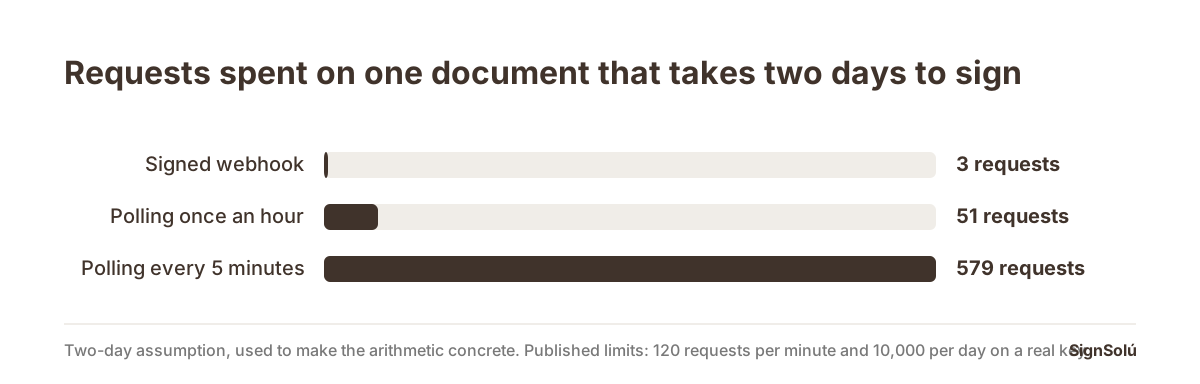
Under per-call billing those three bars are three different prices for the same work. Under per-document or included billing they are the same price, and polling only costs you rate limit rather than money. That is the whole argument, and it is why "what does a call cost" is a less useful question than "what does my integration do while it waits".
How to work out your own number
You can do this on paper before you talk to anyone, and it takes about ten minutes.
- 1Count the documents you expect to send per month. Not the optimistic number: the one you can defend.
- 2Count the signatories on a typical document, and ask the provider whether that document is billed once or once per signatory.
- 3Sketch the calls your integration will make per document, including every status check while it waits.
- 4Multiply by the model on the table: calls for per-call, documents for per-document, nothing extra for included.
- 5Ask what the sandbox costs, and whether sandbox documents count against anything.
- 6Ask for the rate limits and the service level in writing, in the contract rather than on a help page.
Step five matters more than it looks. A sandbox you have to pay for, or one that is metered, means you cannot rehearse your real volume before committing, and the surprises then arrive in production. Step six matters because a published limit can be changed without telling you and a contractual one cannot.
Three costs that are not on anybody price page
The documents you send twice
A request that times out before you get the answer gets retried, and if the provider has no way to recognise the repeat you have just created and paid for a second document. Ask how a repeated request is identified. With SignSolú a retry carrying the same idempotency key, or the same reference you assigned, never creates a new document.
The documents that never get signed
Under per-document billing you are usually charged when a document is sent, not when it comes back signed. If a third of what you send is never completed, your real cost per signed contract is half as good as the rate card suggests. That is an argument for getting the reminder flow right rather than for negotiating the rate, and it is covered in how to sign a contract remotely with someone in Mexico.
Getting your documents back out
The cheapest API is expensive if your signed documents can only be verified inside the tool that made them. Ask two separate questions: can you export the signed files with their certificates, and can a third party check one without an account. The second is the one that keeps the price honest later on.
How SignSolú counts it
SignSolú uses the third model. The API has no separate price: it comes with the paid plan, and each document created through the API counts exactly like one created in the dashboard. A document counts once however many people sign it. The plan includes 200 documents a month; above that there is a tailored plan and a shared document pack for the team, and you write in with your volume and your locations. The figures are on the pricing page and the product view on the e-signature API page.
Test keys are free on any account, including the free one. Test documents behave exactly like real ones, carry a watermark, never email anybody, do not count against your plan and delete themselves after 30 days. A test key only ever sees test documents, so the two worlds cannot mix. The published rate limits are 120 requests per minute and 10,000 per day on a real key, and 30 per minute in test mode; going over returns a 429 with Retry-After, and retrying with the same idempotency key never creates a second document. The reference is in the developer guide.
What comes back with every document is the same whether your code created it or a person did: an audit certificate with the time, IP address, device and the SHA-256 hash of the file, plus an international timestamp following the RFC 3161 standard on the signed document. Anyone can check a signed document at the verification page without an account, which is also what makes the documents portable if you ever move. What an electronic signature has to carry on the Mexican side comes from the Commercial Code, and is set out in is an electronic signature legally binding, and where.
Where SignSolú is the right call
If you are building a product whose documents get signed by people in Mexico, this is the combination that fits: the API is included rather than metered, so your integration design does not change your invoice; the signer needs no account and no card; the signing link goes out over WhatsApp as well as email, which is where Mexican counterparties actually read; and every signed document can be verified by anyone, including a counterparty or a court, without going through SignSolú at all. If several people have to sign on one device at a counter, that is covered too: in-person signing. Whether an e-signature holds up on that side of the border is covered in is an electronic signature valid in Mexico, and the practical side of getting a document signed remotely in how to sign a contract remotely with someone in Mexico.
You can test the whole thing with your own volume before paying anything: create a free account, make a test key and run your real worst case through it. If what you are choosing is the platform rather than the integration, the shortlist for companies working with Mexico is in e-signature platforms for doing business in Mexico, and whether a document signed in Mexico travels north in is a Mexican e-signature valid in the US.
Frequently asked questions
Is there a free e-signature API?
Free test access is common; free production sending is not. With SignSolú any account, including the free one, creates test keys at no cost: test documents work exactly like real ones but carry a watermark, email nobody and delete themselves after 30 days. Sending real documents through the API needs a paid plan, which includes the API at no separate price.
Does an API call cost the same as sending a document?
That depends entirely on the model. Under per-call billing every request counts, including the ones that only ask whether a document has been signed. Under per-document or included billing only the document counts, so the number of calls behind it changes nothing on the invoice.
Why does polling make an API integration expensive?
Because a document waiting to be signed can wait for days, and a system checking every five minutes spends around 576 requests on a single document instead of the three or four the work actually needs. A signed webhook removes that cost entirely, since the request is made by the provider rather than by you.
Does a document with four signatories cost four times as much?
With some providers, yes, and it is worth asking in those exact words. With SignSolú a document counts once however many people sign it, whether it was created in the dashboard or through the API.
What should I get in writing rather than from a help page?
The rate limits per minute and per day, the service level, how a document is counted, and how you export your signed documents and their certificates. A help page can change without notice; a contract cannot.
Send your next contract to Mexico for signature
Create a free account and send 10 documents with no card. Your dashboard works in English. You set the language per signer, and their email, WhatsApp message and signing page arrive in that language.