Domestic workers in Mexico: the written contract the law requires
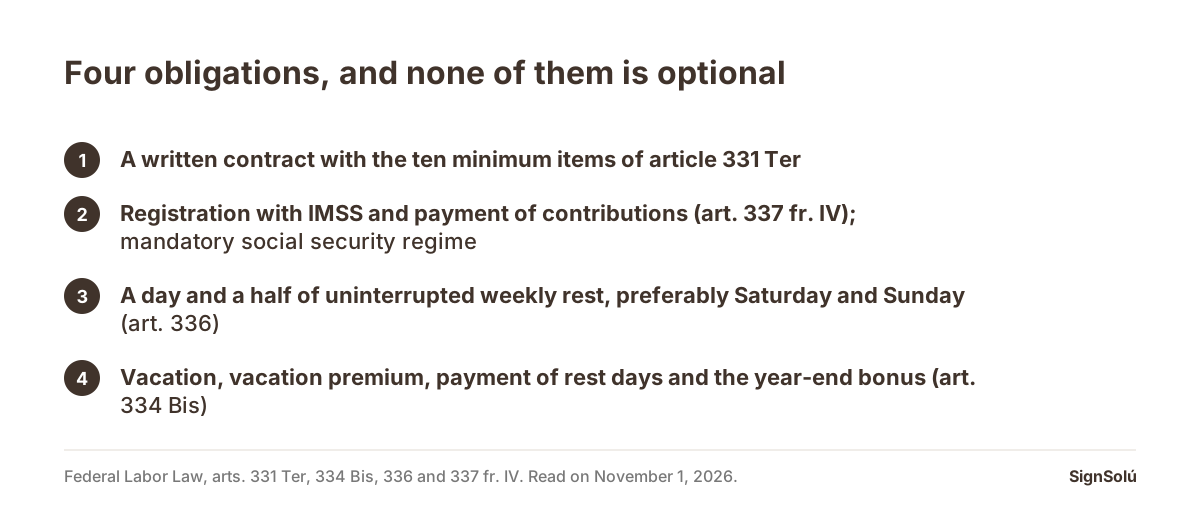
A written contract with ten specific items, and it is not optional. Article 331 Ter of Mexico’s Federal Labor Law, added in July 2019, requires domestic work to be set out in a written contract stating at minimum the names of both parties, the usual place of work, the start date and duration, the type of work, the pay with its method of calculation and frequency, the working hours, the paid annual vacation and daily and weekly rest periods, the provision of food and lodging where applicable, the terms for ending the relationship, and the work tools that will be provided. Three more obligations sit alongside it: registering the worker with IMSS and paying the contributions (article 337 fraction IV), a day and a half of uninterrupted weekly rest (article 336), and a ban on asking for a non-pregnancy certificate (article 331 Ter).
If you have moved to Mexico and hired someone to clean, cook or look after children, you have an employment relationship under Mexican federal law — not an informal arrangement. That has been unambiguous since July 2019, when a reform rewrote this chapter of the Federal Labor Law and brought domestic work into the mandatory social security regime. Whether a signed contract holds up in Mexico at all is answered in is an electronic signature valid in Mexico?.
The practical effect for a foreign employer is that most of what you might assume is negotiable is not. Here is what the law actually says, read today.
Who counts as a domestic worker
Article 331 of the Federal Labor Law defines a domestic worker as a person who, for pay, performs care, cleaning, assistance «o cualquier otra actividad inherente al hogar» in an employment relationship that does not bring the employer direct economic benefit. That last clause is the dividing line: someone cleaning your home is a domestic worker, someone cleaning your office is not.
The same article sets out three modes, and the difference matters for rest and lodging: a worker who works for one employer and lives at the home; one who works for one employer and does not live there; and one who works for different employers and does not live at any of their homes. Article 332 excludes from the chapter anyone who does domestic work «únicamente de forma ocasional o esporádica» — occasionally or sporadically. A once-a-month deep clean is not this; two days a week is. Whether the person is your employee at all, rather than genuinely independent, is the first question to settle: it is worked through in independent contractor in Mexico: the services contract.
The ten items the contract must contain
Article 331 Ter requires the work to be fixed by written contract, in accordance with national law or collective agreements, including at minimum:
- 1The first and last names of the employer and of the domestic worker.
- 2The address of the usual place of work.
- 3The start date and, where the contract is for a specific period, its duration.
- 4The type of work to be performed.
- 5The pay, the method of calculating it, and how often it is paid.
- 6The working hours.
- 7The paid annual vacation and the daily and weekly rest periods.
- 8The provision of food and lodging, where applicable.
- 9The terms relating to ending the employment relationship.
- 10The work tools that will be provided for performing the job properly.
The same article adds four rules that are easy to miss because they are not in the list. Food provided to a domestic worker must be hygienic and nutritious, of the same quality and quantity as that intended for the employer’s own consumption. It is forbidden to request a certificate or proof of non-pregnancy for hiring, and a pregnant worker cannot be dismissed — if she is, the dismissal is presumed to be discrimination. If you require a uniform or work clothing, the cost is yours. And the contract applies without distinction of conditions to migrant domestic workers.
Social security: the change that made 2019 different
Article 337 fraction IV sets out, among the employer’s special obligations, to «inscribir a la parte trabajadora al Instituto Mexicano del Seguro Social y pagar las cuotas correspondientes» — to register the worker with IMSS and pay the corresponding contributions. And article 334 Bis states that domestic workers have the following benefits under this law and are included in the mandatory social security regime: vacation; vacation premium; payment of rest days; mandatory access to social security; the year-end bonus (aguinaldo); and any other benefit the parties may agree.
The other three fractions of article 337 are older and still binding: to treat the worker with consideration, refraining from any mistreatment in word or deed; to provide comfortable and hygienic lodging, healthy and sufficient food and working conditions that safeguard life and health; and to cooperate with the worker’s general instruction in accordance with the rules issued by the competent authorities.
Hours, rest and the part most employers get wrong
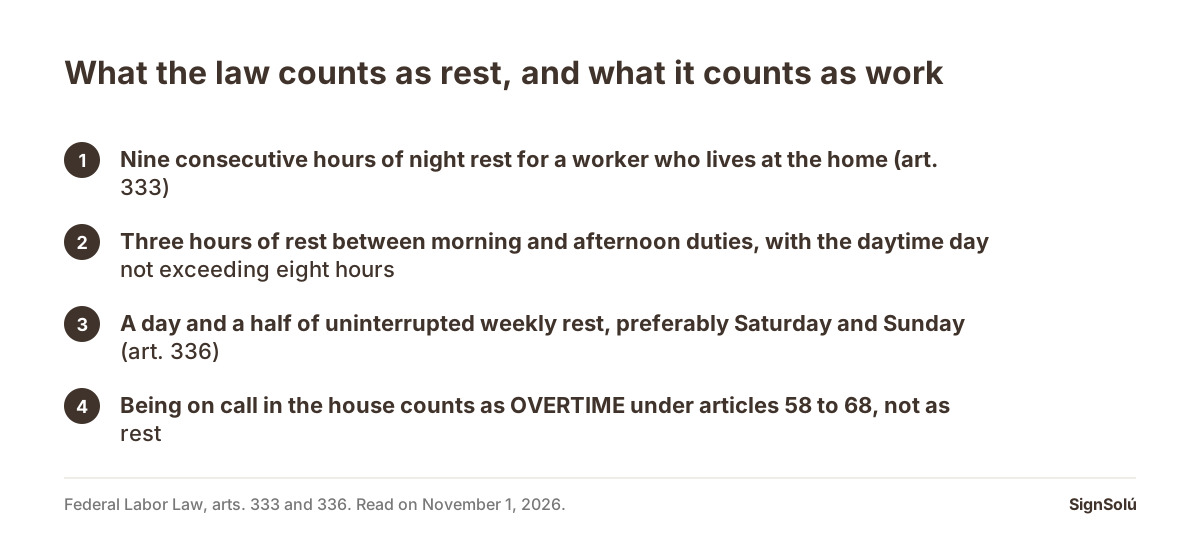
Article 336 gives domestic workers the right to a day and a half of uninterrupted weekly rest, preferably Saturday and Sunday. By agreement the half days can be accumulated over two-week periods, but a full day of rest must still be taken each week. Domestic workers are also entitled to the statutory public holidays of article 74, and if those days are worked, the ordinary rules apply.
For a live-in worker, article 333 adds two minimums that are frequently breached without anyone noticing: a minimum nightly rest of nine consecutive hours, and a minimum daily rest of three hours between morning and afternoon duties, with the daytime working day not exceeding the eight hours this law establishes.
And the sentence that catches out employers who think of the arrangement as «she lives here, so she is around»: the periods during which the worker does not freely dispose of her time and remains at the household’s disposal to respond to possible work requirements, or that exceed the hours the law sets for each type of working day, must be treated as overtime under articles 58 to 68 of the law. Being on call in the house is working time.
Ending the relationship: eight days either way
Article 342 lets the worker end the relationship at any time, giving the employer eight days’ notice. Article 343 lets the employer end it within the thirty days following the start of the work, and at any time thereafter, giving the worker eight days’ notice and paying the corresponding compensation under articles 49 fraction IV and 50.
Article 341 makes failure to comply with the obligations in the law a cause for rescission, and states that dismissals on grounds of gender-based violence at work or discrimination are treated as unjustified dismissal, with the compensation of article 50. Read together with the ban on dismissing a pregnant worker in 331 Ter, this is the part of the chapter with the sharpest consequences. If the household is a rental and the arrangement is part of moving in, what you sign for the home is in renting in Mexico City as an American: the lease.
| Item | What the law requires | Article |
|---|---|---|
| Written contract | Ten minimum items, including tools and termination terms | 331 Ter |
| Social security | Register with IMSS and pay contributions; mandatory regime | 337 fr. IV and 334 Bis |
| Weekly rest | A day and a half uninterrupted, preferably Saturday and Sunday | 336 |
| Live-in rest | Nine consecutive night hours and three hours between duties | 333 |
| On-call time | Treated as overtime under articles 58 to 68 | 333 |
| Food and lodging | Guaranteed; valued at 50% of the cash salary | 334 |
| Benefits | Vacation, vacation premium, rest days, aguinaldo | 334 Bis |
| Notice to end | Eight days, from either side | 342 and 343 |
| Minors | Under fifteen prohibited; 15 to 18 with limits and a medical certificate twice a year | 331 Bis |
If the worker is between fifteen and eighteen
Article 331 Bis forbids hiring adolescents under fifteen for domestic work outright. For those over fifteen, the employer must request a medical certificate issued by a public health institution at least twice a year; set working days that under no circumstance exceed six hours a day and thirty-six hours a week; and avoid hiring adolescents over fifteen who have not completed at least secondary education, unless the employer takes responsibility for them finishing it. If the adolescent lives at the home and works for a single employer, the place where she sleeps must be safe. Everything in that article is subject to supervision by the competent labor authority. If the contract will be drawn up in two languages, which one governs is settled in bilingual contracts in Mexico: which language prevails.
Article 337 Bis adds that migrant domestic workers are governed, in addition to this chapter, by articles 28 and 28 A of the law, by the international treaties Mexico is party to, and by other applicable provisions.
How to get the contract signed
The written contract is the first obligation and the easiest to satisfy, and in practice the thing that keeps it from happening is logistics rather than reluctance: nobody wants to print two copies and chase signatures. You fill in the details once and the link goes out over WhatsApp or by email; the worker signs from her own phone, with no account to create and nothing to pay. That matters here, because requiring someone to install software or open an account is exactly the friction that leaves households without a contract.
The sender picks the language for each signer: if you work in English and she signs in Spanish, each of you gets the email, the WhatsApp message and the signing page in your own language, from the same document. The audit certificate is bilingual, with Spanish governing and English as a courtesy. Both sides keep the PDF and its audit receipt — time, IP, device and the SHA-256 hash of the file — and anyone can check it at /verificar with no account.
Mexican templates live at /plantillas; the bilingual employment contract is at contrato individual de trabajo en español e inglés (in Spanish). The walkthrough is at how it works and it is ten documents free with no card at your account. One limitation, as a fact: SignSolú is not an accredited certification service provider and does not issue NOM-151 certificates; what that certificate is and when it matters is in NOM-151 in Mexico.
What the contract does not cover is the IMSS registration, and that is a separate administrative step with the institute. The broader picture of hiring in Mexico is in hiring employees in Mexico: the employment contract; if the person is genuinely independent rather than your employee, the distinction and its risks are in independent contractor in Mexico: the services contract; and the rest of what a foreign resident signs is in retire in Mexico: the documents you sign.
Frequently asked questions
Do I really need a written contract for a housekeeper in Mexico?
Yes. Article 331 Ter of the Federal Labor Law, added by the reform published on July 2, 2019, requires domestic work to be fixed by written contract and lists ten minimum items: the names of both parties, the usual place of work, the start date and duration, the type of work, the pay with its method of calculation and frequency, the working hours, the paid vacation and rest periods, food and lodging where applicable, the terms for ending the relationship, and the work tools provided.
Do I have to register her with social security?
Yes, and this is the change that made 2019 different. Article 337 fraction IV lists among the employer’s special obligations registering the worker with the Mexican Social Security Institute and paying the corresponding contributions, and article 334 Bis states that domestic workers are included in the mandatory social security regime, along with vacation, vacation premium, payment of rest days and the year-end bonus. It is an administrative step with IMSS, separate from the contract.
She lives with us. Is she working when she is just at home?
If she is at the household’s disposal, yes. Article 333 says that periods during which the worker does not freely dispose of her time and remains available to respond to possible work requirements, or that exceed the hours the law sets for the working day, must be treated as overtime under articles 58 to 68. The same article requires a minimum of nine consecutive hours of night rest and three hours of rest between morning and afternoon duties, with the daytime day not exceeding eight hours.
How much weekly rest is she entitled to?
A day and a half, uninterrupted, preferably Saturday and Sunday, under article 336. The half days may be accumulated over two-week periods by agreement, but a full day of rest must still be taken each week. Domestic workers are also entitled to the statutory public holidays listed in article 74 of the law, and if those days are worked, the ordinary rules on working them apply.
Can I count food and lodging as part of her pay?
Partly, and within a rule. Article 334 requires employers in all cases to guarantee food, and lodging too when the worker lives at the home. Unless expressly agreed otherwise, her pay includes food and lodging in addition to the cash payment, and for the purposes of this law those are valued at 50% of the salary paid in cash. The food must be hygienic and nutritious and of the same quality and quantity as that intended for the employer’s own consumption, under article 331 Ter.
What notice do we have to give to end the arrangement?
Eight days, from either side. Article 342 lets the worker end the relationship at any time with eight days’ notice to the employer. Article 343 lets the employer end it within the thirty days following the start of the work, and at any time after that, with eight days’ notice and the compensation under articles 49 fraction IV and 50. Article 341 treats dismissals on grounds of gender-based violence at work or discrimination as unjustified, and article 331 Ter bars dismissing a pregnant worker.
Send your next contract to Mexico for signature
Create a free account and send 10 documents with no card. Your dashboard works in English. You set the language per signer, and their email, WhatsApp message and signing page arrive in that language.