Washington power of attorney: the two witnesses most forms get wrong
Washington gives you a choice the statute spells out: a power of attorney must be signed and dated by the principal, and the signature must be either acknowledged before a notary public or other individual authorised to take acknowledgments, or attested by two or more competent witnesses. The catch is who those witnesses can be. RCW 11.125.050(1) rules out home care providers, care providers at an adult family home or long-term care facility where the principal resides, and anyone related to the principal or the agent by blood, marriage or state registered domestic partnership. The adult children and the spouse sitting in the room are the people the statute excludes.
Most states give you one way to execute a power of attorney, and it ends at a notary. Washington gives you two, and the second one looks like a shortcut until you read who is allowed to stand in it. This is the part generic forms leave out, and it is the part that gets a document rejected months later, when the principal can no longer sign a replacement.
What the statute requires
RCW 11.125.050 opens with the base requirement: a power of attorney must be signed and dated by the principal. Then it offers the alternative. The signature must be either "acknowledged before a notary public or other individual authorized by law to take acknowledgments", or "attested by two or more competent witnesses" who subscribe their names to the power of attorney "while in the presence of the principal and at the principal’s direction or request".
Two things in that second branch are easy to skim past. The witnesses sign in the presence of the principal, and they do it at the principal’s direction or request — a witness who signs later, in another room, after being asked by the agent, has not done what the statute describes. And the word is "attested", not "witnessed loosely": their signatures are the evidence that the principal signed.
Who cannot be one of the two
This is the list that decides whether the witness route is actually available to you, and in most households the answer is no.
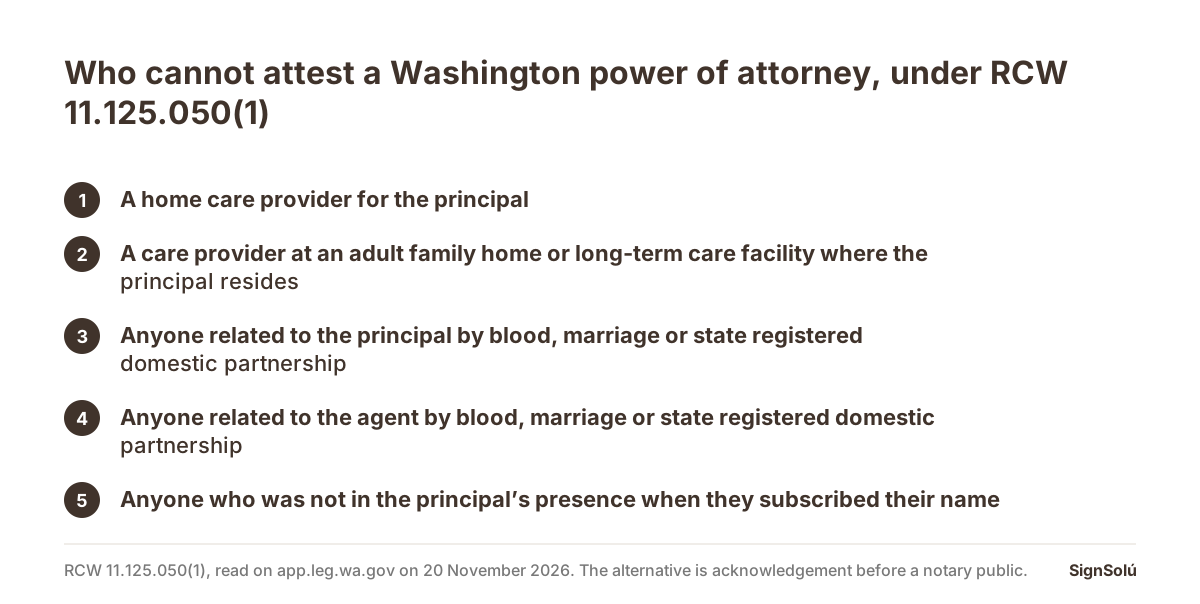
Read the relationship bar carefully, because it runs in two directions: the witness must be unrelated to the principal or agent by blood, marriage or state registered domestic partnership. Naming your daughter as agent and asking your son to witness fails on the agent side even though he is only related to her. In a family where the agent is a family member, which is the usual case, the pool of eligible witnesses is friends, neighbours and colleagues.
The care provider bar is aimed at a specific risk and is worth knowing if the signing happens where the principal lives: the statute disqualifies home care providers for the principal and care providers at an adult family home or long-term care facility in which the principal resides. The staff who are most available to witness a signing in a care setting are the staff the statute excludes.
Why the notary route is usually the simpler one
There is a second reason beyond the eligibility list. RCW 11.125.050(3) says a signature is presumed genuine if the principal acknowledges it before a notary public or another person authorised to take acknowledgments. The witness route satisfies the execution requirement but does not buy that presumption. If you expect the document to be handed to a bank, a title company or a hospital, the presumption is worth the notary appointment.
The default that catches downloaded forms: durability
Here is the second thing Washington does differently, and it is the one that quietly breaks generic forms. Under RCW 11.125.040, the authority terminates upon the incapacity of the principal unless the writing contains language showing the power is intended to continue — wording such as "this power of attorney shall not be affected by disability of the principal", or other words showing that intent.
That is the opposite of the presumption most people carry around. A power of attorney is usually set up precisely for the case where the principal cannot act, and in Washington a document that is silent on the point stops working at exactly that moment. A form downloaded from a national site, drafted against a durable-by-default rule, can be executed perfectly and still fail when it is needed.
| Step | What the statute says | Where |
|---|---|---|
| Principal signs | Signed and dated by the principal | RCW 11.125.050(1) |
| Then either notary | Acknowledged before a notary or other authorised individual | RCW 11.125.050(1) |
| Or two witnesses | Attested by two or more competent witnesses, in the principal’s presence, at their request | RCW 11.125.050(1) |
| Genuineness presumed | Only on acknowledgement before a notary or authorised individual | RCW 11.125.050(3) |
| Survives incapacity | Only if the writing contains language showing that intent | RCW 11.125.040 |
If the principal cannot sign at all
The statute covers that too. RCW 11.125.050(2) allows a principal who cannot sign to make a mark under RCW 11.12.030, and, if unable even to make a mark, to execute the document under RCW 64.08.100. Those are separate procedures with their own requirements, and they are the right route rather than having someone sign on the principal’s behalf informally.
The one place the statute mentions signing electronically
RCW 11.125.050(4) carves out a narrow case: a limited power of attorney used only to transfer a vehicle to an insurer after payment for damages does not require a notarised signature, may be signed electronically, and may be printed on paper. It is a single-purpose exception for insurance total-loss paperwork, not a general rule, and it is the only subsection of the section that speaks to electronic signing at all.
What that tells you is where the friction actually sits. The principal’s signature is one step; the acknowledgement or attestation is a separate step, and that is the step with the notary or the two eligible witnesses in it. Planning the signing around the second step, rather than the first, is what makes the appointment work. For what a power of attorney is called and is not in other systems, see carta de poder in English: what it is called and what it is not and POA full form: what it means at the office, the bank and a company.
The signing appointment, in order
- 1Decide the route first: notary, or two eligible witnesses. That decides who has to be in the room.
- 2If witnesses, pick two people unrelated to both the principal and the agent, and not care providers for the principal.
- 3Check the document contains durability language, or accept that the authority ends at incapacity under RCW 11.125.040.
- 4The principal signs and dates it. That step is theirs alone, under RCW 11.125.050(1).
- 5The notary takes the acknowledgement, or the two witnesses subscribe their names in the principal’s presence at their request.
- 6Keep the executed original, and give the agent a copy they can actually produce at a counter.
When the bank still says no
A correctly executed power of attorney being refused at a counter is a different problem from a defective one, and it has its own statutory answer in most states. The Texas version of that fight, and what the statute gives the holder, is set out in bank refuses a Texas power of attorney: what the statute gives you. The pattern transfers: find the acceptance provision, put the refusal in writing, and go back with both.
Other jurisdictions diverge more than people expect, which is why a form that worked for a relative elsewhere is a bad starting point. Scotland uses a different instrument entirely, covered in power of attorney in Scotland is a different document, and England and Wales use lasting powers with their own commencement rules, in lasting power of attorney health and welfare: when it starts and LP1F form to print: what replaced it.
Keeping proof of the signing
Whatever route the execution takes, the thing that gets questioned years later is when it happened and whether the file is the one that was signed. Documents signed through SignSolú come with an audit certificate: time, IP address, device and the SHA-256 hash of the file, and anyone can check it at /en/verify without an account. Each signed document also gets an RFC 3161 timestamp, so the moment of signature is fixed by something outside the parties.
Signed documents enter a chained log with a daily close anchored outside the platform, which means not even SignSolú can alter one or move its date backwards; there is no public page to browse that log, the point is the mechanism. Why a date on a document is worth being able to prove is set out in is backdating a lease legal: what a signing record shows, and what an electronic signature is and is not in is an electronic signature legally binding, and where.
The forms themselves are at washington power of attorney form and, for the neighbouring state version, virginia power of attorney form. If what you actually need is a one-off authority for a single errand rather than a standing power, sign documents online covers the simple case.
Frequently asked questions
Does a Washington power of attorney have to be notarised?
Not necessarily. RCW 11.125.050(1) requires the principal to sign and date it, and then either acknowledgement before a notary public or other individual authorised to take acknowledgments, or attestation by two or more competent witnesses who subscribe their names in the principal’s presence at their direction or request.
Can a family member witness a Washington power of attorney?
No. RCW 11.125.050(1) requires the witnesses to be unrelated to the principal or agent by blood, marriage or state registered domestic partnership. It also disqualifies home care providers for the principal and care providers at an adult family home or long-term care facility where the principal resides.
Is a Washington power of attorney durable by default?
No, and this is where downloaded forms fail. RCW 11.125.040 says the authority terminates upon the incapacity of the principal unless the writing contains language showing the power should continue, such as wording that the power of attorney shall not be affected by disability of the principal.
Why choose the notary over two witnesses?
Because of the presumption. RCW 11.125.050(3) says a signature is presumed genuine if the principal acknowledges it before a notary public or another person authorised to take acknowledgments. The witness route satisfies execution but does not carry that presumption, which matters when a bank or a title company is on the receiving end.
Can a Washington power of attorney be signed electronically?
The section addresses electronic signing in one narrow case: RCW 11.125.050(4) says a limited power of attorney used only to transfer a vehicle to an insurer after payment for damages does not require a notarised signature, may be signed electronically, and may be printed on paper. For other powers, the acknowledgement or attestation step in subsection (1) is the one to plan around.
What if the principal cannot sign their name?
RCW 11.125.050(2) allows a principal who cannot sign to make a mark under RCW 11.12.030 and, if unable to make a mark, to execute the document under RCW 64.08.100. Those are defined procedures, and they are the correct route rather than an informal signature by someone else.
Send your next contract to Mexico for signature
Create a free account and send 10 documents with no card. Your dashboard works in English. You set the language per signer, and their email, WhatsApp message and signing page arrive in that language.