Is backdating a lease legal? What a signing record shows
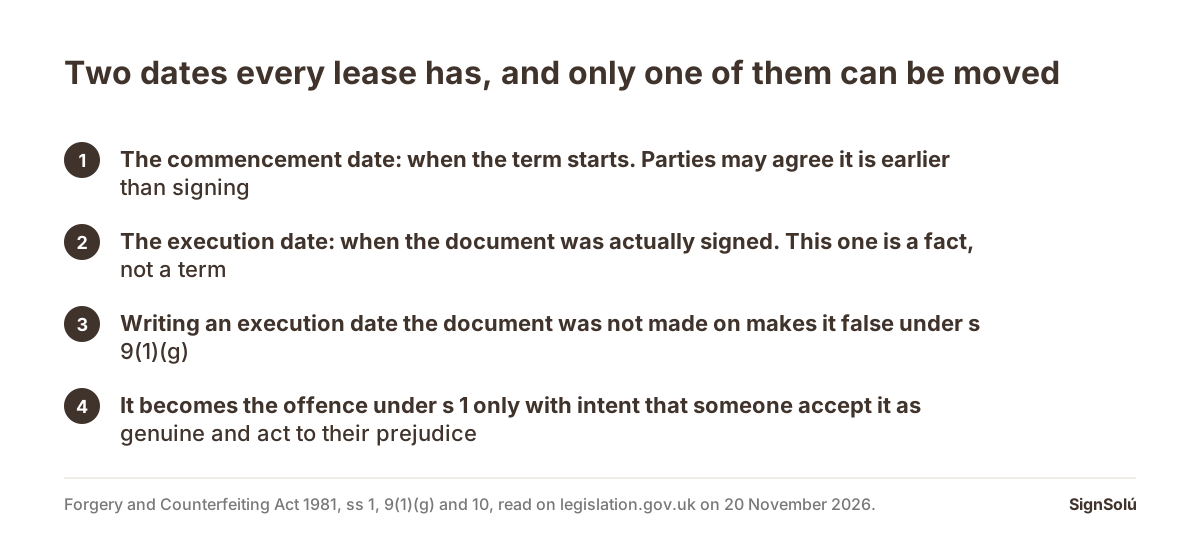
Two different things get called backdating, and only one of them is a problem. Agreeing that the term starts on 1 October when you sign on 14 October is ordinary drafting: the commencement date is a term of the deal. Writing 1 October in the signature block when the document was signed on 14 October is something else. Under section 9(1)(g) of the Forgery and Counterfeiting Act 1981, an instrument is false if it purports to have been made or altered on a date on which, or at a place at which, or otherwise in circumstances in which, it was not in fact made or altered. The offence in section 1 needs intent as well, but the document is already false without it.
The request comes in the same words every time. The tenant moved in two weeks ago, nobody signed anything, and now someone asks whether the agreement can just be dated from the day they got the keys. The answer depends entirely on which date is being moved, and the distinction is sharper in law than it is in conversation.
The two dates a lease carries
Every lease has a commencement date and an execution date, and they do different jobs. The commencement date says when the term begins, when rent starts running, and when the notice periods start counting. It is a term of the agreement, and parties are free to agree it fell before they signed. Lawyers usually write it as a term that takes effect from an earlier date, which is accurate and causes no trouble.
The execution date is not a term. It is a statement about an event: this document was signed on this day. You can agree the term started in October. You cannot agree that a signature happened in October when it happened in November, because that is not a thing the parties get to decide.
| What you want | How to write it | What it is |
|---|---|---|
| The term to start before signing | "This agreement takes effect from 1 October 2026" | A term of the deal |
| Rent to run from an earlier day | A rent commencement clause with its own date | A term of the deal |
| The document to look older than it is | Writing an earlier date in the signature block | A false instrument under s 9(1)(g) |
| To fix a date already signed | A dated side letter or deed of variation | A new document, correctly dated |
What the statute actually says
Section 9 of the Forgery and Counterfeiting Act 1981 lists eight ways an instrument can be false. Seven of them are about who made it or on whose authority. The eighth, paragraph (g), is about circumstances: an instrument is false "if it purports to have been made or altered on a date on which, or at a place at which," "or otherwise in circumstances in which, it was not in fact made or altered". That covers the date, the place, and the circumstances, which is wider than most people assume.
Section 9(2) adds a point that catches the person who edits a document after the fact: someone who alters an instrument so that it becomes false in any respect is treated as making a false instrument, whether or not it was already false in some other respect. Opening a signed PDF and changing the date is making a false instrument, not amending one.
Falsity is not yet the offence
The offence sits in section 1: a person is guilty of forgery if he makes a false instrument "with the intention that he or another shall use it to induce somebody to accept it as genuine" and, by reason of so accepting it, "to do or not to do some act to his own or any other person’s prejudice". So three things have to line up: a false instrument, the intention that someone accept it as genuine, and prejudice.
Section 10 defines prejudice broadly. An act or omission is prejudicial if it results in a loss of property, a lost opportunity to earn or gain money, or a benefit to someone else at that person’s expense, and "loss" includes failing to get something you might have got as well as parting with something you have. It also covers accepting a false instrument as genuine while performing a duty, and it extends to machines: inducing a machine to respond to a false instrument as if it were genuine counts, and the machine’s response is treated as prejudice to a person.
That last part is why "nobody was hurt" is a weak answer. A backdated tenancy agreement handed to a local authority, a lender, an insurer or a court is being used to induce someone to act, and the act it is meant to produce is usually the whole reason for moving the date.
The reasons people give, and what each one actually needs
Almost every request to backdate a lease is an attempt to solve a different problem. The useful move is naming that problem, because each one has a clean answer that does not involve a false date.
- The tenant has been in since October and nothing was signed. Sign today and let the agreement take effect from October as a term. The occupation already happened; the document records what the parties agreed about it.
- Rent needs to run from an earlier day. That is a rent commencement clause, and it carries its own date independent of signature.
- Someone needs proof of a tenancy for a date in the past. A correctly dated agreement that takes effect from the earlier day proves exactly that. A backdated one proves it badly, because the metadata of the file usually disagrees with the ink.
- A term was missed and has to be added. A side letter or deed of variation, dated today, does that and leaves a clean trail.
- A deposit deadline was missed. Moving the date does not restart a statutory clock; it creates a second problem on top of the first. The thirty-day deposit clock and what it counts from is in tenancy deposit protection: the thirty-day clock.
The fifth one is worth sitting with. Statutory deadlines almost always run from an event, not from the date written on a page, so a document that claims an earlier signing does not move the deadline. It just makes the file inconsistent with itself.
Why the signing record settles the question either way
The practical reason backdating has become a bad trade is that signing moved online. A paper signature carries no evidence of when it was made, so a date in a signature block used to be the only record there was. A document signed through a platform carries its own timeline, and that timeline does not bend.
Every document signed through SignSolú comes with an audit certificate: time, IP address, device and the SHA-256 hash of the file, and anyone can check it at /en/verify without an account. On top of that, each signed document gets an RFC 3161 timestamp, the international standard, so the moment of signature is fixed by something outside the parties. What stays with a signature is set out in what evidence is there that a person signed online.
Signed documents also enter a chained log with a daily close anchored outside the platform, which means not even SignSolú can alter a signed document or move its date backwards. There is no public page to browse that log yet; the point here is the mechanism, not a place to visit. The consequence is simple: if the execution date in the document and the record disagree, the record is the one that was not typed by a person.
What this gives the party who did it right
This cuts both ways, and the useful half is the defensive one. A landlord who signs on the day and lets the term run from an earlier date can show the record and close the argument. A tenant who is handed an agreement claiming a signature from six weeks ago can ask for the signing record, and the absence of one is itself informative. Either way the question stops being whose word it is, which is the whole argument for signing online rather than on paper: see sign documents online and online signature for what the signing itself looks like, and is a typed signature legally binding for the form the signature takes.
The sender picks the language for each signer, so a party who signs in English gets the email, the WhatsApp message and the signing page in English. Where a lease sits in the wider picture of what changed for tenancies in England, see residential tenancy agreement: what changed in England in 2026; for the line between a lodger and a tenant, lodger agreement or tenancy: the line that decides eviction; and for ending one, lease termination letter from tenant: the notice period changed.
If the document is already dated wrong
- 1Do not edit the signed file. Section 9(2) treats altering an instrument so it becomes false as making a false one.
- 2Write down what actually happened: when each party signed, and what date appears on the document.
- 3Prepare a short document dated today that records the correct execution date and confirms the agreed commencement date.
- 4Have both parties sign that one, with a record attached.
- 5Keep both documents together. A corrected trail is worth more than a tidy one.
- 6If the document has already gone to a lender, an insurer, a council or a court, take advice before doing anything else.
Step three is the one that gets skipped because it feels like admitting something. It is the opposite: a dated correction is the cheapest thing in this whole article, and it is the only step that turns a false instrument into a documented mistake. For what can and cannot be changed after signature in general, see what happens if you break a lease, and the one right that is federal for the US side, and memorandum of understanding template: when it binds you for documents that bind before the main one is signed. If what you need is a clean document to sign today rather than an old one, the templates are at tenancy agreement template for England, lease agreement and simple lease agreement for the US, and room rental agreement for a single room.
Frequently asked questions
Can a lease start before the date it was signed?
Yes. The commencement date is a term of the agreement, and parties can agree the term takes effect from an earlier day. Drafting it as "this agreement takes effect from" that date is accurate and causes no difficulty.
Is writing an earlier date in the signature block illegal?
It makes the document a false instrument. Section 9(1)(g) of the Forgery and Counterfeiting Act 1981 says an instrument is false if it purports to have been made or altered on a date on which it was not in fact made or altered. The offence in section 1 also needs intent that someone accept it as genuine and act to their prejudice.
What counts as prejudice under the Act?
Section 10 covers a loss of property, a lost opportunity to earn or gain money, and a benefit to someone else at the person’s expense, and "loss" includes failing to get something you might have got. It also covers accepting the document while performing a duty, and extends to inducing a machine to treat it as genuine.
Does backdating a tenancy agreement fix a missed deposit deadline?
No. Statutory deadlines run from the event, not from the date typed on a page, so moving the date does not restart the clock. It adds a false instrument to the original problem.
How can I show when a document was really signed?
With the signing record. A document signed through SignSolú carries an audit certificate with time, IP address, device and the SHA-256 hash of the file, plus an RFC 3161 timestamp, and anyone can check it at /en/verify without an account.
What do I do if a document is already dated wrong?
Do not edit the signed file: section 9(2) treats altering an instrument so that it becomes false as making a false one. Prepare a short document dated today that records the correct execution date and confirms the agreed commencement date, have both parties sign it, and keep both together.
Send your next contract to Mexico for signature
Create a free account and send 10 documents with no card. Your dashboard works in English. You set the language per signer, and their email, WhatsApp message and signing page arrive in that language.