SignSolú

Software development agreement: free in Word, or sign it online

Reviewed in October 2026

A software development agreement sets what a developer will build for a client, in which milestones, how each one is tested and accepted, the price and who owns the code. It also covers open source, warranties, support after launch and what happens if the project stops.

Ten documents free, no card. Signed by the developer and the client.

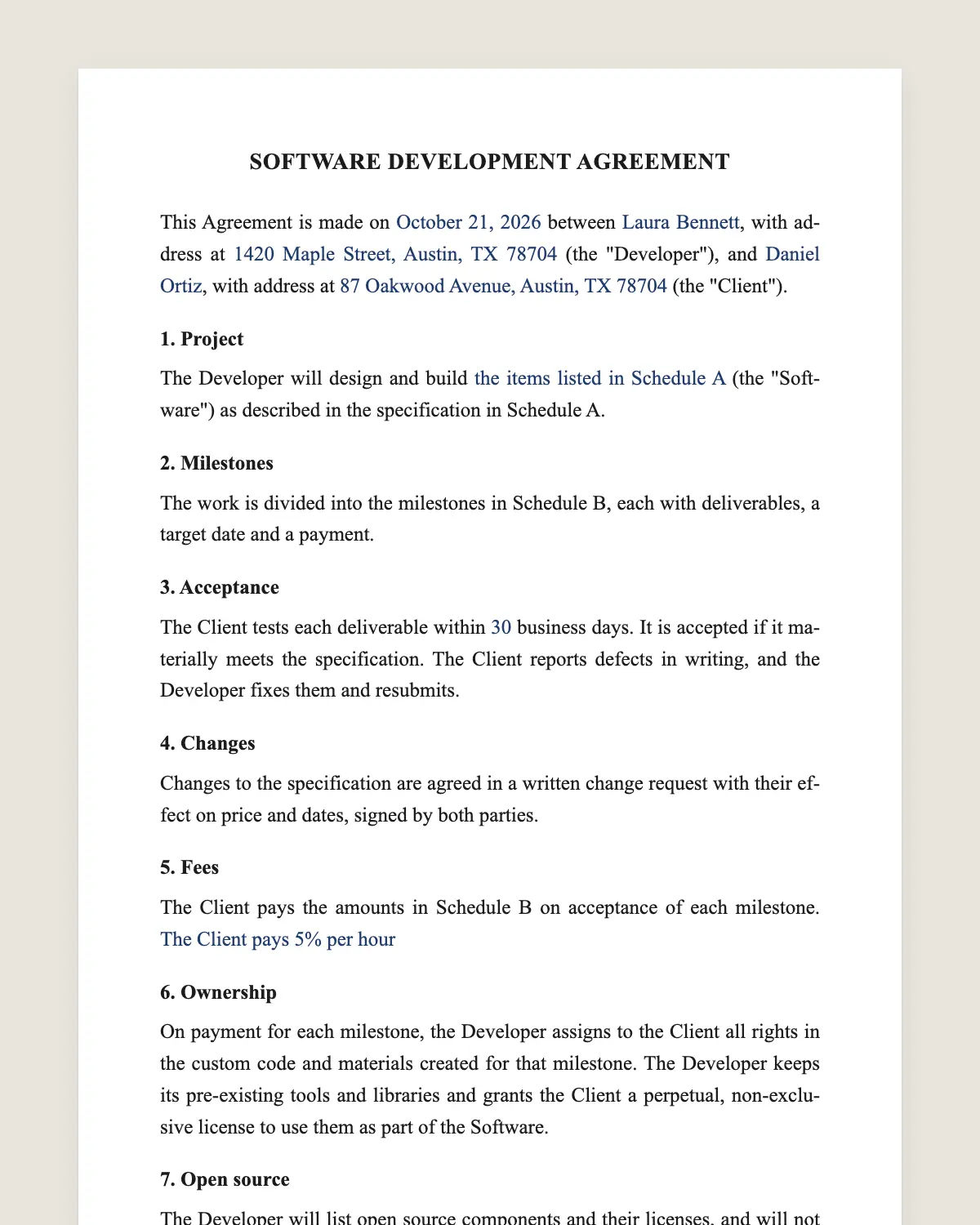
Software development agreement example, filled in with sample data
Example filled in with sample data

The full software development agreement

SOFTWARE DEVELOPMENT AGREEMENT

This Agreement is made on [date] between [Developer legal name], with address at [address] (the "Developer"), and [Client legal name], with address at [address] (the "Client").

1. Project

The Developer will design and build [description of the software] (the "Software") as described in the specification in Schedule A.

2. Milestones

The work is divided into the milestones in Schedule B, each with deliverables, a target date and a payment.

3. Acceptance

The Client tests each deliverable within [number] business days. It is accepted if it materially meets the specification. The Client reports defects in writing, and the Developer fixes them and resubmits.

4. Changes

Changes to the specification are agreed in a written change request with their effect on price and dates, signed by both parties.

5. Fees

The Client pays the amounts in Schedule B on acceptance of each milestone. [Or: The Client pays [hourly rate] per hour, invoiced [every two weeks], up to a cap of [amount] without written approval.]

6. Ownership

On payment for each milestone, the Developer assigns to the Client all rights in the custom code and materials created for that milestone. The Developer keeps its pre-existing tools and libraries and grants the Client a perpetual, non-exclusive license to use them as part of the Software.

7. Open source

The Developer will list open source components and their licenses, and will not use components whose license would require the Client to publish its own code without the Client's approval.

8. Warranty

For [number] days after final acceptance, the Developer will fix defects that make the Software fail to meet the specification, at no cost.

9. Support and maintenance

After the warranty, support is [not included / provided under a separate maintenance agreement at [rate]].

10. Confidentiality

Each party keeps the other's confidential information secret and uses it only for this project.

11. Termination

Either party may end this Agreement with [number] days of written notice. The Client pays for accepted milestones and work in progress, and receives the code for what it paid.

12. Limitation of liability

Neither party is liable for indirect damages. Total liability is limited to the fees paid under this Agreement.

13. Governing law and signature

This Agreement is governed by the laws of [state]. The parties agree to sign it electronically, with the same effect as a handwritten signature.

Schedule A. Specification. Schedule B. Milestones, dates and payments.

Developer

Name and title: ______________

Date: ______________

Client

Name and title: ______________

Date: ______________

What the template includes

  • Project tied to a written specification
  • Milestones with deliverables, dates and payments
  • Acceptance testing and defect fixes
  • Change requests with price and date effects
  • Fixed price per milestone or hourly with a cap
  • Assignment of custom code on payment
  • License for the developer's pre-existing tools
  • Open source list and license limits
  • Warranty period after acceptance
  • Support, confidentiality and termination
  • Liability cap, governing law and electronic signature

What you fill in

FieldExample
DeveloperForge Nine Labs LLC
ClientMediRoute Health Inc.
SoftwarePatient scheduling mobile app for iOS and Android
Milestones4, over 16 weeks
PriceUSD 84,000
Acceptance window5 business days
Warranty60 days
MaintenanceUSD 2,500 per month, optional

How it gets signed

  1. 1Choose «Use this template», fill in the fields and review the full software development agreement.
  2. 2Send it by WhatsApp or email. The other party opens the link on their phone without an account.
  3. 3They tap the brown bar at the bottom that says «Sign as …» and draw their signature once.
  4. 4Everyone gets the signed PDF with its signature certificate. Anyone can check it at signsolu.com/verificar.

The signing screen tells each signer that signing means agreeing to sign electronically. It links to the electronic signature disclosure that the ESIGN Act asks for.

What you get once everyone signs

  • The signed PDF. The final software development agreement with every drawn signature in place.
  • The signature certificate. It lists each signer and the date and time of each signature.
  • A record you can check. The folio on the certificate opens the document history at signsolu.com/verificar.
  • Reminders. Turn them on and SignSolú reminds every signer who has not signed yet.

Your first ten documents are free and need no card.

What the law says

Under 17 U.S.C. 101, software made by an outside developer is usually not a work made for hire. The client owns it only through a written assignment, which clause 6 provides.

Open source licenses travel with the code. Some require sharing source code when the software is distributed, so clause 7 asks for approval before using them.

The ESIGN Act, 15 U.S.C. 7001 gives an electronic signature the same legal effect as one on paper. A contract cannot be denied effect only because it was signed electronically.

Fixed price or time and materials

A fixed price per milestone works when the specification is clear. The client knows the cost, and the developer carries the risk of estimates.

Time and materials fits evolving products. The client pays for hours worked, with a cap that needs approval to exceed.

Many projects mix both. Discovery runs on hours, and the build runs on fixed milestones.

Acceptance that ends arguments

Acceptance is the moment payment is due and ownership moves. Clause 3 sets the testing window and what counts as acceptance.

Send each acceptance through SignSolú as a short sign-off. The client signs from their phone and the invoice goes out the same day.

Ownership of code

Clients want to own what they paid for. Developers want to keep the tools they reuse across projects.

Clause 6 gives the client the custom code and a permanent license to the developer's tools inside the product.

Example of an app project

A health startup hires a studio to build a scheduling app in four milestones over sixteen weeks, for USD 84,000. Each milestone is paid on acceptance.

After launch, the studio fixes defects for sixty days at no cost. The startup then signs an optional maintenance plan at USD 2,500 a month.

Common mistakes

No written specification. Attach Schedule A, even if it is short.

Silent acceptance. Set what happens if the client does not test in time.

Ignoring open source. List components and licenses before launch.

Working with remote developers

Many teams work across time zones. Agree on overlap hours, the tools for tickets and code, and how often demos happen.

Write those working rules in Schedule A. They prevent most frustrations on long projects.

Sign each change request and acceptance from your phone, wherever you are.

Before you sign

Other templates

Frequently asked questions

Is a software development agreement signed online legally binding?

Yes. The ESIGN Act gives electronic signatures the same effect as handwritten ones. The signed PDF and its certificate show who signed and when.

Who owns the code?

The client owns the custom code after paying for each milestone. The developer keeps its pre-existing tools and licenses them.

Is software a work made for hire?

Usually not when an outside developer builds it. That is why clause 6 assigns the rights in writing.

Can we pay by the hour instead?

Yes. Use the hourly option in clause 5 and set a cap.

What if the client never accepts a milestone?

Clause 3 sets the testing window. Add that silence means acceptance if you want that rule.

Who pays for app store and hosting accounts?

The client, usually. Open them in the client's name and give the developer access.

Does the other party need a SignSolú account?

No. They open the link on their phone and sign with the brown bar at the bottom.

Can I edit the clauses before sending it?

Yes. After «Use this template» you can change any clause before you send it.

See also

Create a free account and send 10 documents