Founders’ agreement and the 83(b) election: the 30-day clock that starts when you sign
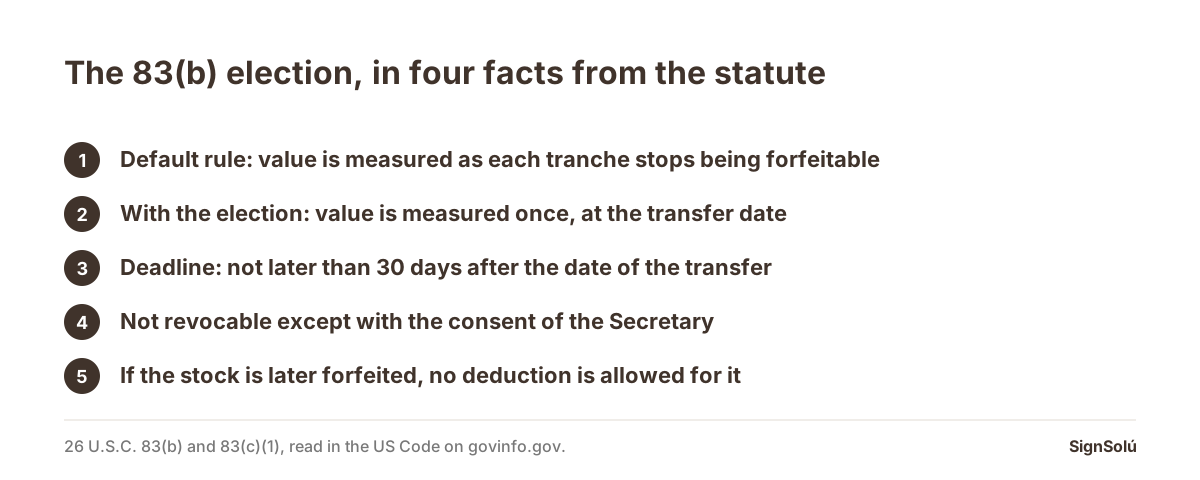
Thirty days from the transfer of the stock, and the statute means the transfer, not the incorporation, not the first vesting date and not the end of the tax year. Section 83(b)(2) of the Internal Revenue Code says the election "shall be made not later than 30 days after the date of such transfer" and that it "may not be revoked except with the consent of the Secretary". Two consequences follow and both are permanent: miss the window and you cannot elect later, and elect on stock you then forfeit and, under 83(b)(1), no deduction is allowed for that forfeiture. The date the stock purchase is signed is therefore the date the clock starts from, which is why that date needs to be provable.
Most founders’ agreement templates get the vesting schedule right and stop there: four years, a one-year cliff, monthly thereafter. What they rarely mention is that the same clause creates a tax deadline measured in days, and that deadline is one of the few in a company’s early life that cannot be cured by filing late, paying a penalty or asking nicely.
Why vesting creates a tax problem in the first place
Section 83 of the Internal Revenue Code deals with property transferred in connection with the performance of services, which is what founder stock is. Its default rule taxes that property when it stops being subject to what the statute calls a substantial risk of forfeiture. Section 83(c)(1) defines that phrase plainly: rights are subject to a substantial risk of forfeiture "if such person’s rights to full enjoyment of such property are conditioned upon the future performance of substantial services by any individual".
A standard vesting schedule is exactly that condition. So under the default rule you are not taxed on day one; you are taxed on each tranche as it vests, at its value then. If the company is worth very little at signing and a great deal three years in, the default rule hands you a tax bill on paper gains you cannot sell, spread over years, at values you did not choose.
What the election actually does
Section 83(b)(1) lets the person performing the services elect instead to include the value at the time of transfer, measured as the excess of fair market value at transfer over the amount paid for it. For founder stock bought at formation at its then value, that excess is often zero or close to it. The text is on the US Code page for section 83.
The election is not a way of paying less in the abstract. It is a way of choosing when the measurement happens, and it only helps when the value at transfer is low. Make the same election on stock that is already valuable and you have accelerated a large bill for no reason.
The three hard edges in the statute
Thirty days, from the transfer
Section 83(b)(2) says the election "shall be made not later than 30 days after the date of such transfer". The word doing the work is transfer. Not the date the company was incorporated, not the first vesting date, not the end of the quarter. In practice the transfer date is the date the stock purchase or restricted stock agreement is signed and the consideration paid, which is why the date on that document matters so much more than it looks.
It cannot be undone
The same paragraph adds that the election "may not be revoked except with the consent of the Secretary". This is not a form you file to keep your options open. It is a choice, made once, on a view of what the stock is worth today.
If you forfeit, there is no deduction
This is the part that is least often spelled out, and it sits in the closing sentence of 83(b)(1): if the election is made and the property is subsequently forfeited, no deduction is allowed in respect of that forfeiture. A founder who elects, pays tax on the value at transfer and then leaves before the cliff has paid tax on stock they no longer hold, with no offsetting deduction for losing it.
| Question | Default rule under section 83(a) | With an 83(b) election |
|---|---|---|
| When is value measured? | As each tranche stops being forfeitable | Once, at the transfer date |
| What if the company grows a lot? | The later tranches are measured at the higher value | The later growth is outside this measurement |
| What if you leave before vesting? | Nothing was included for unvested stock | Tax already paid, and no deduction for the forfeiture |
| Is there a deadline? | No election to miss | 30 days from the transfer, and not revocable |
Three things the election does not do
Half of the confusion around 83(b) comes from applying it to the wrong thing. These are the three boundaries worth holding on to.
- It does not change your vesting. The election is a tax measurement choice. The shares still vest on the schedule in the agreement, and leaving early still forfeits the unvested ones.
- It is not for an option grant. Section 83 applies to property transferred in connection with services. An option to buy stock later is not that transfer, so there is normally nothing to elect on until the option is exercised and shares actually change hands.
- It does not fix a valuation. It fixes the date on which value is measured. What that value is on that date is a separate question, and the one your adviser will want evidence for.
That second point is the one that trips up early employees more than founders, because the paperwork looks similar and the deadline language gets repeated between documents that are not the same document. If your arrangement is a services relationship rather than equity at all, the relevant paperwork is covered in independent contractor in Mexico: the services contract for the Mexican side, and in sales commission agreement: the four lines that decide the money where the pay is variable.
What this means for the document you sign
If the clock runs from the transfer, then the signing date is a fact you may have to establish, to an accountant now or to a tax authority years later. Three practical consequences follow for the paperwork itself:
- 1Sign the stock purchase agreement on a date you can prove, and do not backdate it. A document whose date cannot be supported is worse than a late filing.
- 2Record the number of shares, the price paid and the vesting schedule in the document itself, because the election is measured against those figures.
- 3Diarise the thirty days from the signing date the same day you sign, for every founder separately. Each person elects for their own stock.
- 4Keep the signed agreement and the filing together, since they only make sense as a pair.
A template to start the agreement itself from is at /en/templates/founders-agreement-template, and the related investment paperwork at /en/templates/investment-contract-template. What a signature has to carry to hold up at all is set out in is an electronic signature legally binding, and where, and where a partnership rather than a company is what you are forming, the default rules that fill the gaps are in LLP agreement template: what the default rules decide for you.
Founders in different countries, one signing date
Early teams are rarely in one place, and that is where the signing date gets soft: an agreement that travels by email, gets printed in one country, scanned in another and dated by hand produces four versions and no reliable date. Signing it electronically fixes the date once for everyone who signs, and that is the whole point here. If your team is building across the border, the first documents that tend to need signing are listed in nearshoring in Mexico: the first documents you sign, and the developer side in software developers in Mexico: the development contract.
With SignSolú the agreement goes out by email or over WhatsApp, each founder signs from their phone without opening an account or paying anything, and the signed document comes back with an audit certificate carrying the time, IP address, device and the SHA-256 hash of the file, plus an international timestamp following the RFC 3161 standard. Anyone, including an accountant or a tax authority, can check it at the verification page without an account and without going through SignSolú. If one of your founders is in Mexico, is an electronic signature valid in Mexico covers that side, and how to sign a contract remotely with someone in Mexico covers the practical part. You can create a free account and send the agreement today.
Frequently asked questions
When exactly does the 30 days start?
From the date of the transfer of the stock, which in practice is the date the stock purchase or restricted stock agreement is signed and paid for. Section 83(b)(2) says the election shall be made not later than 30 days after the date of such transfer. Incorporation dates and vesting dates do not start the clock.
Can I file the election late?
No. The statute sets a hard 30-day window and gives no general cure for missing it, which is what makes this different from most tax filings. The election also may not be revoked except with the consent of the Secretary, so it cannot be undone once made either.
What happens if I elect and then leave before vesting?
You have paid tax on value you no longer hold. Section 83(b)(1) closes with the rule that if the property is subsequently forfeited, no deduction is allowed in respect of that forfeiture. That is the main risk of electing on stock you may not keep.
Does every founder file their own election?
Yes. The election is made by the person who performs the services and receives the property, so each founder elects for their own stock and each has their own 30-day window running from their own transfer date.
Why does the signing date of the agreement matter so much?
Because the deadline is measured from it. If the date on the document cannot be supported, neither can the timeliness of the election. A signed document with a verifiable timestamp settles the question, which is why backdating the agreement is a bad trade for a short extension.
Send your next contract to Mexico for signature
Create a free account and send 10 documents with no card. Your dashboard works in English. You set the language per signer, and their email, WhatsApp message and signing page arrive in that language.