Click to cancel: what survived the rule being vacated
The rule itself is gone. In Custom Communications, Inc. v. FTC, filed 8 July 2025, the Eighth Circuit granted the petitions for review and vacated the Negative Option Rule in its entirety, holding that the Commission failed to follow a procedural requirement under section 22 of the FTC Act. What survived is the part most sellers thought the rule had introduced: section 8403 of ROSCA, in force since 2010, already requires clear and conspicuous disclosure of all material terms before billing information is taken, express informed consent before the charge, and simple mechanisms to stop recurring charges. The duties did not move; only the rule that restated them did.
Through 2024 and the first half of 2025, a great deal of compliance work was done against a rule that no longer exists. The useful question now is not whether "click to cancel" is in effect, but which of the obligations people associate with it were ever in that rule to begin with. The answer is: fewer than you would think.
What the court actually decided
The case is Custom Communications, Inc. v. Federal Trade Commission, consolidated by the Judicial Panel on Multidistrict Litigation from petitions filed in four circuits, decided per curiam before Judges Loken, Erickson and Kobes, submitted 10 June 2025 and filed 8 July 2025. The petitioners raised three challenges: that the FTC exceeded its statutory authority, that it declined to conduct a preliminary regulatory analysis, and that the rule was arbitrary and capricious under the Administrative Procedure Act.
The court decided only the second. Concluding that "the Commission failed to follow procedural requirements under § 22 of the Federal Trade Commission Act, 15 U.S.C. § 57b-3(b)(1)", it granted the petitions and vacated the Rule, and said expressly that because the rulemaking process was procedurally insufficient and the petitioners had demonstrated prejudicial error, it "need not address Petitioners’ other substantive challenges". That distinction matters for anyone guessing what comes next: the FTC’s authority over this subject was not ruled on.
Why the severability clause did not save it
The Rule contained a severability provision at 16 C.F.R. § 425.9, designed to keep the remaining provisions alive if any part was stayed or invalidated. The court acknowledged it and vacated everything anyway, reasoning that vacatur of the entire Rule was appropriate "because of the prejudice suffered by Petitioners as a result of the Commission’s procedural error", and that given the breadth of the Rule’s coverage, the party-specific vacatur the Commission requested was not feasible. A procedural defect in the rulemaking is not the kind of flaw a severability clause can isolate.
What stayed in force
This is the part worth pinning to the wall, because it is the answer to "so can we go back to the old flow". No.
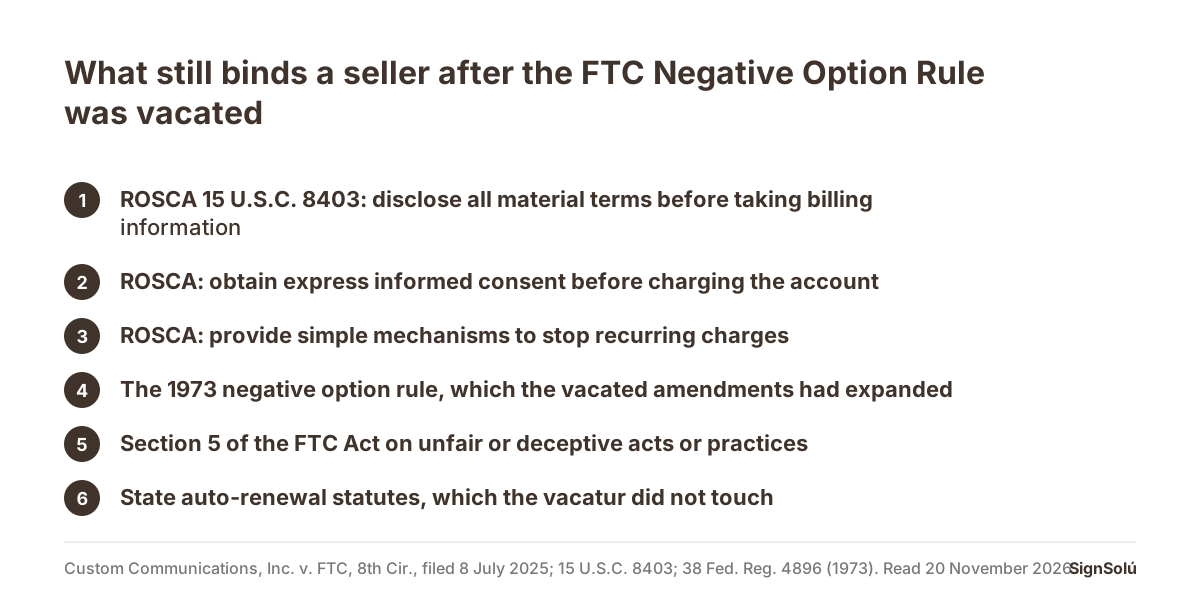
The Restore Online Shoppers’ Confidence Act is the centre of it. 15 U.S.C. § 8403, enacted by Pub. L. 111-345 on 29 December 2010, makes it unlawful to sell goods or services in an Internet transaction through a negative option feature unless the seller does three things, and the statutory wording is tighter than most summaries of it.
- 1Discloses first. "Provides text that clearly and conspicuously discloses all material terms of the transaction before obtaining the consumer’s billing information." The order is in the statute: disclosure precedes the card field.
- 2Gets express informed consent. "Obtains a consumer’s express informed consent before charging the consumer’s credit card, debit card, bank account, or other financial account." Not notice, not acceptance by silence: consent, express and informed.
- 3Makes stopping simple. "Provides simple mechanisms for a consumer to stop recurring charges from being placed on" the account. The word is simple, and it is measured against the signup, not against what the seller finds convenient.
Section 8403 also, in the same chapter, bars the data-pass practice: an initial merchant may not disclose a card or account number, or other billing information used to charge its customer, to a post-transaction third party seller for use in that third party’s Internet sale. And nothing in the chapter supersedes or modifies the requirements of the Electronic Fund Transfer Act.
Behind ROSCA sit two more things the vacatur left untouched: the 1973 negative option rule, published at 38 Fed. Reg. 4896 on 22 February 1973, which is what the 2024 amendments had expanded and which reverts to covering the single form of plan it always covered; and section 5 of the FTC Act, 15 U.S.C. § 45(a), which empowers the Commission to prevent unfair or deceptive acts or practices. State auto-renewal statutes are a separate body of law and a federal rule being vacated does nothing to them.
What this changes about the record you keep
Read the three duties as evidence problems rather than design problems and the compliance work becomes concrete. Each one is a thing you may have to prove about a specific customer on a specific date, long after the screen they saw has been redesigned twice.
| The duty | What has to be provable | What usually gets kept instead |
|---|---|---|
| Disclosure before billing information | What the customer saw, and that it came first | A screenshot of the current page |
| Express informed consent | The affirmative act, by that person, at that time | A boolean column in a database |
| Simple cancellation | That the mechanism existed and worked on the date asked | Nothing |
That is why signed acceptance is worth more here than a checkbox log, particularly for contracts a salesperson sets up on a customer’s behalf. Every document signed through SignSolú comes with an audit certificate: time, IP address, device and the SHA-256 hash of the file, and anyone can check it at /en/verify without an account. The record also keeps the channel the signing link went out on, the masked destination, the acceptance text the signer actually had in front of them, and whether they confirmed a code sent to their email. That last pair is the disclosure and the consent, captured as facts rather than as a flag.
Each signed document also gets an RFC 3161 timestamp, the international standard, so the date is fixed by something outside the parties, and signed documents enter a chained log with a daily close anchored outside the platform, which means not even SignSolú can alter a signed document or move its date. There is no public page to browse that log; the point is the mechanism. Why a provable date is worth having is set out in is backdating a lease legal: what a signing record shows.
Where the written agreement does the work
For anything sold through a salesperson, a renewal, or a business-to-business subscription, the clean answer is that the material terms live in a signed agreement rather than in a flow. The template is at service agreement template, and for a longer relationship with statements of work under it, master service agreement template. What belongs in the terms themselves is covered in conditions and terms.
Two neighbouring questions come up constantly alongside this one. Whether you are billed per user or per document, which is itself a negative-option-shaped decision, is in e-signature billed per user or per document: how to tell. And where a franchise or dealer network is doing the selling, the disclosure clock has its own rules, in franchise disclosure document: the fourteen-day clock and the receipt.
A short list of what to do now
- Stop citing the vacated Rule in policies and contracts. A document that grounds its obligations in 16 C.F.R. part 425 as amended in 2024 is citing something that was vacated on 8 July 2025.
- Re-ground the same obligations in ROSCA. The three duties in 15 U.S.C. § 8403 are the ones that were always binding, and they read very much like what the Rule required.
- Check the state statutes that apply to your customers, because those were never affected and several are stricter than the federal baseline.
- Keep evidence of the act, not of the conclusion: the text shown, the affirmative step taken, the date, and the person.
- Treat the cancellation mechanism as something with a date and a record, not as a page that exists. "Simple" is an assertion someone will test.
The second point is the one that reframes the whole exercise. If your 2024 compliance project was built to satisfy the Rule, most of it was already required and still is. Very little of that work was wasted; it just needs a different citation at the top of the memo. What an electronic signature is and where it binds is in is an electronic signature legally binding, and where, and the signing itself at sign documents online and online signature.
Two more documents sit next to this one in practice. Where the customer is a business rather than a consumer, the terms are usually negotiated rather than presented, and what a signed memorandum does before the main agreement is covered in memorandum of understanding template: when it binds you. Where a contractor or reseller does the selling, the payment terms their own contract has to settle are in independent contractor payment terms: what the contract has to decide, and the waiver language people reach for when a dispute starts is set out in signed waiver meaning: what a waiver can never cover.
Frequently asked questions
Is the FTC click-to-cancel rule in effect?
No. In Custom Communications, Inc. v. FTC, filed 8 July 2025, the Eighth Circuit granted the petitions for review and vacated the Negative Option Rule in its entirety, holding the Commission failed to follow a procedural requirement under section 22 of the FTC Act, 15 U.S.C. § 57b-3(b)(1).
Why was the rule vacated?
On procedure, not on substance. The court held the rulemaking process was procedurally insufficient and that petitioners showed prejudicial error, and said expressly that it need not address the other substantive challenges, which included the argument that the FTC exceeded its statutory authority.
So are recurring charges unregulated now?
No. Section 8403 of ROSCA, in force since December 2010, requires a seller using a negative option feature in an Internet transaction to disclose all material terms clearly and conspicuously before obtaining billing information, obtain express informed consent before charging, and provide simple mechanisms to stop recurring charges.
Did the severability clause keep part of the rule alive?
No. The court noted the severability provision at 16 C.F.R. § 425.9 and vacated the whole Rule anyway, because of the prejudice the procedural error caused petitioners and because, given the breadth of the Rule, the party-specific vacatur the Commission asked for was not feasible.
What happened to the old 1973 rule?
It is what the vacated 2024 amendments had expanded, and it goes back to covering the one form of negative option plan it always covered. It was published at 38 Fed. Reg. 4896 on 22 February 1973.
What evidence should a seller keep about consent?
Evidence of the act rather than of the conclusion: the text the customer actually saw, that it came before billing information was taken, the affirmative step they took, the date, and who took it. A true or false column in a database records someone’s conclusion about consent, not the act that produced it.
Send your next contract to Mexico for signature
Create a free account and send 10 documents with no card. Your dashboard works in English. You set the language per signer, and their email, WhatsApp message and signing page arrive in that language.