No LLC operating agreement: what Delaware law decides for you
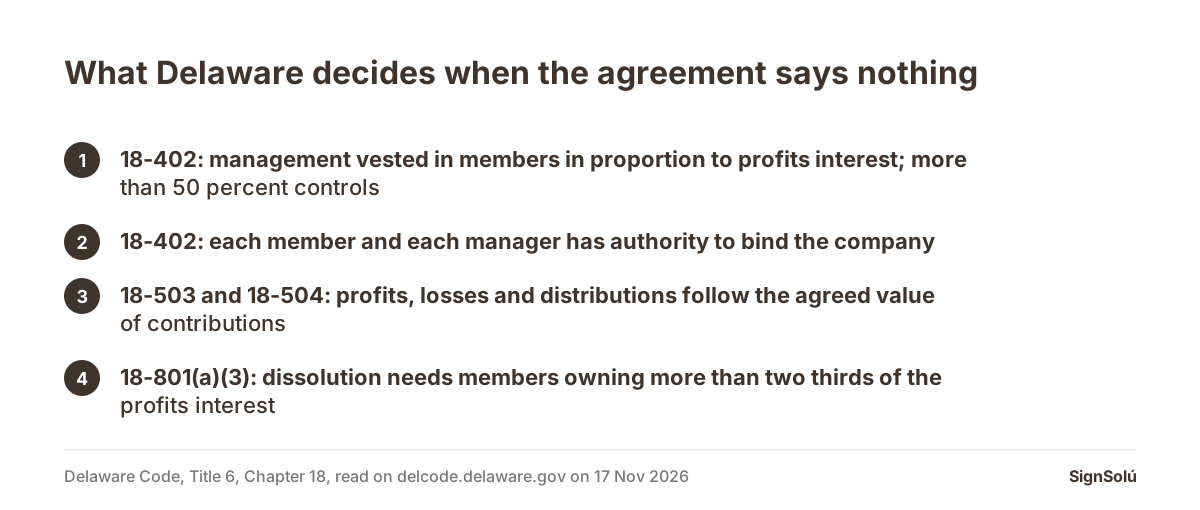
Four statutory defaults step in, and none of them is the even split people picture. Under § 18-402 of the Delaware Limited Liability Company Act, management is vested in the members in proportion to their current interest in profits, with members owning more than 50 percent controlling — and, unless the agreement says otherwise, each member and each manager has the authority to bind the company. Under §§ 18-503 and 18-504, profits, losses and distributions are allocated on the basis of the agreed value of each member’s contributions, not equally. Under § 18-801(a)(3), it takes members owning more than two thirds of the profits interest to dissolve. And there is a twist most people miss: § 18-101 defines a limited liability company agreement as any agreement, «written, oral or implied», and says it is not subject to any statute of frauds. So the question is rarely whether you have one. It is whether anybody wrote down what it says.
The sentence comes up in the same breath every time: «we never did an operating agreement, we just split everything down the middle». The first half of that sentence is probably wrong, and the second half is the part that ends up in litigation.
The twist first: you may already have one
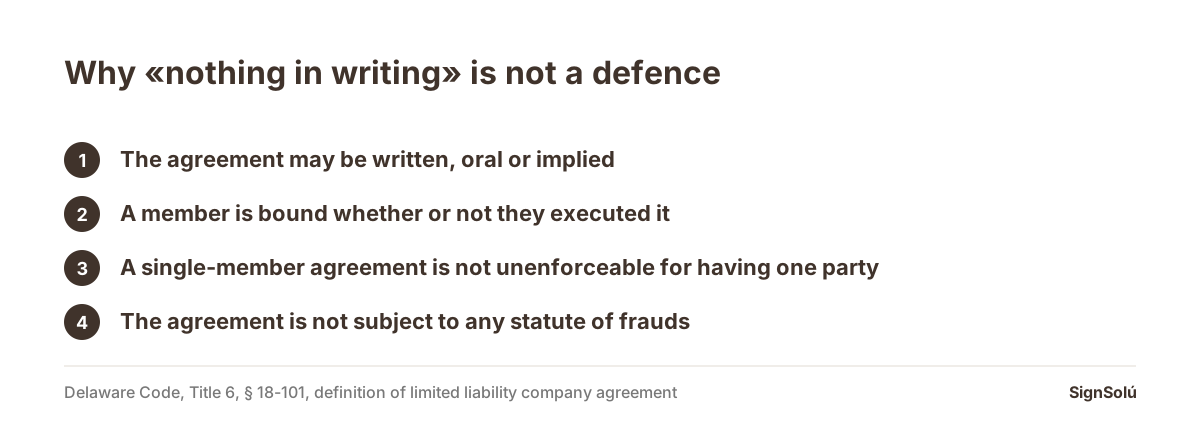
§ 18-101 of the Delaware Limited Liability Company Act, read today on the state’s own code site, defines the term broadly: a limited liability company agreement is «any agreement (whether referred to as a limited liability company agreement, operating agreement or otherwise), written, oral or implied, of the member or members as to the affairs of a limited liability company and the conduct of its business».
Three sentences in the same definition close the escape routes. A member is bound by the agreement «whether or not the member … executes» it. An agreement of a single-member company «shall not be unenforceable by reason of there being only 1 person who is a party» to it. And: «A limited liability company agreement is not subject to any statute of frauds.»
The four defaults that fill the silence
Where the agreement — written, oral or implied — says nothing, the Act supplies the answer. These four are the ones that surprise people, and each opens with the same words: «Unless otherwise provided in a limited liability company agreement.»
| Question | What people assume | What the Act provides |
|---|---|---|
| Who runs it | Everyone has an equal say | § 18-402: management vested in members in proportion to profits interest; more than 50 percent controls |
| Who can sign for the company | Only the managing member | § 18-402: each member and each manager has authority to bind the company |
| How profits are split | Evenly, or by ownership percentage | § 18-503: on the basis of the agreed value of the contributions each member made |
| How cash is distributed | Same as the profit split | § 18-504: same contribution-value basis, stated in the company records |
| How it ends | A majority vote | § 18-801(a)(3): members owning more than two thirds of the profits interest |
| How long it lasts | Until someone leaves | § 18-801(a)(1): perpetual existence if no time is set in the agreement |
The one that does the most damage
It is the contribution-value rule. Two founders agree verbally on fifty-fifty. One puts in $90,000 and the other puts in sweat and $10,000. With nothing written, §§ 18-503 and 18-504 allocate profits, losses and distributions «on the basis of the agreed value (as stated in the records of the limited liability company) of the contributions made by each member». Services can be a contribution — § 18-101 counts «services rendered» — but only at a value the records actually state. If the records state a cash figure and nothing else, the split follows the cash.
The second most damaging is the binding-authority sentence in § 18-402. Unless the agreement says otherwise, each member can bind the company: sign a lease, take on a supplier, commit to a contract. For a two-person LLC that means either person can obligate both, and the other finds out afterwards.
What the written agreement is actually for
- Fixing the splits in numbers, so §§ 18-503 and 18-504 never have to guess from the contribution records.
- Limiting who can sign, so the default of § 18-402 does not leave every member with authority to bind the company.
- Setting the exit terms — what a departing member is owed, and on what timetable — before anybody wants to leave.
- Choosing the dissolution threshold, since § 18-801(a)(3) otherwise asks for more than two thirds.
- Naming the deadlock rule for an even-numbered membership, which the Act does not supply at all.
- Writing the capital-call rule, because an obligation to contribute more money is exactly the kind of term nobody remembers the same way two years later.
- Keeping the confidentiality obligation attached to the company, rather than to whichever founder happened to sign the non-disclosure agreement; what that clause actually does is in the purpose of an NDA.
- Deciding who owns work product brought in by a member or a contractor, which is a separate question from ownership of the company: who owns the logo.
The template itself, with the clauses laid out and free in Word, is the LLC operating agreement. If the question underneath is really about the deal between founders rather than the company’s own rules, the partnership side of it is covered in business partnership agreement: the rules that apply without one, and the UK equivalent problem in LLP agreement template: what the default rules decide for you.
Single-member LLCs, and the «certificate of no operating agreement»
Two practical questions ride along with this search, and they have short answers. First: a single-member LLC can have an agreement, and § 18-101 says it «shall not be unenforceable by reason of there being only 1 person who is a party» to it. Banks and lenders routinely ask for one precisely because it is the document that shows the company is being treated as separate from its owner.
Second: an «affidavit of no operating agreement» or «certificate of no operating agreement» is not a statutory document in Chapter 18. It is a form that a particular bank, title company or counterparty asks for when it needs somebody to state, under oath, who may sign for the company. Read what it says before signing it: it is a representation about authority, and § 18-402’s default is that every member has it.
And in New York, the statute simply requires one
Delaware’s approach — defaults that apply unless you write something else — is not universal, and the state most people are surprised by is New York. § 417 of the New York Limited Liability Company Law, read today on the Senate’s own site, opens subsection (a) with a duty rather than a default: «the members of a limited liability company shall adopt a written operating agreement» containing provisions not inconsistent with law or the articles of organization.
Subsection (c) puts a clock on it: an operating agreement «may be entered into before, at the time of or within ninety days after the filing» of the articles of organization, and it cannot take effect before the company is formed. So the practical answer to «do I need an operating agreement» depends on where the company was formed, and the two most common answers point in opposite directions.
| Where the LLC was formed | Is a written agreement required | What fills the gap |
|---|---|---|
| Delaware | No. The agreement may be written, oral or implied (§ 18-101) | The defaults of §§ 18-402, 18-503, 18-504 and 18-801 |
| New York | Yes. Members shall adopt a written operating agreement (§ 417(a)) | A ninety-day window from the filing of the articles, under § 417(c) |
| Another state | Depends on that state’s LLC act | That state’s defaults, which differ from Delaware’s |
Either way the conclusion lands in the same place. In Delaware the agreement exists whether you wrote it or not, so writing it is how you choose its terms instead of inheriting them. In New York the statute asks for the written document outright, and gives you ninety days. What the document is worth in a dispute depends on what it says and on being able to prove who agreed to it, which is the next problem.
Getting it signed, when the members are in three places
An operating agreement is the classic document that sits unsigned for months because one member is travelling. It does not need a notary and it does not need ink. In SignSolú the owner builds it from the template, picks who signs and sends the link; each member signs from a phone, without opening an account and without paying anything. The counterparty never pays. What makes an electronic signature binding, and where, is set out in is an electronic signature legally binding, and where.
What stays behind each signature is the part that matters for a document nobody reads again until there is a fight: the time, the network address, the device, the SHA-256 hash of the file, the acceptance text the signer saw and the channel the link went out through. The signed PDF carries a manifest of every hash and receives an RFC 3161 timestamp, and anyone can check the document at /en/verify without an account. The full set is on the trust page.
The first ten documents are free, with no card and no expiry, which is enough to get an operating agreement and a couple of founder documents signed before paying anything; the published plan and what it includes are at /en/pricing, and the signing flow itself at /en/sign-documents-online. If you want every member to sign the same document at once rather than one after another, that is in in-person signing: what it means and how two people sign on one tablet. For a company with members or operations in Mexico, what changes is covered in e-signature platforms for doing business in Mexico and in is an electronic signature valid in Mexico.
The short version, in six steps
- 1Check the state of formation first. Delaware supplies defaults; New York asks for the written document within ninety days of the filing.
- 2Write down the splits as numbers, so §§ 18-503 and 18-504 never have to read them out of the contribution records.
- 3Say who may bind the company, because the default of § 18-402 is everybody.
- 4Build it from the [LLC operating agreement template](/en/templates/llc-operating-agreement) rather than from a document a bank sent you.
- 5Send it to every member at once and let each sign from a phone, with no account: how signing works.
- 6Keep the signed file where anyone can check it, including a member who leaves: /en/verify needs no login, and the evidence is listed on the trust page.
Frequently asked questions
What happens if an LLC has no operating agreement?
The statute fills the gap. In Delaware, § 18-402 vests management in the members in proportion to their profits interest, with more than 50 percent controlling, and lets each member and manager bind the company. §§ 18-503 and 18-504 allocate profits, losses and distributions on the basis of the agreed value of each member’s contributions. § 18-801(a)(3) requires more than two thirds of the profits interest to dissolve.
Does an operating agreement have to be in writing?
In Delaware, no. § 18-101 defines a limited liability company agreement as any agreement «written, oral or implied», and adds that it is not subject to any statute of frauds. Writing it down does not create the agreement; it fixes what the agreement says, which is the part that gets argued about later.
Does a single-member LLC need one?
The Act does not require it, and § 18-101 makes clear that an agreement is not unenforceable merely because there is only one party to it. Banks, lenders and title companies often ask for one anyway, because it is the document that shows the company is being run as something separate from its owner.
Can one member sign a contract for the whole LLC?
By default, yes. The last sentence of § 18-402 says that unless the agreement provides otherwise, each member and each manager has the authority to bind the limited liability company. Limiting that authority is one of the main reasons to write the agreement down.
What is an affidavit of no operating agreement?
It is not a document created by Chapter 18. It is a form some banks, title companies and counterparties ask for, in which someone states under oath who may act for the company. Since the statutory default gives every member authority to bind the company, read carefully what the form says about authority before signing it.
Is a written operating agreement required in New York?
Yes. § 417(a) of the New York Limited Liability Company Law says the members of a limited liability company shall adopt a written operating agreement, and § 417(c) allows it to be entered into before, at the time of, or within ninety days after the filing of the articles of organization. Delaware takes the opposite approach and supplies defaults instead.
Do the members have to sign it in the same room?
No. There is no notary requirement and no ink requirement. Each member can sign from a phone through a link sent by email or by message, without opening an account, and the signed file keeps the time, device, hash and acceptance text of each signature.
Send your next contract to Mexico for signature
Create a free account and send 10 documents with no card. Your dashboard works in English. You set the language per signer, and their email, WhatsApp message and signing page arrive in that language.