A commercial lease agreement in Ontario: the assignment clause that can be contracted out of, and usually is
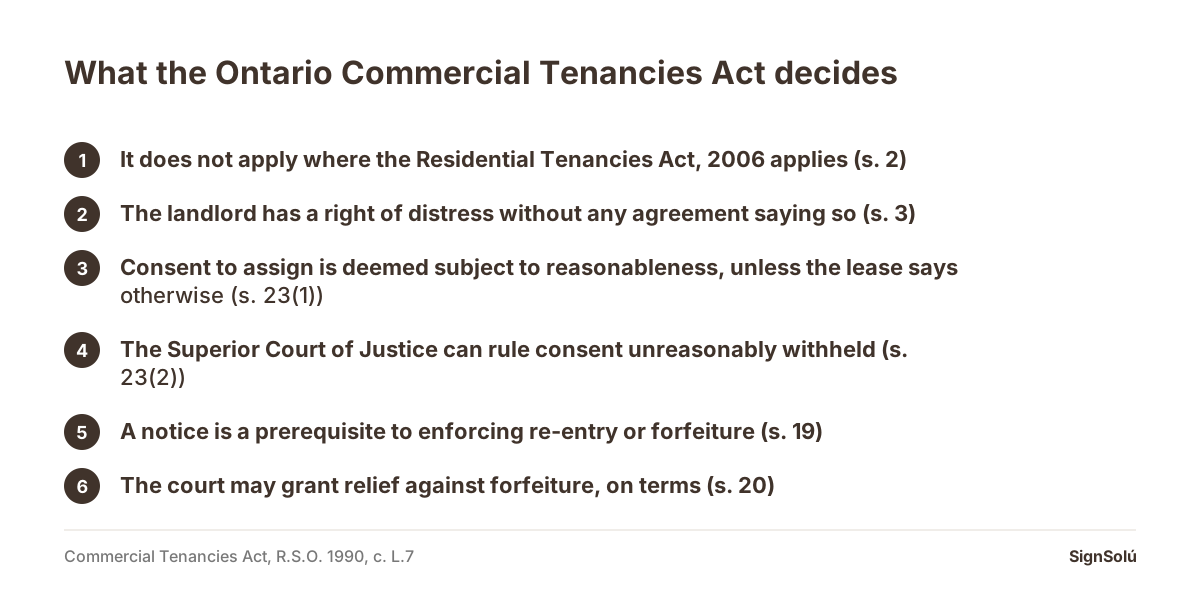
Section 23(1) of the Commercial Tenancies Act says that in every lease made after 1 September 1911 containing a covenant against assigning, underletting or parting with possession without consent, that covenant is deemed subject to a proviso that the consent is not to be unreasonably withheld — «unless the lease contains an express provision to the contrary». That last clause is the whole point: in Ontario the protection is a default, not a floor, and a commercial landlord can remove it by saying so in the lease. Where it survives, section 23(2) lets the tenant, the assignee or the sub-tenant apply to a judge of the Superior Court of Justice for an order that consent was unreasonably withheld, and that order is the equivalent of the landlord’s consent.
A commercial tenant in Ontario is not a residential tenant
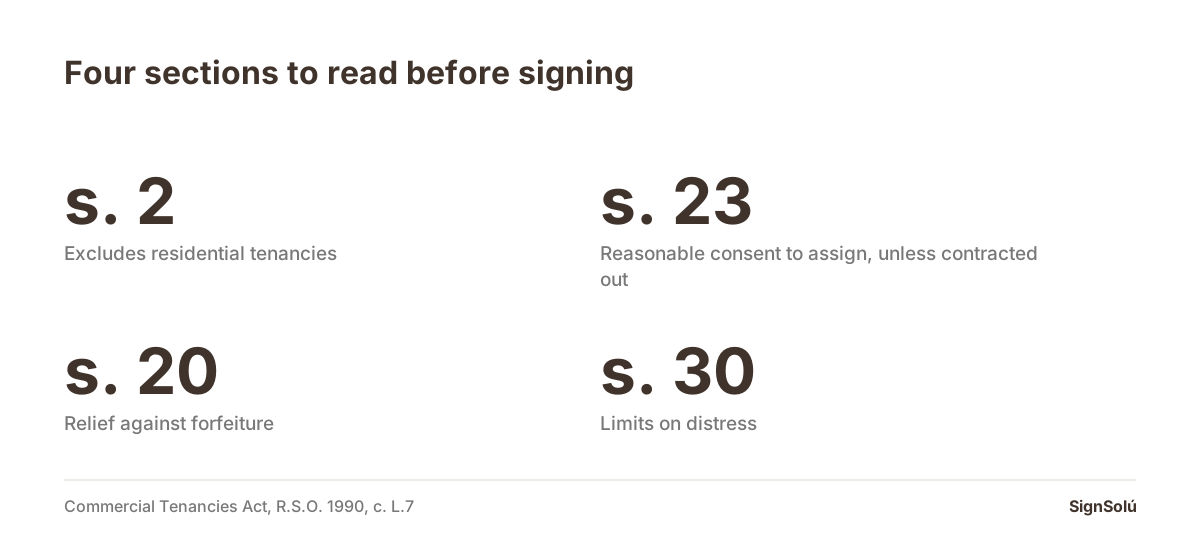
The first thing to settle is which statute is in play, and section 2 of the Commercial Tenancies Act settles it in one line: the Act does not apply to tenancies and tenancy agreements to which the Residential Tenancies Act, 2006 applies. The two regimes are not variations of each other. The residential one is protective and procedural; the commercial one is older, shorter, and leaves far more to the lease.
That difference runs through everything that follows. A commercial landlord in Ontario still has a common-law right of distress — section 3 says the relation of landlord and tenant does not depend on tenure, and that it is not necessary, in order to give a landlord the right of distress, that there is an agreement for that purpose between the parties. The right exists without being written down.
Section 23: a default that the lease can remove
Section 23(1) does something unusual. It reaches into every lease made after 1 September 1911 that contains a covenant, condition or agreement against assigning, underletting, parting with possession or disposing of the property without licence or consent, and deems that covenant subject to a proviso to the effect that such licence or consent is not to be unreasonably withheld. A commercial tenant who reads only the lease will not find that proviso there; it is supplied by the statute.
And then six words undo it: «unless the lease contains an express provision to the contrary». A landlord who writes that consent may be withheld in its sole and absolute discretion is not drafting around the statute — the statute invites that drafting. This is the opposite of how the equivalent protection works in some other jurisdictions, and it is the single most valuable thing for a tenant to check before signing a commercial lease in Ontario.
What section 23(2) gives the tenant when the proviso survives
If the lease is silent, the proviso applies, and the tenant has a route that does not depend on the landlord changing its mind. Where the landlord refuses or neglects to give a licence or consent to an assignment or sub-lease, a judge of the Superior Court of Justice may, on the application of the tenant, the assignee or the sub-tenant, make an order determining whether the consent is unreasonably withheld and, if it is, permitting the assignment or sub-lease to be made. Section 23(2) then says the order is the equivalent of the licence or consent of the landlord within the meaning of any covenant requiring it, and the assignment or sub-lease is not a breach.
For a business selling itself, that matters more than it looks. A sale of a restaurant, a clinic or a franchise is often a sale of the lease with equipment attached, and a landlord who simply stops answering can stall the transaction. Section 23(2) names «neglects» as well as «refuses», which covers silence.
| The question | Ontario commercial lease | Where it comes from |
|---|---|---|
| Which statute applies | The Commercial Tenancies Act; not the Residential Tenancies Act, 2006 | s. 2 |
| Does the landlord need a distress clause | No; the right does not depend on an agreement | s. 3 |
| Consent to assign | Reasonableness is implied unless the lease expressly says otherwise | s. 23(1) |
| If consent is refused or ignored | Application to a judge of the Superior Court of Justice; the order replaces consent | s. 23(2) |
| Before forfeiting for breach | A notice is a prerequisite to enforcing re-entry or forfeiture | s. 19 |
| After forfeiture is started | The tenant may apply for relief, and the court may grant it on terms | s. 20 |
| Ending a monthly tenancy | A month’s notice to quit, ending with the month, is sufficient | s. 28 |
| Goods exempt from seizure | Not liable to distress for rent; on a monthly tenancy the exemption covers two months’ arrears | s. 30(1), (2) |
Forfeiture is a procedure, not a switch
A commercial lease usually gives the landlord a right of re-entry on breach, and tenants read that as a trapdoor. Sections 19 to 22 slow it down. Section 19 makes a notice a prerequisite to enforcing a right of re-entry or forfeiture, and defines «lease», «lessee» and «lessor» broadly enough to catch under-leases, derivative under-leases and grants at a fee farm rent.
Section 20(1) then gives the tenant the application: where a lessor is proceeding by action or otherwise to enforce a right of re-entry or forfeiture, whether for non-payment of rent or for other cause, the lessee may apply to the court for relief, and the court may grant such relief as it thinks fit having regard to the proceeding and conduct of the parties and all the other circumstances — on terms as to payment of rent, costs, expenses, damages, compensation or penalty, including an injunction to restrain a like breach in future. Subsection (3) adds a drafting point worth knowing: a lease limited to continue only as long as the tenant abstains from breaching a covenant takes effect as a lease for the longer term it could subsist, determinable by a proviso for re-entry.
The small print that is not in the lease at all
- Notice to quit on a periodic tenancy. Section 28 says a week’s notice and a month’s notice to quit, ending with the week or the month, are sufficient to determine a weekly or a monthly tenancy. «Ending with the month» is the part that invalidates notices drafted to expire mid-month.
- Distress has limits. Section 30(1) says goods and chattels exempt from seizure under execution are not liable to seizure by distress for rent, and 30(2) limits that exemption on a monthly tenancy to two months’ arrears. Section 30(3) puts the burden on the person claiming the exemption to select and point out the goods.
- Third parties’ goods. Sections 31 and 32 deal with goods on the premises that are not the tenant’s and with the position of an under-tenant, which matters where equipment is leased or on consignment.
- Proceedings served on a tenant. Section 29 obliges a tenant served with an originating process in an action for the recovery of land to notify the landlord forthwith, and makes the tenant answerable for the damages caused by failing to do so.
The practical checklist before signing is short. Read the assignment clause first and look for the express words that displace section 23(1). Read the forfeiture clause second and remember that section 19 still requires the notice and section 20 still offers relief. Then read the term: how it ends, and whether it goes periodic afterwards, which decides whether section 28 applies at all.
Starting points for the documents themselves: commercial lease agreement for the lease, sublease agreement template if the exit is a sublet rather than a sale, lease extension agreement for a renewal and lease termination letter for the end. If the arrangement is a short occupation rather than a lease, the starting point is short-term rental agreement, and for storage space, storage agreement template; a change to an existing lease goes in contract amendment template. The English and Welsh regime, which handles the same questions through an entirely different statute, is in a commercial lease in England and Wales and in licence or lease: the test that decides security of tenure.
Two neighbouring Ontario documents, since they come up in the same deal: a separation agreement in Ontario, where the witness requirement is the trap, and a month-to-month lease in Alberta, which shows how differently the notice periods run province by province. A tenant’s own notice, and the statutory minimum behind it, is in a lease termination letter from a tenant.
Signing it across a border
A commercial lease is routinely signed by a director who is not in the city, and increasingly by one who is not in the country — a Mexican or US parent signing for an Ontario subsidiary. Whether an electronic signature binds, and where, is set out in is an electronic signature legally binding, and where; when a document has to be a deed rather than a signature, in supplier agreement, e-signature and the deed question.
SignSolú sends the lease by WhatsApp or by email and each party signs from a phone, with no account and no payment on the signer’s side. Every document carries an audit receipt with time, IP, device and a SHA-256 hash, and anyone can check it at /verificar without an account. The interface is in Spanish; the sender chooses the language of each signer, so a signer added in English receives the email, the WhatsApp message and the signing page in English. SignSolú is a Mexican platform; for documents that need it in Mexico, it issues NOM-151 conservation certificates on the signed document through a certification service provider accredited by Mexico’s Ministry of Economy, switched on for your team on request. For a lease that has to come back signed by several people in different cities before a possession date, signing from a phone with that receipt is usually what is needed: start here — the free plan is 10 documents, no expiry and no card.
Frequently asked questions
Can my Ontario landlord refuse an assignment for any reason at all?
It depends on the lease. Section 23(1) of the Commercial Tenancies Act deems a covenant against assigning without consent to be subject to a proviso that consent is not to be unreasonably withheld, but only «unless the lease contains an express provision to the contrary». If the lease says consent may be withheld in the landlord’s sole and absolute discretion, the statutory proviso does not apply.
What can I do if the landlord simply does not answer my request to assign?
Where the statutory proviso applies, section 23(2) covers silence as well as refusal: it speaks of a landlord who «refuses or neglects» to give a licence or consent. A judge of the Superior Court of Justice may determine whether the consent is unreasonably withheld and permit the assignment or sub-lease, and that order is the equivalent of the landlord’s consent, so the assignment is not a breach of the covenant.
Does the Residential Tenancies Act protect a tenant in a mixed-use building?
Section 2 of the Commercial Tenancies Act says that Act does not apply to tenancies and tenancy agreements to which the Residential Tenancies Act, 2006 applies. Which statute governs a particular unit depends on the nature of that tenancy, not on the building, so a mixed-use property can have units under each regime.
Can the landlord seize my equipment for unpaid rent?
Distress is available to a commercial landlord in Ontario, and section 3 says it does not require an agreement for that purpose between the parties. It has limits: section 30(1) says goods and chattels exempt from seizure under execution are not liable to seizure by distress for rent, section 30(2) limits that exemption on a monthly tenancy to two months of arrears, and section 30(3) requires the person claiming the exemption to select and point out the goods.
Is a forfeiture clause in the lease enough to get the premises back?
Not on its own. Section 19 makes a notice a prerequisite to enforcing a right of re-entry or forfeiture, and section 20(1) allows the tenant to apply to the court for relief whether the forfeiture is for non-payment of rent or for other cause. The court may grant relief on terms as to payment of rent, costs, expenses, damages, compensation or penalty.
How much notice ends a monthly commercial tenancy in Ontario?
Section 28 says a month’s notice to quit, ending with the month, is sufficient to determine a monthly tenancy, and a week’s notice ending with the week for a weekly one. The phrase «ending with the month» is the one that catches people out: a notice drafted to expire part-way through a month does not meet the section.
Send your next contract to Mexico for signature
Create a free account and send 10 documents with no card. Your dashboard works in English. You set the language per signer, and their email, WhatsApp message and signing page arrive in that language.
Keep reading
- A commercial lease in England and Wales: the clause that is void without the notice
- Licensing agreement or lease? The heading does not decide it, and Part II of the 1954 Act is what is at stake
- Separation agreement in Ontario: the witness most templates forget, and the Act calls it unenforceable without one