Mobile home bill of sale: the document that does not transfer the home
It records the sale, the price and the condition, and it is worth having. What it does not do is move ownership, because a manufactured home is never transferred by a bill of sale alone. It is in one of two states, and they call for different documents. If the title has not been eliminated, ownership runs through the certificate of title: RCW 65.20.030 points to chapter 46.12 RCW for exactly that case. If the title has been eliminated, the home is real property and, under RCW 65.20.060, it transfers by deed, lease or real estate contract along with the land. Find out which state the home is in before you fill in any form.
Search for a mobile home bill of sale and you get a hundred one-page forms, several of them asking whether you want the version without a notary. The form is the easy part. The part that decides whether the sale actually happened is a question none of those pages ask: is this home still titled, or has it become part of the land?
Two states, two different transfer documents
A manufactured home starts life as something closer to a vehicle than to a house. It is built in a factory, it arrives on wheels, and it gets a certificate of title the way a car does. If it is then permanently affixed to land the owner owns, most states let that title be cancelled so the home stops being personal property and becomes part of the real estate. Washington runs that process under chapter 65.20 RCW, which is unusually readable, so it is the one worth reading even if your home sits somewhere else.
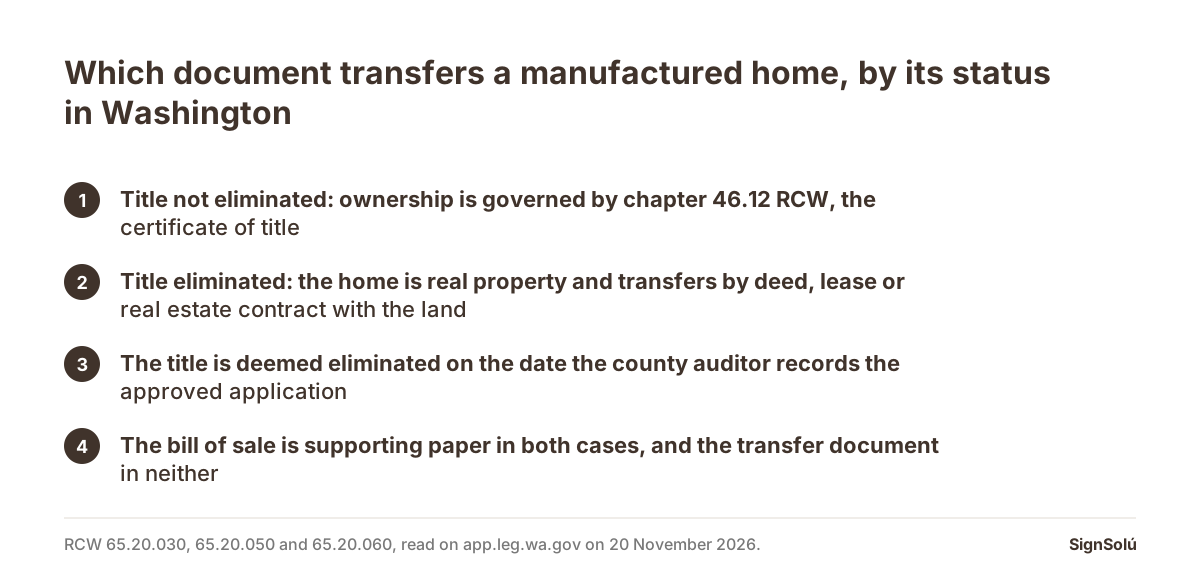
RCW 65.20.020(3) defines eliminating the title as cancelling an existing certificate of title issued by Washington or another jurisdiction, or waiving the chapter 46.12 title requirement, and recording the appropriate documents in the county real property records. RCW 65.20.030(1) then says that once the title is eliminated the home is real property, and that where it has not been eliminated, ownership is governed by chapter 46.12 RCW. Those two sentences are the whole fork in the road.
The date that decides which column you are in
RCW 65.20.050(3) is precise about timing: the title is deemed eliminated on the date the county auditor records the documents. Not when the application was signed, not when the department approved it, and not when the home was bolted down. That makes the status a recording fact, which means it is checkable: the county real property records either show the recorded application or they do not.
This is the single most useful thing a buyer can do before signing anything. One search answers whether you are buying personal property that needs a title transfer, or a piece of real estate that needs a deed. Getting it wrong is not a paperwork problem; it is paying for something the seller did not convey.
What the elimination file contains, and why it matters to a buyer
RCW 65.20.040 lists what the application has to include, and the list tells you what was true at the time somebody made the home part of the land.
- An affidavit signed by all owners covering the date, the owner names, the legal description of the land, and a description of the home: model year, make, width, length and vehicle identification number.
- A statement that the owner owns the land. This is the condition the whole chapter turns on: RCW 65.20.040 applies to homes affixed to land owned by the homeowner.
- The certificate of title or the manufacturer’s statement of origin, which is the document being cancelled.
- A local government certification that the home is affixed to the land.
- Fees and taxes, including vehicle licence, excise, use and real estate taxes.
Two details in that list repay attention. The first is the land ownership condition: a home on rented ground in a park is not a candidate, which is why most park homes keep their titles for life. The second is RCW 65.20.130, which sets penalties for falsifying the affidavit, so the affidavit is a document people are expected to take seriously rather than a form.
So what is the bill of sale good for
Quite a lot, as long as you know what job it is doing. It is the record of the commercial terms and the condition of the thing on the day it changed hands, which is exactly what the title transfer and the deed do not capture.
| What a buyer needs | Which document does it | What the bill of sale adds |
|---|---|---|
| Ownership of a titled home | Certificate of title under ch. 46.12 RCW | Price, date, parties and condition |
| Ownership of an eliminated-title home | Deed, lease or real estate contract (RCW 65.20.060) | The personal property that went with it: appliances, shed, furniture |
| Proof of what was promised about condition | Nothing else does this | The as-is wording, or the disclosure |
| Proof of what was paid and when | Nothing else does this reliably | The amount, the date, the method |
The as-is wording deserves care, because it does less than people think and sometimes more. What an as-is clause does and does not reach, with the statute that governs it, is in car bill of sale as-is: what the clause does not cover. The general template is at bill of sale for a car, and for the home itself at mobile home bill of sale.
The notary question, answered sideways
"Without a notary" is one of the most common things people search next to this form, and the honest answer is that it is the wrong worry. Whether a bill of sale needs notarising varies by state and by what is being sold, but it is not what makes the sale effective either way. The documents that carry weight here are the title transfer and the recorded deed, and those have their own formalities set by statute and by the county. A notarised bill of sale attached to a missing title transfer still conveys nothing.
Where a signature does need to be proved rather than witnessed, the useful thing is a record of who signed and when. What that looks like for a power of attorney in the same state is in Washington power of attorney: the two witnesses most forms get wrong.
A short order of operations
- 1Search the county real property records for a recorded title elimination on that parcel. That answers which column you are in.
- 2If there is no elimination, ask for the certificate of title and check the names and the lienholders on it against the people in front of you.
- 3If there is an elimination, you are buying real estate: the transfer is a deed with the land, and the title you check is the land’s.
- 4Agree the as-is or disclosure wording before the bill of sale is drafted, not in the signing meeting.
- 5List the personal property separately: appliances, sheds, furniture. That is the part the deed will not carry.
- 6Sign everything on a date you can prove, and keep the signing record with the file.
Step six sounds like housekeeping and is not. These sales are often informal, between neighbours, with months between the handshake and the recording, and the question that comes up later is when each document was actually signed. Moving a date on a signed document is its own problem, set out in is backdating a lease legal.
Signing it, and keeping the proof
Every document signed through SignSolú comes with an audit certificate: time, IP address, device and the SHA-256 hash of the file, and anyone can check it at /en/verify without an account. Each signed document also gets an RFC 3161 timestamp, the international standard, so the moment of signature is fixed outside the parties. Signed documents enter a chained log with a daily close anchored outside the platform, which means not even SignSolú can alter a signed document or move its date; there is no public page to browse that log, the point is the mechanism.
The sender picks the language for each signer, so a party who signs in English gets the email, the WhatsApp message and the signing page in English. The practical effect in a sale like this one is that the seller who lives two states away signs from a phone, and the file carries its own evidence of when. What stays with an electronic signature, and where it is binding, is in is an electronic signature legally binding, and where, and the signing itself at sign documents online.
For neighbouring documents: a sale of equipment rather than a home is at equipment bill of sale; a vehicle sale in the same state at washington bill of sale; a motorcycle at motorcycle bill of sale; and if what you are actually signing is a long ground lease rather than a purchase, land lease document: the three-year and seven-year thresholds covers the thresholds that change the document. If the home sits on leased ground in a park, the agreement you are signing is closer to lease agreement than to a purchase, and licence or lease: the test that decides security of tenure is the line that matters.
Frequently asked questions
Does a bill of sale transfer ownership of a mobile home?
No. If the title has not been eliminated, ownership runs through the certificate of title: RCW 65.20.030(1) points to chapter 46.12 RCW. If it has been eliminated, the home is real property and RCW 65.20.060 says it transfers by deed, lease or real estate contract along with the land. The bill of sale records the terms either way.
How do I know whether a mobile home still has a title?
Search the county real property records for a recorded title elimination on the parcel. RCW 65.20.050(3) says the title is deemed eliminated on the date the county auditor records the documents, so the status is a recording fact rather than a matter of opinion.
Can a mobile home on rented land have its title eliminated?
Not under chapter 65.20 RCW as written: RCW 65.20.040 requires an affidavit stating that the owner owns the land, and RCW 65.20.040 applies to homes affixed to land owned by the homeowner. Homes in parks on rented ground normally keep their certificates of title.
Does a mobile home bill of sale have to be notarised?
It varies by state and by what is being sold, and it is not what makes the sale effective. The documents that carry the transfer are the certificate of title or the recorded deed, each with its own formalities. A notarised bill of sale with no title transfer behind it conveys nothing.
What should the bill of sale list that the deed will not?
The personal property that goes with the home: appliances, sheds, furniture, anything not affixed. A deed carries the real estate, so items that stayed personal property need their own line, with the price and condition agreed in writing.
What goes in the title elimination application?
Under RCW 65.20.040: an affidavit signed by all owners with the date, owner names, legal description of the land and a description of the home including model year, make, width, length and VIN; the certificate of title or manufacturer’s statement of origin; a local government certification that the home is affixed; and the fees and taxes.
Send your next contract to Mexico for signature
Create a free account and send 10 documents with no card. Your dashboard works in English. You set the language per signer, and their email, WhatsApp message and signing page arrive in that language.