Clinics in Mexico and the US: one consent workflow, two sets of rules
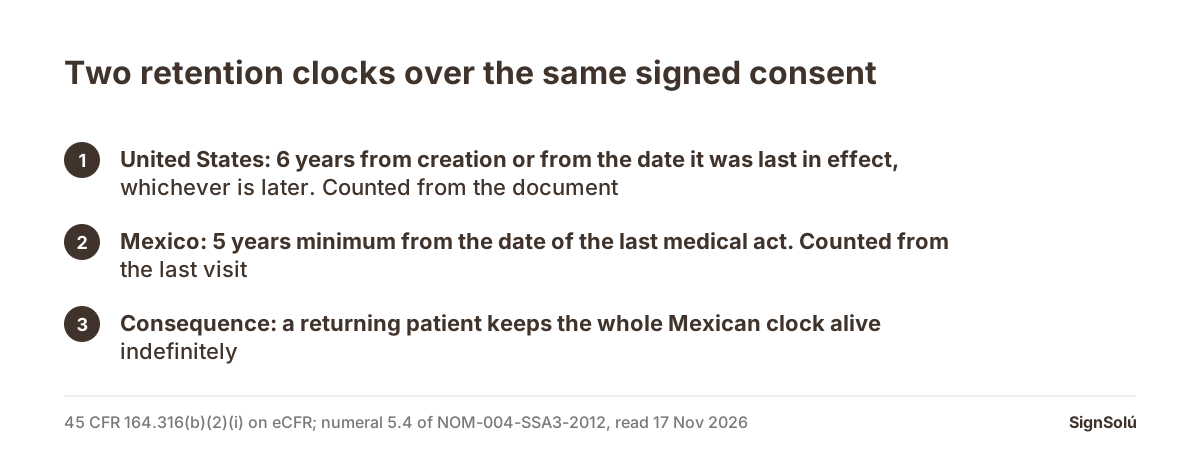
They ask for different things, and the gap is wider in the records than in the signature. On the US side, 45 CFR 164.312(b) requires audit controls: hardware, software or procedural mechanisms that record and examine activity in systems holding electronic protected health information, and § 164.316(b)(2)(i) requires that the documentation be kept for six years from creation or from the date it was last in effect, whichever is later. On the Mexican side, numeral 10.1.1 of NOM-004-SSA3-2012 asks for four signatures on the consent letter — the patient, the physician who gives the information, and two witnesses — and numeral 5.4 asks for a minimum of five years counted from the date of the last medical act, so the clock restarts at every visit. One signing workflow can satisfy both, as long as the evidence travels with the document: an audit record per signer, a hash that proves the file did not change, and an RFC 3161 timestamp that fixes the moment.
A clinic in Tijuana that treats patients from San Diego, a dental practice in Mérida with American patients, a telehealth provider licensed on both sides: all of them sign the same consent twice over, in the sense that two rulebooks look at it. Neither rulebook mentions the other, and they count time in different ways.
What the US Security Rule asks of the record
The HIPAA Security Rule does not say much about signatures. It says a great deal about records. 45 CFR 164.312, read today on eCFR, is the technical safeguards section, and four of its standards land directly on an electronic consent.
- § 164.312(b), audit controls. «Implement hardware, software, and/or procedural mechanisms that record and examine activity in information systems that contain or use electronic protected health information.» This is a standard with no implementation specification under it, which means there is no «addressable» escape hatch: it applies.
- § 164.312(c), integrity. Policies and procedures «to protect electronic protected health information from improper alteration or destruction», with an addressable specification to «implement electronic mechanisms to corroborate that electronic protected health information has not been altered or destroyed in an unauthorized manner».
- § 164.312(d), person or entity authentication. «Implement procedures to verify that a person or entity seeking access to electronic protected health information is the one claimed.»
- § 164.312(e)(2)(i), integrity controls. Measures to ensure that information transmitted over a network «is not improperly modified without detection until disposed of».
And the part that decides how long you keep all of it: § 164.316(b)(2)(i) requires you to «retain the documentation required by paragraph (b)(1) of this section for 6 years from the date of its creation or the date when it last was in effect, whichever is later». Paragraph (b)(1)(ii) is the one that matters for a consent flow: if an action or activity is required to be documented, keep a written — which may be electronic — record of it.
One more thing worth knowing before any vendor conversation: § 164.306(b)(2) tells a covered entity to choose security measures taking into account its size and complexity, its technical infrastructure, the cost of the measures and the probability and criticality of potential risks. HIPAA does not certify software, and no product is «HIPAA approved». What exists is a set of requirements that your records either meet or do not. The three documents people confuse under the name «HIPAA compliance form» are sorted out in «HIPAA compliance form»: there is no single one, and the authorization itself is in the HIPAA release form template.
What the Mexican rule asks of the signature
Mexico goes the other way: little about systems, a lot about who signs. NOM-004-SSA3-2012, on the clinical record, published in the Diario Oficial on 15 October 2012 and read today in that publication, sets out the consent letter in numeral 10.1.
- Four signatures, in three lines. Numeral 10.1.1.8 asks for the patient’s full name and signature if their state of health allows it, and otherwise that of the closest relative present, the guardian or the legal representative. 10.1.1.9 asks for the physician who gives the information and obtains the consent. 10.1.1.10 asks for two witnesses.
- No printed form is required for consents beyond the mandatory list. Numeral 10.1.3 says health personnel may obtain additional consent letters «sin que, para ello sea obligatorio el empleo de formatos impresos» — without the use of printed forms being mandatory.
- Electronic signatures are named. Numeral 5.10 requires every note in the record to carry date, time and the full name of whoever writes it, «así como la firma autógrafa, electrónica o digital, según sea el caso»: handwritten, electronic or digital signature, as the case may be.
- The record may be electronic. Numeral 5.12 allows, optionally, electronic, magnetic, optical «or any other technology» media for the clinical record.
- Five years from the last medical act. Numeral 5.4 requires the records to be kept «por un periodo mínimo de 5 años, contados a partir de la fecha del último acto médico».
There is one Mexican document that stays on paper, and a cross-border clinic should know it before promising a paperless admission. Article 82 of the Regulation of the General Health Law on the provision of medical care services, in the text in force after the 17 July 2018 amendment, says the hospital admission authorization of articles 80 and 81 «deberá ser impreso»: it must be printed. Article 83 adds two suitable witnesses when the procedure causes a permanent physical change.
Where the two rulebooks actually disagree
| Question | United States | Mexico |
|---|---|---|
| Who must sign | The individual or their personal representative | Patient, physician who informs, and two witnesses |
| Is a printed form required | No | Only for hospital admission authorization |
| Is an electronic signature named in the rule | Not in the Security Rule | Yes, numeral 5.10: handwritten, electronic or digital |
| How long records are kept | 6 years from creation or last in effect | 5 years minimum from the last medical act |
| When the clock restarts | It does not | At every visit |
| What the rule asks of the system | Audit controls, integrity, authentication, transmission security | Date, time, full name and signature on every note |
| Who owns the record | Not addressed in these sections | The institution or provider that generates it, numeral 5.4 |
One workflow that answers both
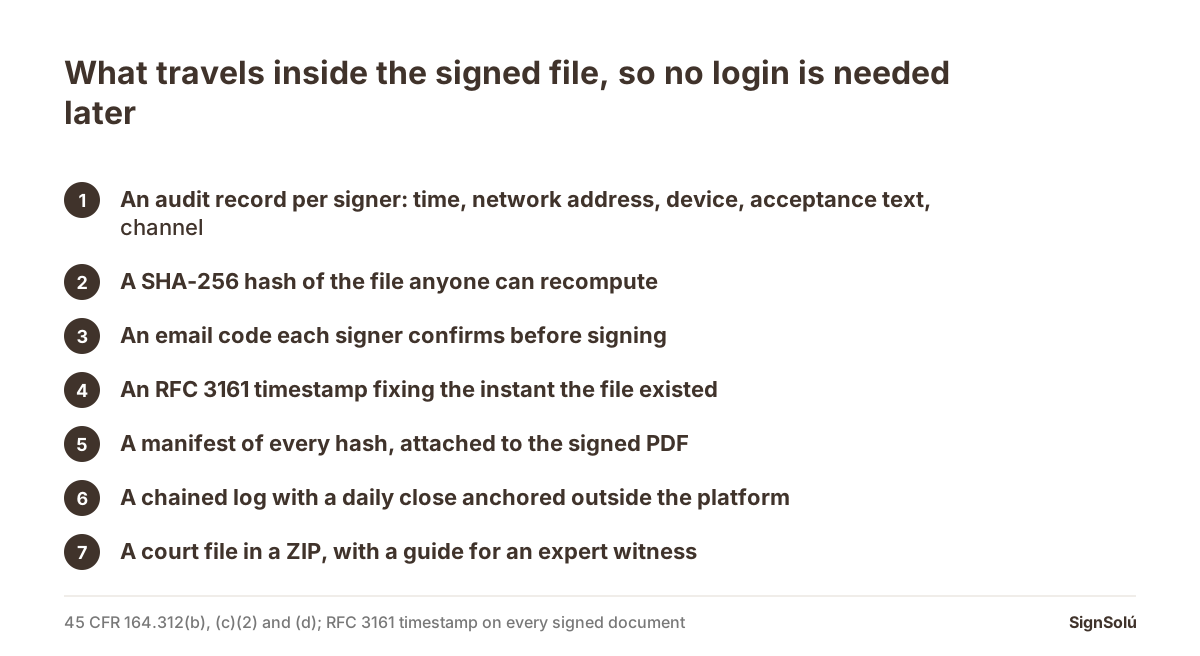
The trick is not a feature. It is that the evidence has to travel inside the document, so that six years later nobody needs access to a dashboard — or to a vendor that may no longer exist — to read it. That is what SignSolú puts around each signed file, and what you can check before deciding anything, on the trust page.
- 1An audit record per signer, with the time, the network address, the device, the acceptance text the signer saw and the channel the link went out through. This is the record that § 164.312(b) is about, and it is also what numeral 5.10 asks of a note: date, time and the full name of the person.
- 2A SHA-256 hash of the file, so anyone can recompute it and see that the document is the same one that was signed. That is the «mechanism to corroborate» of § 164.312(c)(2), stated in the plainest possible way.
- 3An email code before signing, so that each of the four Mexican signatories confirms a code that reached their own inbox. It is a procedure to verify that the person is the one claimed, in the sense of § 164.312(d).
- 4An RFC 3161 timestamp on every signed document. It is the international standard, it works outside Mexico, and it fixes the instant the file existed in that exact state. For a record with two clocks running on it, that fixed point is what makes both of them measurable.
- 5A manifest attached to the signed PDF, carrying the hashes of every piece of evidence, so the file and its record cannot be separated later.
- 6A chained log with a daily close anchored outside the platform, which means not even SignSolú can alter a signed document or backdate it. There is no public page to browse it yet; the point here is the mechanism.
- 7A court file in a ZIP, with the original and the signed document, the audit certificate, each piece of evidence with its hash, a list of records, a guide for an expert witness and instructions to verify everything without depending on SignSolú.
Four signatures on one device is the other half of the Mexican problem, and it has its own piece: in-person signing: what it means and how two people sign on one tablet. Whether a signature made in Mexico stands up in the United States is answered in is a Mexican e-signature valid in the US, and the general rule on binding force in is an electronic signature legally binding, and where.
The consent documents a cross-border clinic actually signs
- The treatment consent for a patient who flew in, which in dentistry is the most common case of all: what it has to carry is in dental work in Mexico: the consent form.
- A consent for a minor travelling without both parents, which is a different document with its own authority problem: medical consent form for a minor while the parents are away, and the general consent form template.
- The release that lets records move to a doctor back home: the HIPAA release form sets out who may release, who may receive, what, why and until when.
- The bilingual version, when the patient reads one language and the sanitary file is kept in another. Which text governs is decided in advance, and the rule is in bilingual contracts in Mexico: which language prevails.
- Everything signed from a distance, when the patient is already home: the mechanics are in how to sign a contract remotely with someone in Mexico, and what makes a Mexican signature valid at all in is an electronic signature valid in Mexico.
What to ask in writing, on both sides
- Who can open which record. Numeral 5.7 of NOM-004 limits disclosure of the clinical record to judicial authorities, prosecuting bodies and administrative authorities, and numeral 5.5.1 requires a written request from the patient or their representative for anyone else. In practice that means access per site, not one administrator for everything.
- How signed documents are exported. The clinical record belongs to the institution that generates it under numeral 5.4, so the export is not a favour: it is how you keep what is yours. In SignSolú the signed documents of a period are exported with their certificates.
- What the audit record contains, field by field. Ask for a sample certificate, not a description of one. What a usable audit receipt has to carry is set out in e-signature platforms for doing business in Mexico.
- Whether verification survives the vendor. Anyone can check a signed document at /en/verify without an account, and the signing flow itself is described at /en/sign-documents-online.
- How the vendor handles protected health information, and the written agreement your own counsel requires for that. HIPAA sorts vendor relationships through the business associate contract described in 45 CFR 164.504(e); ask for that in writing before any patient data moves.
- What service level is committed, in the written plan rather than in a slide. Above 200 documents a month there is a tailored plan: write in with your volume and your sites, from /en/pricing.
If you want to run the workflow before paying for it, the free test mode exists for exactly that: integrate and try it with your own volume, not with a demonstration. The published limits are 120 requests per minute and 10,000 a day per live key, 30 per minute in test; a retry with the same Idempotency-Key does not duplicate a document, and going over the limit returns a 429 with Retry-After. The interface is included in the paid plans, and the guide is at /en/e-signature-api.
And the plain commercial facts, so the comparison is not abstract: a signed document counts once no matter how many people sign it, which is why a four-signature consent letter is one document and not four; users and templates are unlimited; the first ten documents are free, with no card; the counterparty never opens an account or pays; and the signer can be sent the email, the WhatsApp message and the signing page in their own language, which for a clinic with American patients is the difference between a consent they read and one they only signed. For a cross-border clinic that needs one workflow to answer two rulebooks, that is the case for using SignSolú: the evidence rides inside the file, anyone can check it without an account, and both clocks start from a timestamp you can prove.
Frequently asked questions
Does HIPAA require an audit trail on signed consents?
45 CFR 164.312(b) requires audit controls: hardware, software and/or procedural mechanisms that record and examine activity in information systems that contain or use electronic protected health information. It is a standard with no implementation specification beneath it, so there is no addressable alternative to consider.
How long do the records have to be kept on each side?
In the United States, § 164.316(b)(2)(i) requires six years from the date of creation or the date the documentation was last in effect, whichever is later. In Mexico, numeral 5.4 of NOM-004-SSA3-2012 requires a minimum of five years counted from the date of the last medical act, which means the period restarts every time the patient returns.
How many people sign a Mexican consent letter?
Four, in three lines of numeral 10.1.1: the patient under 10.1.1.8 — or the closest relative present, the guardian or the legal representative if their state of health does not allow them to sign — the physician who gives the information and obtains the consent under 10.1.1.9, and two witnesses under 10.1.1.10.
Does Mexico require consent forms to be printed?
Not for the consents beyond the mandatory list: numeral 10.1.3 says health personnel may obtain additional consent letters without the use of printed forms being mandatory. The exception is the hospital admission authorization, which article 82 of the Regulation of the General Health Law on the provision of medical care services says must be printed.
Is a software product ever «HIPAA certified»?
No. There is no certification scheme in the rule. § 164.306(b)(2) asks a covered entity to choose security measures taking into account its size and complexity, its technical infrastructure, the cost of the measures and the probability and criticality of potential risks. What you can check is whether the records meet each standard.
What does the RFC 3161 timestamp add?
It fixes the instant the signed file existed in that exact state, using an international standard that works outside Mexico. With two retention clocks running over the same document, a provable fixed point is what makes both of them measurable years later.
Send your next contract to Mexico for signature
Create a free account and send 10 documents with no card. Your dashboard works in English. You set the language per signer, and their email, WhatsApp message and signing page arrive in that language.