Private school in Mexico: the enrollment contract for expat families
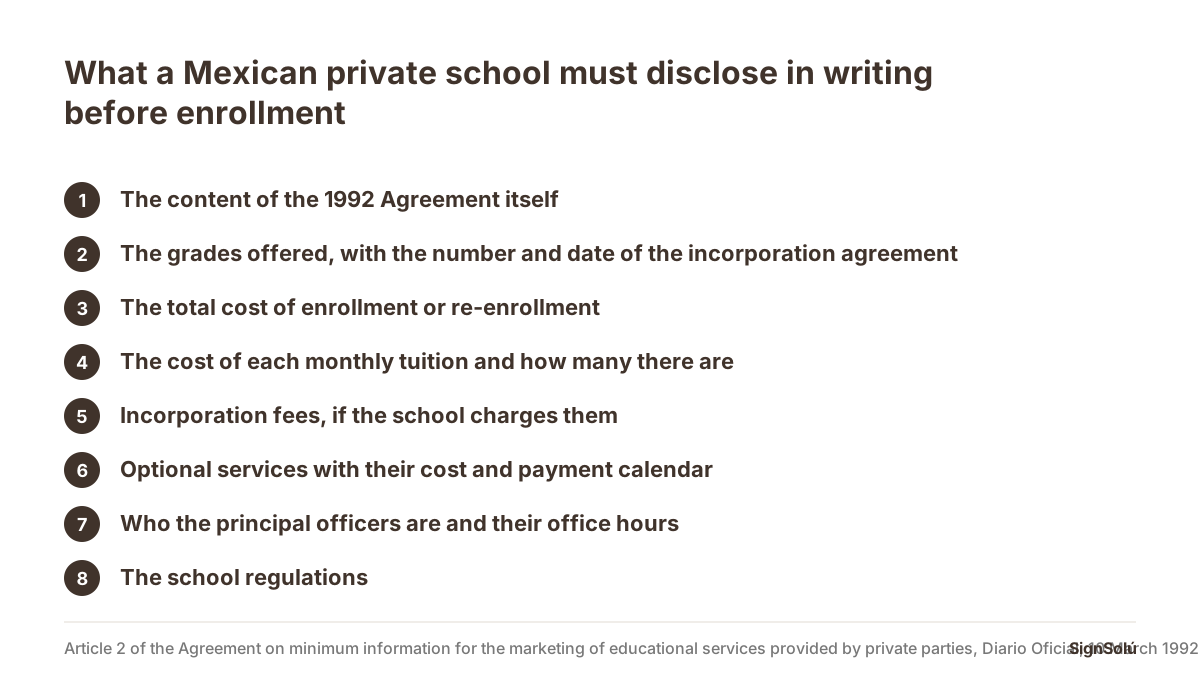
A Mexican private school must give you, in writing and before you enroll, the list in article 2 of the Agreement published in the Diario Oficial on 10 March 1992: the content of the Agreement itself, the grades offered with the number and date of its incorporation agreement, the total cost of enrollment, the cost and number of monthly tuitions, any incorporation fees, optional services with their payment calendar, who the principal officers are, and the school regulations. Only three charges may be general and mandatory, and student records may not be held over a debt.
You are moving to Guadalajara, Mérida or Querétaro with school-age children, and the school sends a one-page enrollment letter with an amount and a bank account. It is not a bad school and it is not a scam; it is the normal document. What it usually leaves out is the part that a federal agreement from 1992 already decided, and that part is where the questions come from in March: the comedor charge, the uniform supplier, the refund if you leave, and the records.
The 1992 Agreement that already wrote the contract
Its full name is long: the Agreement establishing the minimum information bases for the marketing of educational services provided by private parties, published in Mexico Diario Oficial de la Federación on 10 March 1992. Its article 1 applies it to private providers of elementary and middle-level education, which in practice covers preschool, primary, secondary and upper secondary. It does not cover universities, which have their own regime.
Its article 2 is, effectively, the table of contents of a proper enrollment contract. It requires the school to inform you in writing, before enrollment and in every school year, of eight specific things. A school that puts all eight in a document you sign has, by that act, proof that it informed you. A school that does not is not necessarily hiding anything, but you are entitled to ask for the list.
RVOE and authorisation, which are not the same thing
This is the distinction that confuses most foreign parents. Article 146 of the Ley General de Educación separates two regimes: preschool, primary and secondary require prior authorisation from the State, while other studies may obtain a recognition of official validity, the RVOE. Article 148 requires the school documentation to state its incorporated status, with the number and date of the agreement and the authority that issued it. So those three data points —number, date, authority— belong in the body of the contract, not in a logo on the letterhead. Ask for them, and check that the grade your child is entering is the grade covered.
Three mandatory fees, and everything else is optional
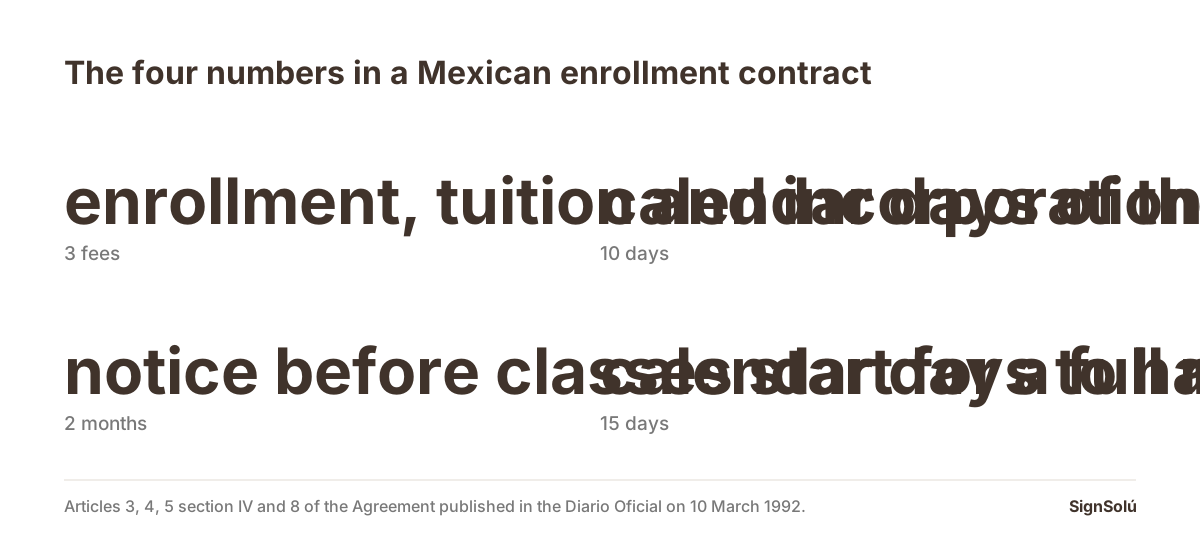
Article 3 of the Agreement limits the charges that may be general and mandatory to three: enrollment or re-enrollment, monthly tuition, and incorporation fees. And it states that those fees include the use of the library, laboratories and workshops during ordinary school hours, so those are not billed separately.
Everything else —lunchroom, transport, afternoon activities, field trips— is optional. That does not mean a school cannot charge for them; it means they are charged as optional, with their own price, with you choosing. A single bundled total that quietly includes the comedor turns something optional into something mandatory, and that is the most common thing worth questioning politely before signing.
Pesos, and the first ten days of the month
Article 4 requires charges in Mexican pesos and treats a payment made within the first ten calendar days of the month as made without a surcharge. Two practical consequences for a family arriving from abroad: tuition is not set in dollars, and a school payment calendar that insists on a single day of the month is stricter than the Agreement needs it to be.
No mid-year increases and no extraordinary fees
Sections II and III of article 5 prevent raising tuition in the middle of the school year, other than in the majority-of-parents and force-majeure case the Agreement itself allows, and rule out extraordinary fees, leaving donations as voluntary. For a family budgeting a year in a new country, that is the useful part: the number you are told before enrollment is the number for the year.
| What is charged | Mandatory | What the Agreement says |
|---|---|---|
| Enrollment or re-enrollment | Yes | Article 3, with its amount disclosed in advance |
| Monthly tuition | Yes | Article 3, with how many there are and the calendar |
| Incorporation fees | Yes, if the school charges them | Article 3, disclosed in advance |
| Library, laboratories, workshops in school hours | Included in the fees above | Article 3: not billed separately |
| Lunchroom, transport, afternoon activities | No: optional | Article 2, with cost and payment calendar |
| Uniforms and school supplies | No specified supplier, no new-items rule | Article 5 sections V and VII, and article 6 |
| Extraordinary fees and donations | The first do not exist; the second are voluntary | Article 5 sections II and III |
If you leave mid-year, which expat families often do
Section IV of article 5 answers half of it and leaves the other half to the contract. If notice of withdrawal is given at least two months before classes start —one month in shorter cycles— the enrollment fee is refunded in full. If notice comes later, what is refunded is what was agreed at the time of enrollment.
That second half is a school decision, which means it is a number you should look for in the document before you sign, not after. If the contract is silent, ask for the percentage in writing. And give the notice itself as a dated, signed document rather than a WhatsApp message, because the date of the notice is exactly what decides the refund.
- 1Find the two scenarios in the contract: notice with the Agreement full lead time, and late notice with its percentage.
- 2Give notice in writing, dated, and get an acknowledgement of receipt. The date is the whole argument.
- 3Separate enrollment from tuition in the refund conversation: the Agreement rule is about the enrollment fee.
- 4Ask for the records within fifteen calendar days, free of charge, under article 8 of the Agreement.
- 5Keep the full file: signed contract, signed regulations, notices and a receipt for every payment.
Student records cannot be held over a debt
Article 8 of the Agreement requires the school to hand over the student records free of charge within fifteen calendar days, and article 146 of the Ley General de Educación establishes that records may not be withheld over debts and that the educational service may not be conditioned on buying uniforms or materials. If you are moving countries and need a transcript, those two provisions are the ones to cite, politely and in writing.
What the enrollment contract does not cover
Three things, each with its own document, and it is worth knowing which is which so you do not sign a blank one. Field trips, laboratory use and school transport go in separate release forms with their own scope. The handling of your child personal data goes in the school privacy notice, which the contract refers to and does not replace. And a one-off authorisation for someone else to pick up your child or run an errand on your behalf is a different instrument altogether: how far a simple Mexican power of attorney reaches is explained in Mexican power of attorney: the carta poder.
- Does this contract need a notary? No. It is a private contract between the school and the parent or guardian; what does and does not need a Mexican notary is in what needs a Mexican notary and what does not.
- Can you sign it from abroad, before you land? Yes, and that is the normal case for a family relocating: see how to sign a contract remotely with someone in Mexico.
- Is an electronic signature valid for it? Yes: is an electronic signature valid in Mexico? goes through the Commercial Code article by article.
- Which language governs if the school sends it in two? Say so in the document: bilingual contracts in Mexico.
- Do the other relocation documents work the same way? Mostly: the lease is in renting in Mexico City as an American and the rest of the paperwork in retire in Mexico: the documents you sign.
Why the school does not have to register the contract with Profeco
Article 11 of the Agreement exempts from registration as an adhesion contract those contracts that conform to its bases. So a school whose enrollment contract follows article 2, the three fees of article 3, the prohibitions of article 5 and the records rule of article 8 does not need to register it. If a school tells you its contract is registered, that is fine; if it tells you registration is why it can charge something the Agreement rules out, that does not follow.
The other paperwork that lands in the same month
A school enrollment never arrives alone. The same weeks usually bring a lease, a work permit, a bank account and, if anyone in the family needs care, a medical consent form. All of them are documents signed with a Mexican counterparty, and the legal basis is the same one described below: articles 89 to 114 of the Codigo de Comercio, read on 27 October 2026 in the Chamber of Deputies PDF.
- The lease. What a Mexican landlord will ask for and what the contract must say: renting in Mexico City as an American.
- The employer side. If the move is for a job, what your employer signs is in work permit Mexico: what your employer signs and hiring employees in Mexico.
- A medical consent form, which is its own document with its own scope: dental work in Mexico: the consent form.
- An apostille, if a document issued abroad has to be used here: apostille Mexico: when a signed document needs one.
- NOM-151, the Mexican conservation standard, in case someone brings it up: NOM-151 in Mexico: what it is and when you need it.
Signing it, from wherever you are
Most relocating families sign the enrollment paperwork before they arrive, which is exactly the case an e-signature is for. The Mexican template a school uses for this is contrato de prestación de servicios educativos, in Spanish, with the eight disclosure items of article 2 and the three fees of article 3 built in, and the school regulations as an annex that is signed with it.
SignSolú is a Mexican e-signature platform that works over WhatsApp. The school sends the link by WhatsApp or email and you sign from your phone without creating an account and without paying anything; the sender picks the language of each signer, so a parent who signs in English receives the email, the WhatsApp message and the signing page in English while the school works in Spanish. Each signed document carries an audit trail —time, IP, device and the SHA-256 hash of the file— that anyone can verify at /verificar with no account, and the audit certificate is bilingual, with the Spanish text governing and English as a courtesy. One thing stated once and plainly: SignSolú is not an accredited certification service provider and does not issue NOM-151 conservation certificates. Which platforms are available for a document signed with a party in Mexico, and what each one own site publishes, is in the 6 e-signature platforms for doing business in Mexico. Ten documents are free with no card from your account, and the flow is described in how it works.
Frequently asked questions
What must a Mexican private school tell me before I enroll my child?
Eight things, in writing, before enrollment and in every school year, under article 2 of the Agreement published in the Diario Oficial on 10 March 1992: the content of the Agreement itself, the grades offered with the number and date of its incorporation agreement, the total cost of enrollment, the cost of each monthly tuition and how many there are, incorporation fees if charged, optional services with their cost and payment calendar, who the principal officers are with their office hours, and the school regulations.
Can the school make the lunchroom or transport mandatory?
No. Article 3 of the Agreement limits the charges that may be general and mandatory to three: enrollment or re-enrollment, monthly tuition, and incorporation fees, and it states that those include the use of the library, laboratories and workshops during ordinary school hours. Lunchroom, transport and afternoon activities are optional services, charged separately and chosen by the family.
We are leaving Mexico mid-year. Do we get the enrollment fee back?
If notice is given at least two months before classes start, yes, in full, under section IV of article 5 of the Agreement; in shorter cycles the lead time is one month. With less notice, the refund is whatever was agreed at the time of enrollment, which is why that percentage is a number to look for in the contract before signing. Give the notice as a dated, signed document: the date is what decides it.
Can the school hold my child transcript over unpaid tuition?
No. Article 8 of the Agreement requires handing over the student records free of charge within fifteen calendar days, and article 146 of the Ley General de Educación establishes that records may not be withheld over debts and that the educational service may not be conditioned on the purchase of uniforms or materials. Those are the two provisions to cite, in writing.
Does the school have to sell me the uniform?
No, and it may not require you to buy from a particular supplier. Sections V and VII of article 5 of the Agreement prevent requiring that uniforms and supplies be bought from specified suppliers or be new items, and article 6 adds that the uniform is not mandatory and that its design must last five years. Article 146 of the Ley General de Educación also bars conditioning the service on those purchases.
Can I sign the enrollment contract before I move to Mexico?
Yes, and it is the common case. An electronic signature has the same legal effects as a handwritten one under article 89 of Mexico Codigo de Comercio, and nothing in the Agreement requires a physical signature. In practice the school sends a link by WhatsApp or email, you sign from your phone, and the signed PDF comes back with an audit trail showing time, device and the hash of the file.
Send your next contract to Mexico for signature
Create a free account and send 10 documents with no card. Your dashboard works in English. You set the language per signer, and their email, WhatsApp message and signing page arrive in that language.