Zero hours contract holiday pay: where the 12.07% comes from, and the line on the payslip that makes it lawful
From regulation 15B of the Working Time Regulations 1998, for leave years beginning on or after 1 April 2024. For an irregular hours worker or a part-year worker, annual leave accrues on the last day of each pay period at the rate of 12.07% of the number of hours they have worked during that pay period, capped at 28 days in a leave year. Regulation 16A then allows the employer to pay that leave as it is earned: holiday pay may be paid by way of a 12.07% uplift to the worker’s remuneration for work done, paid at the same time as that remuneration. But 16A(7) attaches a condition people miss: where the employer pays holiday pay that way, any itemised pay statement provided to the worker must indicate the amount of holiday pay that has been paid for the period to which the statement relates. Rolled-up pay that is not shown on the payslip is rolled-up pay that has not been identified.
The number used to be a convention. Now it is in the Regulations
For years 12.07% was a rule of thumb — 5.6 weeks of statutory leave divided by the 46.4 working weeks that remain — and rolled-up holiday pay sat in a grey area that case law had made uncomfortable. Both things changed when regulations 15B to 15F were inserted into the Working Time Regulations 1998 by the Employment Rights (Amendment, Revocation and Transitional Provision) Regulations 2023, with effect for leave years beginning on or after 1 April 2024.
What follows is only about those two categories of worker. For someone on fixed hours, the old arithmetic of 5.6 weeks still applies and none of regulation 15B does. Where the engagement is not employment at all, the holiday question does not arise and the money is settled in the contract: 1099 contractor agreement template.
Who counts as an irregular hours worker
Regulation 15F defines both categories, and the definitions are narrower than the labels suggest. A worker is an irregular hours worker, in relation to a leave year, if the number of paid hours they will work in each pay period during the term of their contract in that year is, under the terms of their contract, wholly or mostly variable. A worker is a part-year worker if, under the terms of their contract, they are required to work only part of that year and there are periods within that year, during the term of the contract, of at least a week which they are not required to work and for which they are not paid.
Two refinements matter in practice. Subsection (2) says that where a worker has more than one contract with the same employer, whether the hours are wholly or mostly variable is judged when the terms of their contracts with that employer are looked at in the round — so splitting someone across two contracts does not settle the question. And subsection (3) says that in deciding whether someone is a part-year worker, any period of sick leave or statutory leave taken in that leave year is to be ignored. A term-time worker and a bank worker usually qualify; someone on a steady four-shift pattern with an occasional extra shift usually does not.
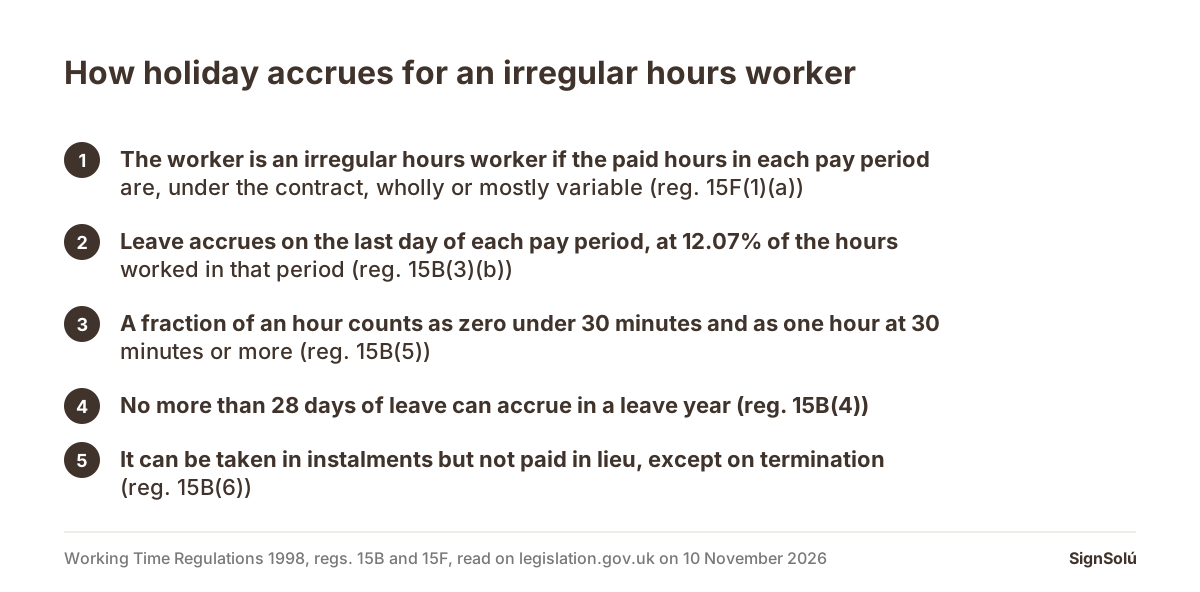
Regulation 15B: the accrual, with its rounding rule
Regulation 15B(2) sets the entitlement as a running balance: the amount of annual leave at any time during a leave year is what has accrued in that year, plus anything carried forward into it, less anything taken during it. Subsection (3) says how it accrues: during any period of sick leave or statutory leave in accordance with regulation 15C, and otherwise on the last day of each pay period at the rate of 12.07% of the number of hours that they have worked during that pay period.
Then three details that decide whether a payroll run is right. Subsection (4): a worker cannot, in any leave year, accrue more than 28 days of annual leave under the regulation. Subsection (5): where the amount accrued includes a fraction of an hour, the fraction is to be treated as zero if it is less than 30 minutes and one hour if it is 30 minutes or more. And subsection (6): the leave may be taken in instalments, but it may not be replaced by a payment in lieu except where the worker’s employment is terminated.
Subsection (7) sets when the leave year begins: on the date provided for in a relevant agreement, or, where no relevant agreement applies, on the date the worker’s employment begins and each subsequent anniversary of it. That is worth settling in the contract itself rather than discovering a worker whose leave year starts on a different day from everybody else’s, and it belongs in the same document as the hours: a mutual NDA and an employee confidentiality agreement travel separately, but the leave year does not. The contract clause that most zero-hours templates still get wrong is a different one, and it is in zero hours contract template.
Regulation 16A: rolled-up pay is allowed, with a condition
Regulation 16A applies to pay due under regulation 16(1) in respect of leave to which the worker is entitled under 15B. Subsection (2): such holiday pay may be paid by way of a 12.07% uplift to the worker’s remuneration for work done. Subsection (3): it must be paid at the same time as that remuneration. Subsection (9) closes an obvious gap: the reference to remuneration is a reference to all types of payments that are to be included when determining the amount of a week’s pay for the purposes of regulation 16, so the uplift is not calculated on basic pay alone.
And subsection (7), which is where employers come unstuck: where an employer pays holiday pay in that way, any itemised pay statement provided by the employer to the worker must indicate the amount of holiday pay that has been paid for the period to which the statement relates. Subsection (8) gives the reward for doing it properly: an employer who pays in accordance with (2) or (5) is discharged from their liability to make payments under regulation 16 in respect of that leave. The discharge and the payslip line are two halves of the same arrangement.
What happens when the worker goes off sick
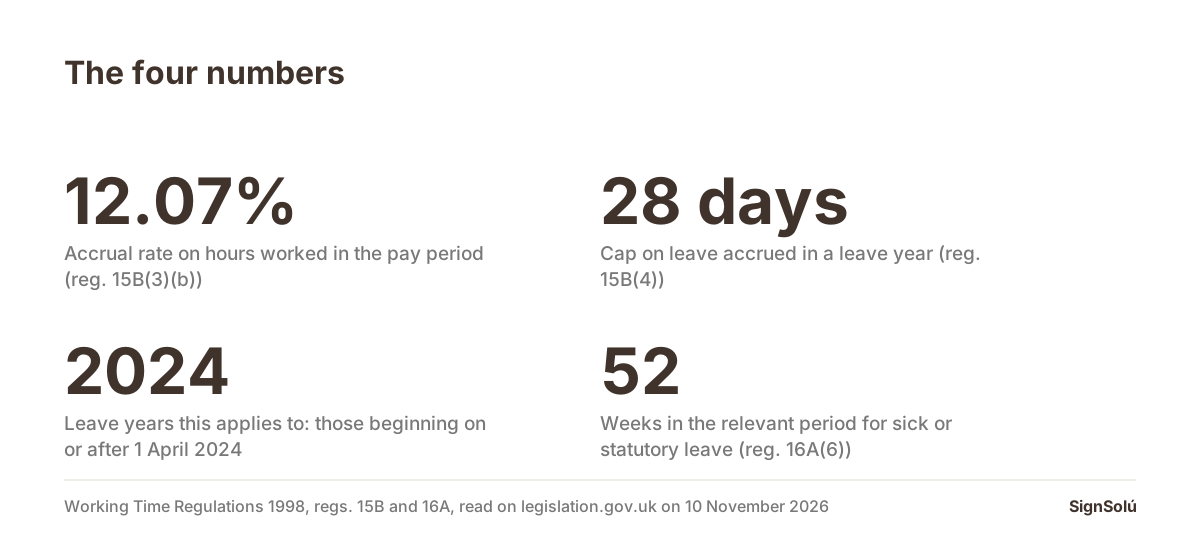
This is the corner the 12.07% uplift cannot reach on its own, because there is no remuneration to uplift. Regulation 16A(4) and (5) handle it: a worker on sick leave or statutory leave who was being paid rolled-up holiday pay before going off must be paid holiday pay by way of a payment each pay period during that leave, equal to the average amount of holiday pay they were paid for each pay period during the relevant period. Subsection (6) defines the relevant period as the 52 weeks ending with the day before the leave started, or the shorter period if they had been receiving rolled-up pay for less than 52 complete weeks.
| The question | What the Regulations say | Where |
|---|---|---|
| Who this applies to | Irregular hours workers and part-year workers, as defined | reg. 15F(1) |
| Two contracts with the same employer | The terms are looked at in the round | reg. 15F(2) |
| From when | Leave years beginning on or after 1 April 2024 | reg. 15B(1) |
| Accrual rate | 12.07% of hours worked, on the last day of each pay period | reg. 15B(3)(b) |
| Rounding | Under 30 minutes is zero; 30 minutes or more is an hour | reg. 15B(5) |
| Annual cap | 28 days | reg. 15B(4) |
| Payment in lieu | Not allowed except on termination | reg. 15B(6) |
| Rolled-up pay | Allowed, as a 12.07% uplift paid at the same time | reg. 16A(2) and (3) |
| Payslip | Must indicate the holiday pay for the period | reg. 16A(7) |
| Effect of paying it properly | Discharges the regulation 16 liability | reg. 16A(8) |
| During sick or statutory leave | Average of the relevant period, each pay period | reg. 16A(4) to (6) |
What to fix, in order
- 1Decide, per worker, whether they are an irregular hours worker or a part-year worker, on the terms of the contract rather than on how the rota happened to look. Regulation 15F is a contractual test.
- 2Fix the leave year in the contract, so regulation 15B(7) does not hand you a different start date for every hire.
- 3Choose one method and say so: accrue and pay when leave is taken, or roll up at 12.07%. Doing half of each is how the same hours get paid twice or not at all.
- 4If you roll up, put the holiday pay line on the payslip. Regulation 16A(7) requires the itemised pay statement to indicate the amount for the period, and 16A(8) only discharges the liability for payments made in accordance with the regulation.
- 5Build the rounding rule into the payroll, not into a note. Under 30 minutes is zero, 30 minutes or more is an hour, per 15B(5).
- 6Have a plan for sick leave, because the uplift has nothing to uplift: regulation 16A(4) to (6) requires an average based on the 52 weeks before the leave began.
For the documents around all this: the letter of offer of employment is where the leave year and the pay arrangement belong from day one, an employment letter confirms terms that changed, and a contract amendment is the right instrument when hours or method change mid-term. Where the engagement is not employment at all, none of this applies and the money has to be settled in the contract instead: independent contractor payment terms, a freelance contract or an independent contractor agreement. For agency arrangements, a staffing agency contract.
When the relationship ends, the leave accrued but untaken is the one thing regulation 15B(6) does allow to be paid in lieu, and the notice side of the letter is set by statute too: contract termination letter for an employee, with a termination letter for the structure, and a settlement agreement where the exit is negotiated — whose six statutory conditions are in settlement agreement template.
Proving what the worker was told
Holiday pay claims are arithmetic disputes that run over years, and they turn on what the worker was told and when: which method applied, when the leave year started, what the payslip showed. The payroll record is half of that. The other half is the document the worker actually received and acknowledged.
SignSolú is an e-signature platform that works over WhatsApp, and that is the narrow job it does here. Each document you send keeps an audit receipt with the time, the IP, the device and a SHA-256 hash of the file, and the recipient acknowledges it by signing rather than by replying — so the letter explaining the leave year and the 12.07% arrangement becomes a dated, hashed, acknowledged document rather than an email nobody kept. Anyone can check it later at /verificar without an account, and signers need no account and pay nothing. The interface is in Spanish; what the sender chooses per signer is the language, so a signer set to English gets the email, the WhatsApp message and the signing page in English. Whether that signature binds, and where, is in is an electronic signature legally binding. The free plan is 10 documents with no expiry and no card: start here.
Frequently asked questions
Where does the 12.07% come from?
It is now written into the Regulations. Regulation 15B(3)(b) of the Working Time Regulations 1998 says an irregular hours worker or part-year worker accrues annual leave on the last day of each pay period at the rate of 12.07% of the number of hours they have worked during that pay period, for leave years beginning on or after 1 April 2024.
Is rolled-up holiday pay lawful now?
For these two categories of worker, yes, on conditions. Regulation 16A(2) allows holiday pay for leave under regulation 15B to be paid by way of a 12.07% uplift to the worker’s remuneration for work done, and 16A(3) requires it to be paid at the same time as that remuneration. Regulation 16A(8) then discharges the employer from the regulation 16 liability for that leave.
What is the condition employers miss?
The payslip. Regulation 16A(7) says that where an employer pays holiday pay as a rolled-up uplift, any itemised pay statement provided to the worker must indicate the amount of holiday pay that has been paid for the period to which the statement relates. Paying the uplift but not showing it is the common failure.
Who is an irregular hours worker, exactly?
Regulation 15F(1)(a) defines it as a worker whose number of paid hours in each pay period during the term of the contract in that leave year is, under the terms of their contract, wholly or mostly variable. It is a test on the contract, not on the rota. Where someone has more than one contract with the same employer, 15F(2) says the terms are looked at in the round.
Can I just pay the leave out instead of giving it?
Not while they are employed. Regulation 15B(6) says the leave may be taken in instalments but may not be replaced by a payment in lieu except where the worker’s employment is terminated. Rolled-up pay under 16A is not a payment in lieu: it is paying the leave as it is earned, and the leave still has to be available to take.
What happens to the uplift if the worker is off sick?
There is no remuneration to uplift, so regulation 16A(4) and (5) switch to an average: a worker who was being paid rolled-up holiday pay before going on sick leave or statutory leave must be paid, each pay period during that leave, an amount equal to the average holiday pay they received for each pay period during the relevant period, which 16A(6) defines as the 52 weeks ending the day before the leave began, or a shorter period if applicable.
Send your next contract to Mexico for signature
Create a free account and send 10 documents with no card. Your dashboard works in English. You set the language per signer, and their email, WhatsApp message and signing page arrive in that language.
Keep reading
- Zero hours contract template: the clause in most of them that has been unenforceable since 2015
- Contract termination letter for an employee: the notice the law sets, and the date the law moves
- Independent contractor payment terms: no federal statute sets them, so the contract is the only place they exist