EPC contract in Mexico: the five Civil Code articles your template did not plan for
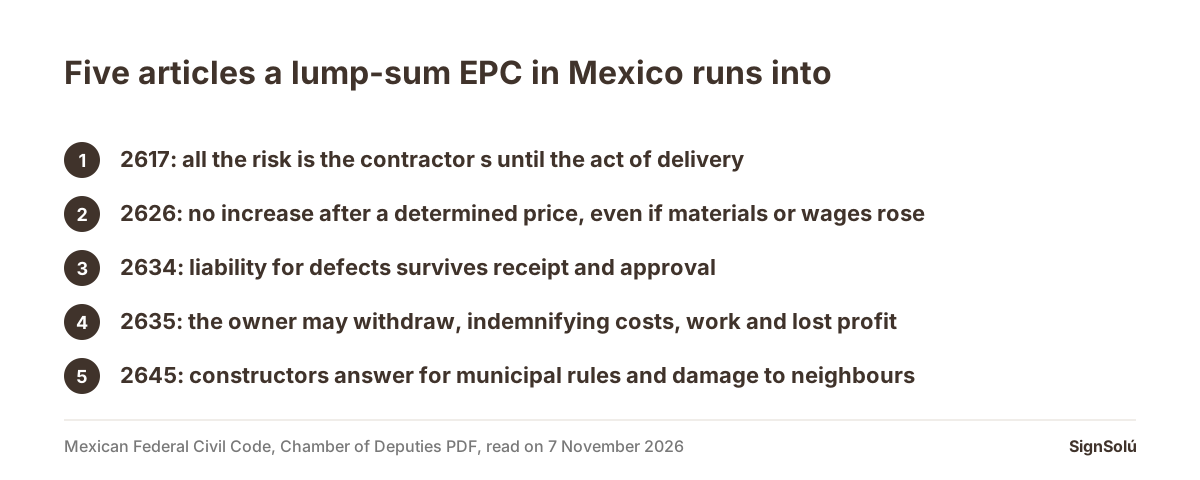
Five, and they are short. Article 2617: all the risk of the works is the contractor’s until the act of delivery, unless the owner is in default in receiving them or there is express agreement otherwise. Article 2626: a contractor engaged for a determined price has no right to demand any increase afterwards, even if the price of materials or of wages has risen. Article 2634: after the works are received and approved, the contractor answers for defects from faulty construction, poor materials or defects of the soil. Article 2635: the owner may withdraw from works agreed at a fixed price, indemnifying costs, work and lost profit. Article 2645: constructors answer for breaches of municipal rules and for any damage caused to neighbours.
The contract arrives already written
An EPC contract for a plant in Mexico usually lands as a document drafted somewhere else: a FIDIC-shaped form, or a sponsor’s own template, with escalation clauses, a change-order mechanism and a care-of-the-works regime that assumes a particular legal background. None of that is unusable in Mexico. What is risky is assuming it starts from a blank slate.
For a privately-owned plant, the background rules are the chapter on works at an agreed price of the Federal Civil Code, articles 2616 onwards. Article 2616 sets the scope: the contract for works at an agreed price, where the contractor directs the works and supplies the materials, is subject to the rules that follow. That is the EPC shape.
Article 2617: the risk stops at delivery, not at completion
The wording matters. All the risk of the works runs at the contractor’s charge until the act of the delivery, unless there is default on the part of the owner of the works in receiving them, or express agreement to the contrary.
Two practical consequences. First, the pivot is the act of delivery, so the contract has to define what delivery is and record when it happened — a dated, signed handover document, not a milestone in a schedule. Second, the owner’s delay in receiving moves the risk, which makes the owner’s obligation to attend the handover a commercial term worth drafting, not a formality.
And the article invites the parties to allocate it differently: «express agreement to the contrary» is how a care-of-the-works and insurance regime from an international form is made to fit. It has to be express, though. Silence means the contractor carries it.
Article 2626: the escalation clause has to be written in
This is the one that surprises people arriving with a form drafted for an inflation-indexed market. A contractor who undertakes to execute works for a determined price has no right to demand any increase afterwards, even if the price of the materials or of the wages has risen.
It is a default rule, not a prohibition: the parties can agree an indexation or a change-order mechanism. But if the contract says «lump sum» and then says nothing about escalation, article 2626 answers the question, and it answers it against the contractor. For a multi-year plant with imported equipment, that is the single clause most worth checking before signature.
Two related defaults sit next to it. Article 2624: where no price was fixed when the works were commissioned, the price is the one set by the tariffs or, failing those, the one assessed by experts. And article 2619: where there is no plan, design or budget and difficulties arise, they are resolved taking into account the nature of the works, their price and local custom, hearing expert opinion. In other words, the absence of a priced scope is filled by experts, not by the party with the better letter.
Article 2618: it has to be in writing, with a detailed description
Whenever the contractor undertakes works on an immovable by closed adjustment, where the value exceeds the figure the article names, the contract shall be granted in writing, including a detailed description and, in the cases that require it, a plan, design or budget of the works.
The money figure in that article is a historic one and is not the point; the requirement is. A detailed description and, where needed, a plan or budget is not administrative decoration: it is what article 2619 falls back on, and what article 2626 measures «determined price» against.
| Question | What the Code says if the contract is silent | Article |
|---|---|---|
| Who carries the risk of the works? | The contractor, until the act of delivery | 2617 |
| Can the contractor claim more if steel or wages rise? | No, where the price was determined | 2626 |
| What if no price was fixed? | Tariffs, or a price assessed by experts | 2624 |
| What if there is no plan, design or budget? | Disputes resolved by the nature and price of the works and local custom, with expert opinion | 2619 |
| Does the owner’s acceptance end the contractor’s liability? | No, for defects of construction, materials or soil | 2634 |
| Can the owner walk away mid-way? | Yes, indemnifying costs, work and the profit that could have been made | 2635 |
| Who answers to the neighbours and the municipality? | The constructors | 2645 |
Article 2635: the owner can withdraw, and what that costs
The owner of works agreed for a fixed price may withdraw from the undertaking already begun, provided the owner indemnifies the contractor for all the costs and work and for the profit the contractor could have made from the works.
That is a termination-for-convenience right the Code gives the owner without needing a clause, and the compensation it names includes lost profit — which is more than the costs-plus-demobilisation that many forms provide for. A contractor negotiating a termination schedule in Mexico is negotiating against that baseline, not into a vacuum.
Article 2634: liability survives acceptance
Once the works are received and approved by the person who commissioned them, the contractor is responsible for the defects that appear afterwards and that proceed from defects in construction and workmanship, poor quality of the materials employed, or defects of the soil on which they were built.
The article also gives the contractor two exits, and both of them are documentary. The contractor is not responsible where the owner expressly directed the use of defective materials after the contractor had made their defects known, or where the works were built on unsuitable ground chosen by the owner despite the contractor’s observations. Both defences are only as good as the written record of the warning, which is exactly the kind of thing that goes unsigned on a busy site.
Article 2645: the neighbours are not a schedule item
Constructors are responsible for the non-observance of municipal or police provisions and for any damage they cause to neighbours. On a plant site that means permits, working hours, access, dust, vibration and the wall next door, and it means the liability sits on the constructor by statute rather than by clause.
It pairs with a separate rule outside this chapter: whoever uses mechanisms or apparatus dangerous in themselves answers for the damage they cause even without acting unlawfully. For heavy plant on a site, that is the regime behind the insurance conversation. A lien waiver, where one is asked for, is a different instrument with its own limits: the waiver federal law makes void and what a signed waiver can never cover.
One article for the engineering, not the construction
Article 2620 covers the «E» of EPC in the simplest case: the expert who draws up the plan, design or budget and executes the works cannot charge for the plan separately from the fee for the works; but if the works were not executed for a cause attributable to the owner, the expert may charge for it, unless it was agreed at the outset that the owner does not pay for it if the owner does not wish to accept it. A paid-FEED-then-maybe-EPC structure needs that agreement written down.
What this means for the document you are signing
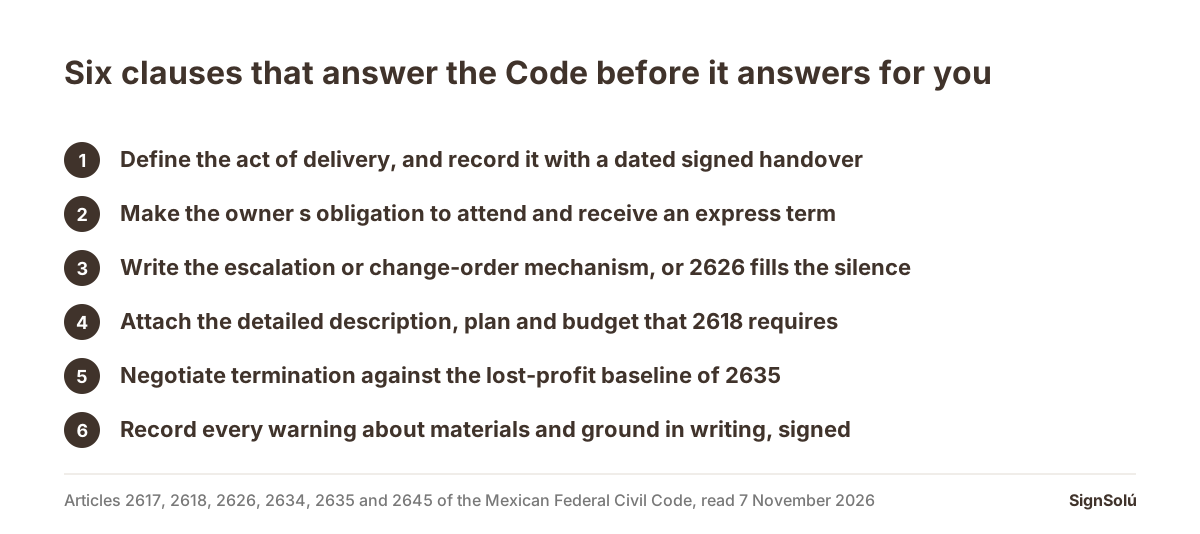
- 1Define the act of delivery and the handover document, with a date and signatures, because article 2617 pivots on it.
- 2Make the owner’s obligation to attend and receive an express term, since the owner’s default moves the risk.
- 3Write the escalation or change-order mechanism expressly. Article 2626 fills the silence against the contractor.
- 4Attach the detailed description and, where needed, the plan, design or budget that article 2618 requires.
- 5Negotiate termination compensation knowing the article 2635 baseline includes lost profit.
- 6Record every warning about defective materials or unsuitable ground in writing, signed, for the article 2634 defences.
- 7Allocate permits, working hours and neighbour liability knowing article 2645 puts them on the constructor.
The guide to the document itself is the EPC agreement. The upstream papers are in nearshoring in Mexico: the first documents you sign and a letter of intent with a Mexican company; the confidentiality side in an NDA with a Mexican supplier and what the purpose clause actually does. Where a Mexican notary is needed and where not: the Mexican notary. For the people on site, hiring employees in Mexico, the independent contractor services contract and employer of record or your own contract. For the assembly operation downstream, the maquila contract.
Signing it, and the documents that follow it
An EPC contract is signed once; the documents that give those articles their teeth are signed weekly, on site, by people in two countries. Article 1803, paragraph I, of the Federal Civil Code admits consent expressed by electronic means, and article 1834 bis treats the written form as satisfied where the information generated or communicated in its entirety is attributable to the obliged parties and accessible for later consultation. For the service and supply layers around the works, the base documents are the service agreement template, the independent contractor agreement and the annual maintenance contract; where equipment is hired rather than bought, the equipment lease agreement; and for the confidentiality layer, the mutual NDA and the NDA template.
SignSolú is a Mexican e-signature platform. It sends a document over WhatsApp or by email; the other person signs from a phone without creating an account or paying anything; and the audit receipt records time, IP address, device and the SHA-256 hash of the file. The sender picks the language for each signer, so a site manager signs in Spanish and a project director abroad gets the email, the WhatsApp message and the signing page in English, on the same document. The audit certificate is issued in each signer’s language, with the Spanish version governing. Anyone can check that the file did not change at the verification page, with no account. SignSolú is not an accredited certification service provider and does not issue NOM-151 conservation certificates.
How that works across a border is in how to sign a contract remotely with someone in Mexico, the validity question in is an electronic signature valid in Mexico and is a Mexican e-signature valid in the US, which language prevails in bilingual contracts in Mexico, what NOM-151 is in NOM-151 in Mexico, how the receipt is built on the trust page, and the prices on the pricing page. The free plan is 10 documents, with no expiry and no card.
Frequently asked questions
Who carries the risk of the works in a Mexican EPC contract?
Article 2617 of the Federal Civil Code puts all the risk at the contractor’s charge until the act of delivery, unless the owner is in default in receiving the works or there is express agreement to the contrary.
Can the contractor claim more if material prices rise?
Not where the price was determined. Article 2626 says a contractor engaged to execute works for a determined price has no right to demand any increase afterwards, even if the price of materials or wages has risen. An escalation or change-order mechanism has to be agreed expressly.
Does the owner’s acceptance release the contractor?
No. Article 2634 keeps the contractor responsible, after the works are received and approved, for defects that later appear from faulty construction and workmanship, poor materials or defects of the soil, with two exceptions that both depend on a written warning.
Can the owner terminate for convenience?
Article 2635 lets the owner of works agreed at a fixed price withdraw from the undertaking already begun, provided the owner indemnifies the contractor for all costs and work and for the profit the contractor could have made.
Does the EPC contract have to be in writing in Mexico?
For works on an immovable by closed adjustment above the value article 2618 names, yes: the contract shall be granted in writing, including a detailed description and, where required, a plan, design or budget of the works.
Can the contract and the site documents be signed electronically?
Yes. Article 1803, paragraph I, admits consent by electronic means and article 1834 bis treats the written form as satisfied where the information is complete, attributable and accessible. With SignSolú each signer signs from a phone and the audit receipt records time, IP address, device and the SHA-256 hash.
Send your next contract to Mexico for signature
Create a free account and send 10 documents with no card. Your dashboard works in English. You set the language per signer, and their email, WhatsApp message and signing page arrive in that language.